By Team INVC | INVC NEWS
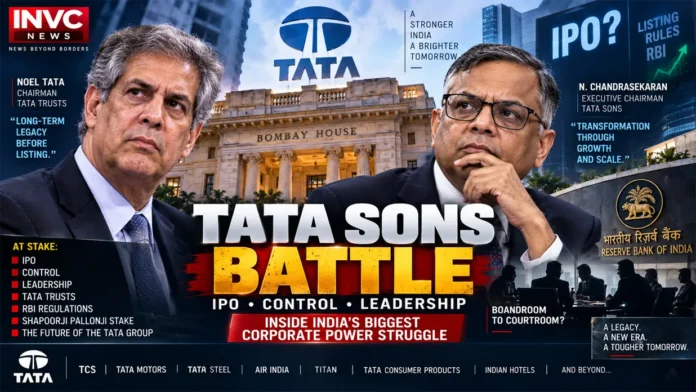
MUMBAI, India | September 21, 2026 — Tata Sons, the company sitting at the heart of India’s Tata Group, is facing one of its most consequential governance battles in years as disagreements over a potential stock-market listing and the reappointment of Executive Chairman N. Chandrasekaran threaten to move from Bombay House into the courtroom.
At the centre of the dispute are Tata Trusts Chairman Noel Tata, Chandrasekaran, the Tata Sons board, controlling shareholder Tata Trusts, minority shareholder Shapoorji Pallonji Group and the Reserve Bank of India.
This is not simply a clash between two powerful corporate figures.
The real questions are much bigger:
Should Tata Sons remain privately held?
How much authority should Tata Trusts exercise over the Tata Sons board?
Can the Reserve Bank of India effectively force the holding company toward a public listing?
And who will shape the Tata Group’s next era?
The answers could reshape the ownership and governance structure of one of India’s most influential business groups.
Why the Tata Sons Battle Exploded Now
Two decisions taken at Tata Sons’ September 17 board meeting brought the long-running tensions into the open.
The board backed a fresh five-year term for N. Chandrasekaran as executive chairman and moved toward complying with the Reserve Bank of India’s regulatory requirements, which could lead to a public listing of Tata Sons.
Noel Tata opposed both developments.
Tata Trusts, which controls roughly 66% of Tata Sons, subsequently challenged the validity of Chandrasekaran’s reappointment and reiterated its opposition to listing the holding company.
That transformed a long-running disagreement into an open governance confrontation.
What Is Tata Sons — and Why Does It Matter So Much?
Tata Sons is not an ordinary operating company.
It is the principal investment holding company and promoter of Tata companies.
The wider Tata Group comprises 31 companies across multiple sectors, operates in more than 100 countries and generated aggregate revenue of more than $180 billion in 2024-25.
Twenty-six Tata companies were publicly listed as of March 31, 2025, with an aggregate market capitalisation above $328 billion.
Tata Sons holds important stakes across the group.
That places it at the centre of capital allocation, strategic direction and ownership across an empire spanning technology, automobiles, steel, airlines, consumer businesses, hotels and other industries.
Any fundamental change at Tata Sons therefore matters far beyond Bombay House.
Who Actually Owns Tata Sons?
The ownership structure explains much of the present conflict.
Philanthropic Tata Trusts own about 66% of Tata Sons.
The Shapoorji Pallonji, or SP, Group holds approximately 18.37%.
Various Tata Group companies together hold around 13%, while the remaining shares are held by other shareholders, including members of the Tata family.
This gives Tata Trusts effective majority control.
However, ownership is only one layer of the story.
The dispute now centres on how that majority ownership interacts with the Tata Sons board and the company’s Articles of Association.
Why Does RBI Want Tata Sons Listed?
The listing battle originates in financial regulation.
The Reserve Bank of India classified Tata Sons as an Upper Layer Non-Banking Financial Company in September 2022.
Under RBI’s scale-based regulatory framework, companies in that category face stricter governance requirements and are generally required to list within three years.
That created an original listing deadline in 2025.
Tata Sons instead sought permission to surrender its registration as a Core Investment Company after reducing debt and restructuring its financial position.
The RBI rejected that request in September 2026, keeping Tata Sons within the regulatory framework that carries the listing requirement.
The RBI has also filed a caveat in the Bombay High Court, meaning it wants to be heard before a court grants any relief that could affect its decision.
That dramatically raised the stakes.
Why Tata Trusts Does Not Want Tata Sons Listed
For Tata Trusts, the debate is not merely about raising money through an IPO.
It is about preserving a governance structure that has existed for generations.
The Trusts argue that Tata Sons’ private ownership allows the group to pursue long-term goals without the short-term pressures that often accompany public markets.
A stock-market listing would introduce public shareholders, greater disclosure requirements and a new level of outside scrutiny.
Tata Trusts has therefore asked Tata Sons to explore alternatives to listing.
The Trusts also emphasise their philanthropic character.
Around two-thirds of Tata Sons is owned by charitable trusts whose work supports education, healthcare, livelihoods, culture and other social initiatives.
From that perspective, the battle is partly about whether a century-old ownership model should change because of financial regulation.
Why Chandrasekaran’s Reappointment Is Now Contested
The second battle concerns leadership.
N. Chandrasekaran has led Tata Sons since 2017.
At its September 17 meeting, the Tata Sons board approved another five-year term for him.
But Tata Trusts argues that the reappointment did not satisfy provisions in Tata Sons’ Articles of Association governing the role of Trust-nominated directors.
One Trust nominee supported the resolution while Noel Tata opposed it.
Tata Trusts argues that the necessary affirmative support from its nominee directors was therefore absent and has challenged the validity of the board resolution.
Tata Sons and the Trusts are consequently interpreting the company’s governance provisions differently.
That is precisely the kind of dispute that can end up before a court.
Is the Tata Battle Heading to Court?
The possibility is growing.
Tata Trusts is weighing legal options to challenge Chandrasekaran’s reappointment, according to reports published over the weekend.
Its position is that the September 17 resolution cannot override the rights provided to the Trusts under Tata Sons’ Articles of Association.
The Trusts are reportedly waiting for Tata Sons’ formal response before deciding their next legal step.
Senior lawyers have also become involved on both sides.
That means what began as an internal governance disagreement could soon become a major corporate-law case.
The Shapoorji Pallonji Group Is the Wild Card
There is another major player in this drama.
The Shapoorji Pallonji Group owns around 18.4% of Tata Sons, making it the largest shareholder outside Tata Trusts.
The SP Group has long sought greater liquidity from its Tata Sons holding.
A recent proposal involved monetising part of that stake for approximately ₹25,000 crore, potentially through a structured transaction completed in two stages. Tata Trusts itself publicly disclosed the proposal.
But those discussions have not resolved the broader liquidity issue.
The SP Group is now backing a public listing as another route to unlock value from its Tata Sons stake.
That gives the listing camp a powerful minority shareholder.
Why an IPO Could Be Historic
A Tata Sons listing would not resemble an ordinary IPO.
Tata Sons sits above some of India’s best-known corporate names.
Market estimates for its potential valuation vary significantly, and no official IPO valuation or offer size has been announced.
However, outside estimates have placed a possible valuation at levels that could make any eventual offering one of the largest in Indian market history.
That is why speculation around a Tata Sons IPO immediately affects listed Tata Group stocks.
Investors start calculating the implied value of Tata Sons’ holdings and what public price discovery could mean for shareholders.
But there is an important warning:
A Tata Sons IPO has not yet been formally launched.
No final offer document, price band, listing date or public issue size exists.
Would Tata Trusts Lose Control After an IPO?
Not necessarily.
A listing and a loss of control are two different things.
Tata Trusts currently owns around two-thirds of Tata Sons.
If a future IPO involved only a relatively small dilution and the Trusts did not sell a substantial part of their holding, they could remain the controlling shareholder even after listing.
The more important change would be governance.
Public listing would introduce outside shareholders, stock-exchange rules, broader disclosures and a higher level of market scrutiny.
That could change how Tata Sons operates even if Tata Trusts remains the largest owner.
Why This Is Bigger Than Noel Tata vs Chandrasekaran
It is tempting to describe the dispute simply as Noel Tata versus N. Chandrasekaran.
That makes for an easy headline.
But it understates what is actually happening.
Noel Tata represents the interests and governance philosophy of the controlling Trusts.
Chandrasekaran leads Tata Sons and has overseen a period of substantial expansion and investment across businesses including aviation, electronics, semiconductors, automobiles and digital services.
The RBI represents the regulatory layer.
The SP Group represents minority-shareholder liquidity.
Meanwhile, the Tata Sons board has its own fiduciary and governance responsibilities.
This is therefore a collision between ownership, management, regulation and minority shareholder interests.
What Happens to TCS, Tata Motors and Other Tata Companies?
For ordinary shareholders, this is an important question.
A Tata Sons governance dispute does not automatically change the day-to-day operations of TCS, Tata Motors, Tata Steel, Indian Hotels or other listed Tata companies.
Tata itself states that each operating company functions independently under the supervision of its own board.
However, Tata Sons remains the promoter and strategic centre of the group.
Long-running uncertainty at the holding-company level could affect decisions involving capital allocation, major acquisitions, shareholder support and long-term investments.
That is why investors are paying attention even when individual Tata companies continue operating normally.
Markets Are Watching — But This Is Not Yet a Group Crisis
Some Tata stocks reacted sharply as details of the dispute emerged.
However, investors should separate governance uncertainty at Tata Sons from the operating performance of each listed Tata company.
The dispute has not resulted in a shutdown, insolvency or interruption of normal Tata Group businesses.
The immediate risk is uncertainty.
Markets dislike uncertainty about leadership, control and major structural changes.
That uncertainty increases when lawyers, regulators and controlling shareholders begin taking opposing positions.
The Ratan Tata Legacy Makes the Battle Even More Sensitive
The dispute carries enormous symbolic weight because of Tata Group’s history.
Ratan Tata’s leadership provided a central figure around whom many of the group’s strategic and ownership relationships revolved.
After his death in October 2024, Noel Tata became Chairman of Tata Trusts.
The current confrontation is therefore one of the first major tests of the group’s governance structure in the post-Ratan Tata era.
It raises a question that goes well beyond one chairman’s tenure:
How will Tata balance the authority of its philanthropic owners with the independence of its professional management?
What Happens Next?
Several events now require close attention.
First, Tata Sons must determine how it will respond to the RBI’s listing requirement.
Second, Tata Trusts must decide whether to formally challenge Chandrasekaran’s reappointment in court.
Third, Tata Sons and its shareholders need to address the SP Group’s demand for liquidity.
Fourth, the two sides may need to clarify the governance provisions that determine how future Tata Sons chairmen are appointed.
Any one of those developments could change the direction of the dispute.
The Biggest Question: Can Tata Avoid a Corporate Stalemate?
For more than a century, the Tata model has combined business ownership with philanthropy and unusually concentrated control at the holding-company level.
That model now faces a major stress test.
A public listing could create transparency, liquidity and public price discovery.
It could also alter the private governance culture that Tata Trusts wants to preserve.
Chandrasekaran’s continuation offers management continuity.
Yet Tata Trusts argues that continuity cannot come at the cost of shareholder rights embedded in the company’s governance framework.
Both debates now intersect.
That makes this one of the most consequential corporate stories in India.
The fight is no longer simply about whether Tata Sons should list or whether N. Chandrasekaran should remain chairman.
It is about who ultimately decides the future structure of the Tata Group — its board, its controlling shareholder, its regulator or, eventually, the courts.
And until that question is settled, Bombay House will remain at the centre of one of India Inc’s most closely watched power struggles.
LIVE UPDATE TRACKER
September 21, 2026: Tata Trusts weighs legal options over N. Chandrasekaran’s reappointment as the boardroom dispute moves closer to a possible court battle.
September 20, 2026: Tata Trusts publicly challenges the validity of Chandrasekaran’s fresh term.
September 18, 2026: Disagreement between Tata Sons and Tata Trusts over listing and chairman appointment becomes public.
September 17, 2026: Tata Sons board approves a fresh five-year term for Chandrasekaran and begins addressing RBI compliance requirements.
September 15, 2026: RBI’s rejection of Tata Sons’ deregistration effort intensifies expectations of a listing.
This tracker should be updated whenever Tata Sons, Tata Trusts, RBI, SP Group or a court takes a material new step.