By Team INVC | INVC NEWS
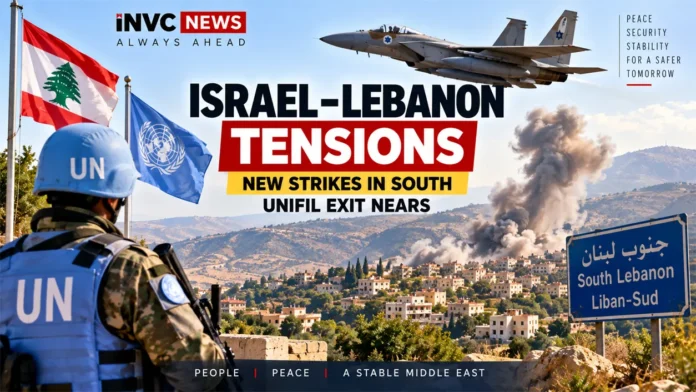
BEIRUT, Lebanon | September 20, 2026 — Israel carried out fresh airstrikes against what its military described as Hezbollah targets across southern Lebanon after two Israeli soldiers were lightly wounded by an explosive device, adding new pressure to an already fragile security situation as the United Nations prepares to wind down its long-running peacekeeping mission.
Lebanon’s state-run National News Agency reported three Israeli airstrikes on Nabatiyeh al-Fawqa on September 19. The Israeli military said it targeted Hezbollah observation posts and other infrastructure following an explosive-device incident involving Israeli troops.
The renewed strikes come at a sensitive moment. UNIFIL, the United Nations peacekeeping force that has operated in southern Lebanon for nearly five decades, is preparing for a withdrawal process after the end of 2026. Its leadership says an orderly handover to Lebanese authorities and other UN agencies will be essential to prevent a security and humanitarian gap.
Two Israeli Soldiers Wounded Before Strikes
The Israeli military said an engineering vehicle carrying troops struck an explosive device in territory held by Israeli forces in southern Lebanon.
Two soldiers suffered light injuries and were taken for medical treatment.
Israel attributed the explosive device to Hezbollah and said it responded by striking several sites that it described as infrastructure used by the armed group, including observation posts.
Hezbollah had not immediately provided an independently verifiable account of the specific September 19 incident in the reporting reviewed by INVC NEWS.
That distinction remains important because both sides have repeatedly issued competing claims during the conflict.
Three Strikes Reported Near Nabatiyeh
Lebanon’s National News Agency reported that Israeli warplanes carried out three strikes on Nabatiyeh al-Fawqa in southern Lebanon.
One strike came close to paramedics moving toward the area, according to the Lebanese report, although no injuries were reported from those particular strikes.
Nabatiyeh and surrounding areas have repeatedly become flashpoints during the latest Israel-Hezbollah confrontation.
Earlier attacks in the region have caused substantial casualties and damage, while Israel has said it is acting against Hezbollah military infrastructure and operatives.
Fragile Ceasefire Has Failed to End Violence
Israel and Hezbollah entered another ceasefire arrangement in June after months of intense fighting.
However, violence has continued intermittently.
Israel has maintained troops in parts of southern Lebanon, while Hezbollah has rejected demands that would require it to fully disarm before Israeli forces leave contested or occupied areas.
A U.S.-backed framework has sought to create a sequence in which Israeli troops withdraw as Lebanese government forces expand control and Hezbollah gives up weapons.
Implementation has stalled.
The result is an unusual security environment in which a formal framework exists but Israeli strikes, explosive incidents and armed tensions continue.
UNIFIL Withdrawal Adds a New Question
The situation has become even more significant because UNIFIL is approaching the end of its mission.
Major General Diodato Abagnara, who heads the peacekeeping force, said a smooth transition is critical before the withdrawal begins.
UNIFIL is working with the Lebanese Armed Forces and other United Nations agencies to determine how security, humanitarian assistance and operational responsibilities can be transferred.
The UN Security Council has ordered the mission to wind down.
Without another Security Council decision, UNIFIL operations are expected to end after the scheduled transition.
Nearly Five Decades of UN Presence
UNIFIL was established in 1978 and later expanded its responsibilities following subsequent conflicts between Israel and Lebanon.
Today, its role extends beyond observing military activity.
Peacekeepers have helped facilitate humanitarian movement, maintain communication channels and support access to communities in volatile areas.
Reuters reported this week that UNIFIL has more than 7,500 peacekeepers and around 50 bases, including positions in or near territory currently controlled by Israeli forces.
Its departure therefore raises questions about who will perform those functions once the mission ends.
Residents Fear a Security Vacuum
Communities in southern Lebanon are particularly concerned.
Some villages remain isolated by fighting, damaged infrastructure and military deployments.
Residents interviewed by Reuters have expressed fears that UNIFIL’s withdrawal could reduce humanitarian access and international monitoring in areas where Israeli forces remain present.
Lebanon has sought an extension of the peacekeeping mission, but discussions over its future remain unresolved.
The United States and Israel have previously questioned UNIFIL’s effectiveness, particularly regarding Hezbollah’s military presence.
Lebanese authorities and several international partners, meanwhile, have warned about the risks of removing the force before a functioning replacement system is established.
France and Regional Partners Discuss What Comes Next
European and Arab military officials have already begun discussing possible alternatives.
A meeting in Paris this week examined options for strengthening the Lebanese Armed Forces and potentially establishing another international support mechanism after UNIFIL.
Possible ideas include military training, equipment, intelligence assistance and advisory support rather than simply creating an identical replacement for the UN mission.
France, Lebanon and other governments have stressed that the Lebanese army will need substantially more resources if it is expected to assume responsibility across the south.
Hezbollah Disarmament Remains the Central Dispute
The most difficult political and military issue remains Hezbollah’s weapons.
Lebanon’s government has committed to strengthening state control over armed groups, while Israel has said it will not fully withdraw unless Hezbollah is disarmed.
Hezbollah has rejected terms that it considers equivalent to surrender and has continued to resist full disarmament.
That disagreement has prevented the existing security framework from being fully implemented.
It also complicates any effort to replace UNIFIL because international forces cannot resolve the underlying political dispute on their own.
Israel Also Continues Operations in the South
Israeli forces remain deployed in parts of southern Lebanon.
UNIFIL’s commander has criticised continuing Israeli demolitions in areas such as Mansouri and said violations of existing UN resolutions further complicate the transition.
Israel has maintained that its forces need to act against threats from Hezbollah until satisfactory security arrangements exist.
Lebanon considers the continuing Israeli military presence a violation of its sovereignty.
Those competing positions remain unresolved.
Why the Latest Strikes Matter
The September 19 strikes by themselves do not signal the start of a new full-scale war.
However, they show how easily individual incidents can trigger military retaliation even while diplomatic arrangements remain formally in place.
The timing makes the development more consequential.
Southern Lebanon is moving toward a period in which UN peacekeepers may no longer provide the same monitoring, humanitarian and liaison functions they have performed for decades.
At the same time, Israeli troops remain on Lebanese territory, Hezbollah retains weapons and the Lebanese army faces significant resource constraints.
That combination makes every fresh military incident harder to contain.
What Happens Next?
Attention will now focus on three developments.
First, whether Israel and Hezbollah avoid another cycle of retaliation following the latest strikes.
Second, whether negotiations over Israeli withdrawal and Hezbollah disarmament make progress.
Third, whether the international community can establish a workable security arrangement before UNIFIL begins its withdrawal.
For southern Lebanon, the central challenge is becoming increasingly clear: the peacekeeping mission is preparing to leave before the political and military disputes that brought it there have been fully resolved.