By Team INVC | INVC NEWS
WASHINGTON, United States | September 18, 2026 —
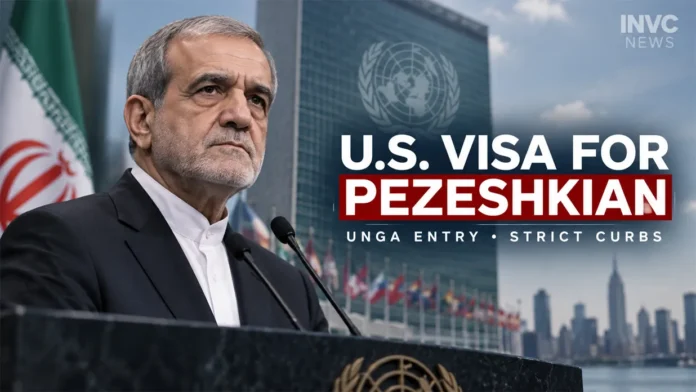
The Trump administration has approved visas for Iranian President Masoud Pezeshkian and senior members of his delegation to attend next week’s United Nations General Assembly in New York, even as the United States and Iran remain locked in a prolonged military confrontation.
The decision creates one of the most striking diplomatic contrasts ahead of this year’s UN gathering.
Washington is allowing Iran’s president and Foreign Minister Abbas Araghchi to enter the United States for the UN meetings while simultaneously maintaining strict restrictions on where the Iranian delegation can travel and what its members can purchase.
The delegation will also be smaller than last year’s Iranian team.
The United States says the decision reflects its responsibilities as host country of the United Nations headquarters.
However, the visa approval does not signal a broader easing of tensions with Tehran.
Instead, it allows diplomatic participation at the UN while preserving significant restrictions on the Iranian officials during their stay in New York.
Pezeshkian and Araghchi Included in Iran’s Core UN Delegation
The approved Iranian delegation includes President Masoud Pezeshkian and Foreign Minister Abbas Araghchi.
Essential staff required for Iran’s participation in the UN high-level meetings will also be permitted to enter.
That means Tehran will have senior political representation in New York at a time when relations with Washington remain deeply hostile.
The visa decision is particularly significant because the two countries are not simply engaged in a diplomatic dispute.
The United States and Iran remain involved in an unresolved conflict that began earlier this year and has since affected regional security, energy markets and shipping routes.
But Iran’s Delegation Will Face Strict Restrictions
Visa approval will not give the Iranian officials unrestricted access to the United States.
The State Department has said the delegation will operate under travel restrictions.
Officials will also face prohibitions on purchasing luxury and certain other goods.
Washington has imposed similar limits on Iranian delegations in previous years.
Those restrictions have historically confined Iranian diplomats largely to areas connected with the United Nations, Iran’s UN mission, the residence of Iran’s UN ambassador and John F. Kennedy International Airport.
The precise movement rules applying to every member of the 2026 delegation will depend on the terms imposed by U.S. authorities.
Why Did the US Approve the Visas During a War?
The answer lies partly in America’s unusual role as host country of the United Nations headquarters.
The UN headquarters is located in New York.
Under the 1947 UN Headquarters Agreement, the United States is generally expected to provide access to foreign representatives attending official United Nations meetings.
That responsibility does not prevent Washington from imposing restrictions.
The United States maintains that security, terrorism and foreign-policy considerations can justify visa limitations or other controls in particular cases.
This creates a diplomatic balancing act.
Washington can permit representatives of governments it strongly opposes to attend UN meetings without treating their entry as ordinary diplomatic travel.
That is essentially what is happening with Iran.
Visa Approval Does Not Mean US-Iran Relations Are Improving
The visa decision should not be interpreted as evidence of normalisation between Washington and Tehran.
The conflict remains unresolved.
Diplomatic contacts aimed at ending the confrontation have taken place intermittently, but no comprehensive settlement has emerged.
Disputes over Iran’s nuclear programme remain central.
Regional security has become another major issue.
Shipping through strategically important waterways has also faced disruption.
Meanwhile, the United States continues to apply substantial economic pressure against Iran.
Allowing President Pezeshkian to speak at the United Nations therefore represents diplomatic access rather than a political breakthrough.
Pezeshkian’s UN Speech Could Draw Global Attention
President Pezeshkian’s appearance in New York is now likely to become one of the most closely watched speeches of the UN high-level week.
Iran will arrive at the General Assembly facing several major diplomatic questions.
Tehran is expected to defend its position on the ongoing conflict.
Its nuclear programme will remain under scrutiny.
Iran’s relationship with Gulf states will also receive attention.
The Strait of Hormuz crisis and the wider regional confrontation will provide another major backdrop.
Pezeshkian could also use the UN platform to criticise U.S. sanctions and military actions.
The precise content of his address, however, will become clear only when he speaks.
US and Iran Still Have Reasons to Keep Diplomatic Channels Open
Despite the conflict, neither side has completely abandoned diplomacy.
Contacts aimed at reducing tensions and discussing possible pathways toward an end to the war have continued intermittently.
The UN General Assembly creates another opportunity for indirect or direct diplomatic engagement.
That does not mean formal negotiations are guaranteed.
However, the presence of both senior American officials and Iran’s president and foreign minister in New York creates possibilities for diplomacy that would not exist if Tehran’s senior delegation were excluded entirely.
In international conflicts, such channels can remain important even when public positions appear far apart.
The Abbas-Pezeshkian Visa Contrast Will Attract Attention
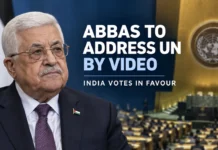
The Iranian visa decision also creates an immediate comparison with Washington’s treatment of Palestinian President Mahmoud Abbas.
The United States denied Abbas permission to attend the UN gathering in person.
The UN General Assembly subsequently approved arrangements allowing him to participate remotely by video.
Iran’s president, by contrast, will be allowed to enter New York under restrictions.
The two cases involve different legal, diplomatic and political circumstances.
Nevertheless, the contrast is likely to become part of the broader debate over America’s role as host of the United Nations.
Iran Delegation Smaller Than Last Year
Washington has also made clear that the Iranian delegation will be smaller than the group that attended last year’s UN meetings.
That detail shows that the visa decision is not an unrestricted return to normal diplomatic arrangements.
The administration appears to be allowing only the core group necessary for Iran to participate in the high-level meetings.
Limiting delegation size gives Washington another mechanism to control access while continuing to meet its host-country responsibilities.
Restrictions on Shopping Are More Than Symbolic
The restrictions on purchases may sound unusual, but they form part of a broader U.S. policy toward Iranian delegations.
Washington has previously limited Iranian officials’ access to certain stores and goods.
The restrictions are intended to prevent sanctioned or politically sensitive delegations from using official UN travel for activities unrelated to diplomatic participation.
They also underline the unusual status of the visit.
Pezeshkian will be present in New York as a foreign leader attending the United Nations, but his delegation will not enjoy the freedom of movement associated with an ordinary state visit.
UNGA Arrives at a Critical Moment in the Iran Conflict
The timing adds considerably to the significance of the decision.
The conflict has continued for more than six months.
Military pressure has been accompanied by economic sanctions.
Energy markets remain sensitive to events in the region.
The security of shipping routes through the Middle East remains another major concern.
At the same time, several governments are trying to prevent the confrontation from expanding further.
The UN gathering will bring many of those governments into the same city.
That makes New York one of the most important diplomatic stages for the conflict next week.
What Could Happen in New York?
Several developments will now be closely watched.
President Pezeshkian’s speech could reveal whether Tehran is hardening its position or leaving space for negotiations.
Foreign Minister Araghchi’s meetings may offer additional clues about Iran’s diplomatic strategy.
Any contact between Iranian and American officials would attract immediate international attention.
Meetings involving Gulf governments could prove equally important.
However, none of those outcomes should be assumed before they occur.
The confirmed development is narrower but still significant:
The United States has authorised Iran’s core delegation to attend the UN gathering despite the ongoing conflict, while imposing substantial restrictions on its movements and activities.
Why Washington’s Decision Matters
Blocking Iran’s president completely would have created a major confrontation over America’s obligations as host of the United Nations.
Granting unrestricted access would have been politically difficult while the two governments remain in conflict.
The administration has chosen a middle path.
Pezeshkian can attend.
Araghchi can attend.
Iran can address the world body.
But the delegation will remain under tight controls while in the United States.
That makes the decision both diplomatic and restrictive at the same time.
The Bigger Question: Can UN Week Create an Opening for Diplomacy?
The visas themselves will not end the conflict.
They will not settle the nuclear dispute.
Nor do they remove American sanctions on Iran.
Their importance lies elsewhere.
For several days next week, political leaders from Iran, the United States, Gulf countries, Europe and other major powers will be gathered in New York.
That creates opportunities for conversations—formal or otherwise—that are much harder to organise during an active conflict.
Whether those opportunities produce anything meaningful remains uncertain.
For now, the most unusual reality is already clear:
President Masoud Pezeshkian will travel to New York to address the United Nations while his government remains in conflict with the country issuing his visa.
That contradiction could become one of the defining diplomatic images of this year’s UN General Assembly.