By Team INVC | INVC NEWS
UNITED NATIONS, United States | September 18, 2026 —
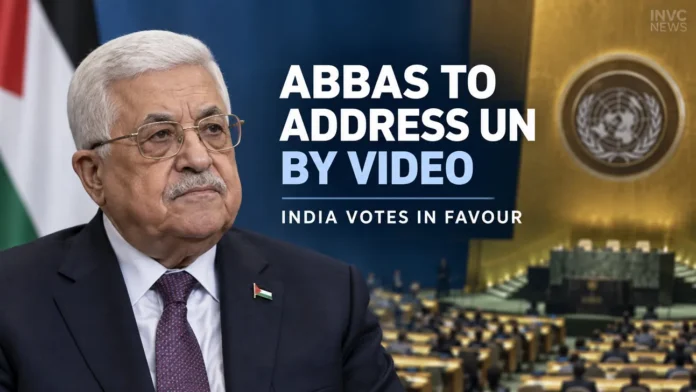
The United Nations General Assembly has approved a resolution allowing Palestinian President Mahmoud Abbas to address world leaders by video after the United States denied him a visa to travel to New York, setting up another diplomatic confrontation over Palestinian participation at the annual UN gathering.
The resolution was adopted by an overwhelming 152 votes in favour, three against and four abstentions. The United States, Israel and Paraguay voted against the measure, while India was among the countries supporting it.
Abbas will now be able to deliver his address remotely during the high-level segment of the 81st session of the UN General Assembly, whose general debate runs from September 22 to September 28 at UN headquarters in New York.
The decision is significant because Washington has denied Abbas permission to attend the General Assembly in person for the second consecutive year. The UN made a similar arrangement in 2025 after an earlier US visa refusal.
India Supports Resolution Allowing Abbas to Speak by Video
India voted in favour of the resolution permitting Abbas to participate remotely.
The vote places New Delhi among the large majority of UN members that backed arrangements ensuring Palestinian participation despite the US visa restrictions.
India has historically supported a negotiated two-state solution and has maintained diplomatic relations with both Palestine and Israel. Its official position has consistently backed the establishment of a sovereign, independent and viable Palestinian state living alongside Israel in peace and security.
The September 17 vote dealt specifically with Palestinian participation in UN proceedings rather than determining the wider political questions surrounding the Israel-Palestinian conflict.
What Exactly Did the UN General Assembly Approve?
The resolution does more than permit one video speech.
It allows President Abbas and other senior Palestinian officials to take part remotely in UN meetings and conferences over the coming year if they are unable to travel to the United States because of visa restrictions.
That provision is intended to prevent travel restrictions imposed by the UN’s host country from completely blocking Palestinian participation in General Assembly-related meetings.
Palestine holds non-member observer state status at the United Nations. It can participate extensively in General Assembly proceedings but does not have the same voting rights as a full UN member.
Why Did the United States Deny Abbas a Visa?
The Trump administration extended visa restrictions this week covering officials from the Palestine Liberation Organization and Palestinian Authority, including Mahmoud Abbas.
Washington has accused the Palestinian leadership of failing to meet commitments related to peace and reform and has objected to Palestinian efforts to pursue action against Israel through international institutions and courts.
US officials have also cited continuing concerns over Palestinian Authority payments linked to Palestinians imprisoned or killed in connection with attacks on Israelis.
The Palestinian Authority rejects Washington’s justification and has described the visa restrictions as unjustified and damaging to diplomatic efforts and prospects for a two-state settlement.
Those competing positions are now likely to feature prominently during next week’s UN meetings.
US and Israel Vote Against the Resolution
The United States and Israel both opposed the measure, joined by Paraguay.
US Deputy Permanent Representative Tammy Bruce defended Washington’s position, saying the Palestinian Authority and PLO needed to renounce terrorism and undertake meaningful reforms. Palestinian representatives rejected that characterization.
Israel has separately argued that Abbas and the Palestinian Authority should face consequences over policies it says reward people involved in attacks against Israelis.
Palestinian officials dispute the broader Israeli and US characterization of their leadership and say denying access to UN meetings restricts Palestinian diplomatic representation.
The Visa Dispute Raises Questions About the UN Host Agreement
The United Nations is headquartered in New York under a 1947 agreement between the UN and the United States.
That agreement generally requires the host country to facilitate access by representatives attending UN business, although the United States maintains that national-security and foreign-policy authorities can apply in particular circumstances.
The repeated denial of visas to Palestinian officials has therefore generated debate over the balance between Washington’s immigration and foreign-policy powers and its responsibilities as host of the United Nations.
The General Assembly’s decision effectively provides a practical workaround without resolving that broader legal and diplomatic dispute.
Abbas Faced the Same Situation Last Year
This is not the first time Mahmoud Abbas has had to address the General Assembly remotely because of a US visa decision.
In September 2025, the General Assembly voted 145-5, with six abstentions, to permit Palestine’s virtual participation after Washington denied visas to Palestinian representatives.
Abbas subsequently addressed world leaders by video, using the speech to outline Palestinian positions on Gaza, Palestinian governance and a future two-state settlement.
The 2026 resolution extends a similar mechanism for the new General Assembly session.
Iran Gets Visas While Abbas Is Barred
The contrast in Washington’s visa decisions has also attracted attention.
The United States has approved visas for senior Iranian officials, including President Masoud Pezeshkian and Foreign Minister Abbas Araghchi, to attend the same UN high-level meetings, although Washington has imposed travel restrictions on the Iranian delegation.
US officials have said those visas reflect its obligations as the UN host country while maintaining separate sanctions and travel restrictions.
For Palestinian officials, however, Washington has continued the visa ban.
Palestine Issue Set to Return to Center Stage at UNGA
The Israel-Palestinian conflict is expected to be one of the major issues during this year’s General Assembly high-level week.
World leaders will also address the Russia-Ukraine war, continuing Middle East tensions, Sudan, artificial intelligence, climate change and reform of the United Nations.
For Palestine, the political symbolism of Abbas addressing the Assembly remotely is likely to be substantial.
The United States has denied him physical entry.
A large majority of the General Assembly has nevertheless voted to ensure that his address is heard.
That does not resolve the dispute between Washington and the Palestinian leadership, nor does it change Palestine’s status at the United Nations.
But it ensures that when global leaders gather in New York next week, Mahmoud Abbas will still have a place in the General Assembly debate — this time, on screen rather than at the podium.