By Team INVC | INVC NEWS
WASHINGTON, United States | September 16, 2026 —
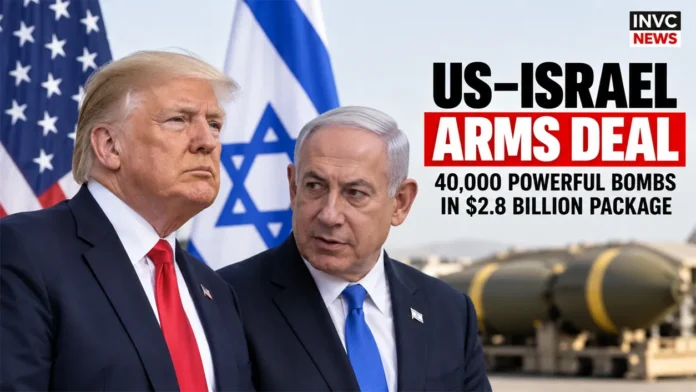
The Trump administration is preparing a proposed $2.8 billion weapons package for Israel that would include 40,000 powerful 2,000-pound bombs, marking one of the largest planned U.S. transfers of the heavy munitions to Israel in recent years.
The proposed package includes 20,000 Mk-84 bombs and 20,000 BLU-117 bombs, according to U.S. officials familiar with the plan. The administration has informally notified the congressional committees that review major foreign arms sales, but the package has not yet been finalized.
The proposal immediately brings renewed attention to the use of heavy aerial bombs in densely populated areas, particularly Gaza, where similar U.S.-made weapons have previously drawn scrutiny over civilian casualties.
40,000 Bombs Included in Proposed $2.8 Billion Package
The planned sale would provide Israel with two major types of 2,000-pound munitions.
The package contains:
20,000 Mk-84 bombs
20,000 BLU-117 bombs
Both fall into the 2,000-pound, or roughly 907-kilogram, class of conventional bombs.
The package is expected to be financed largely through U.S. Foreign Military Financing, a system under which American government funds allow partner countries including Israel to purchase U.S.-made defense equipment.
Congress has been informally notified, but that step does not mean the transaction is complete. Quantities, terms and timing could still change before a final agreement.
Why 2,000-Pound Bombs Draw So Much Attention
The size and destructive power of these weapons make them particularly sensitive.
The Mk-84 is a large general-purpose bomb capable of causing extensive structural damage. The BLU-117 is another 2,000-pound-class bomb body that can be used in different configurations depending on the intended target and guidance system.
Such munitions can be used against hardened structures, underground facilities and large military targets.
However, their use in densely populated urban environments has prompted serious concerns among humanitarian organizations and weapons experts because the blast and fragmentation effects can extend well beyond the immediate target area.
Biden Administration Paused Similar Bomb Shipment in 2024
The proposed transaction revives a debate that intensified during the Biden administration.
In 2024, then-President Joe Biden’s administration paused one shipment of 2,000-pound bombs to Israel over concerns about their potential use in densely populated parts of Gaza and the risk to civilians.
President Donald Trump lifted that hold after returning to office in 2025.
The latest proposal would therefore represent another major expansion of Israel’s access to this class of U.S.-made munitions.
Trump Administration Has Approved Other Israel Arms Sales
The $2.8 billion package would not be the first major U.S. arms move involving Israel under the current Trump administration.
In 2025, the administration approved a nearly $3 billion arms sale that included more than 35,500 2,000-pound bombs and moved ahead without the usual congressional review process, according to AP.
The administration also approved another group of arms sales to Israel worth approximately $6.67 billion in January 2026.
The latest proposal demonstrates that U.S.-Israel defense cooperation remains substantial despite political disagreements and international criticism surrounding Israel’s military operations.
Gaza War Keeps Civilian Casualties at Center of Debate
The proposed sale comes against the backdrop of the continuing humanitarian and political fallout from the Gaza war.
Israel launched its military campaign after the Hamas-led attack on southern Israel on October 7, 2023, which killed around 1,200 people and resulted in 251 hostages being taken, according to Israeli figures cited by AP and Reuters.
Gaza health authorities say more than 73,000 Palestinians have been killed during Israel’s subsequent military campaign. The figures do not generally distinguish between civilians and combatants in the overall total.
Israel says its military operations target Hamas and other armed groups and describes its actions as self-defense. Critics and humanitarian organizations have questioned Israel’s use of heavy weapons in densely populated areas.
A United Nations inquiry has accused Israel of genocide in Gaza. Israel rejects that accusation.
Similar U.S.-Made Bombs Have Been Used in Gaza and Lebanon
Weapons experts examining strike footage and fragments recovered after attacks have linked U.S.-made heavy bombs to Israeli operations in Gaza.
Reuters reports that 2,000-pound bombs have also been used by Israel in Lebanon. Their use has drawn criticism because of the scale of damage such weapons can cause.
The Israeli military has not publicly provided detailed information on every type of bomb used in individual strikes.
Therefore, it would be inaccurate to assume that every major strike involved an Mk-84 or BLU-117 unless the weapon has been independently identified.
US-Israel Alliance Remains Strong Despite Political Strains
The proposed transaction also offers another indication that tensions between President Donald Trump and Israeli Prime Minister Benjamin Netanyahu have not fundamentally altered the security relationship between Washington and Jerusalem.
The two governments have faced disagreements over aspects of regional strategy, including developments involving Iran.
Nevertheless, military cooperation has continued, and the latest weapons proposal would represent another substantial U.S. commitment to Israeli military capability.
Congress Could Become the Next Political Battleground
Congressional scrutiny will now become an important part of the story.
Major U.S. arms transfers usually undergo review by congressional committees before they proceed.
The relevant committees have already received informal notification about the proposed package, according to officials cited by AP and Reuters.
Lawmakers could raise questions about civilian protection, the Gaza ceasefire, U.S. military assistance and the broader Middle East conflict.
The administration, meanwhile, can argue that Israel requires military supplies to maintain its defense capabilities in a volatile regional environment.
Why the Proposed Sale Matters
The significance of this package extends beyond its $2.8 billion price tag.
The proposed sale involves tens of thousands of some of the heaviest conventional aerial bombs in the U.S. inventory.
It also comes at a politically sensitive moment as Washington balances its long-standing security relationship with Israel against continuing international concern over civilian casualties in Gaza.
For now, the most important fact is that the deal remains proposed rather than final.
The next stage will depend on the U.S. arms-sale review process, congressional reaction and whether the administration formally moves ahead with the transaction.