By Team INVC | INVC NEWS
CAIRO, Egypt | September 16, 2026 —
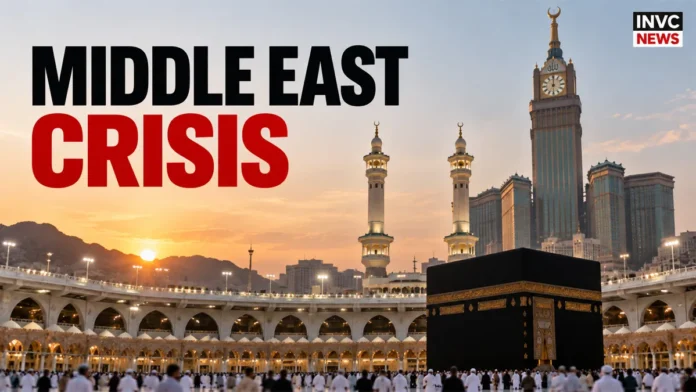
A rapidly widening Middle East crisis September 16 2026 has put Saudi Arabia, Yemen’s Houthis, Iran and key global shipping routes back at the center of international attention after Saudi authorities said they intercepted and destroyed a Houthi drone south of Mecca before it entered restricted airspace over Islam’s holiest city.
The Saudi-led military coalition said its air defenses brought down the drone on Tuesday. Coalition spokesperson Turki al-Malki said early Wednesday that the security of Mecca, Medina and pilgrims represented a “red line” for the kingdom and warned that Saudi Arabia could take deterrent measures.
A Houthi military source, however, denied that the group posed a threat to Mecca or other holy sites, according to comments carried by the Houthi-run SABA news agency.
The confrontation comes after a week of attacks, counterstrikes and territorial changes that have intensified pressure on two of the world’s most strategically important maritime corridors: the Strait of Hormuz and the Bab el-Mandeb Strait.
Saudi Arabia Raises Security Alert After Drone Incident
Saudi Arabia issued security alerts in several parts of the country on Tuesday, including Mecca and other major cities, after a series of attacks linked to the renewed conflict.
According to the Saudi-led coalition, the latest drone was destroyed before reaching prohibited airspace over Mecca.
The coalition described the incident as the second Houthi attempt involving the holy city since a 2017 episode in which Saudi Arabia said a ballistic missile had been launched toward the area. The Houthis have disputed Saudi descriptions of threats against religious sites.
The immediate military incident carries broader political consequences because Saudi Arabia is already facing attacks on cities, military infrastructure and energy routes.
Houthi Attacks Put Saudi Arabia Under New Pressure
The Houthis have announced several attacks against Saudi Arabia over the past week.
On Monday, the group said it fired missiles and drones at the Khamis Mushait military air base in southern Saudi Arabia. The Houthis described those attacks as retaliation for Saudi airstrikes in Yemen.
At the same time, Houthi forces have expanded their position along Yemen’s Red Sea coast.
They have taken control of parts of the coastline overlooking the Bab el-Mandeb Strait, an essential route connecting the Red Sea with the Gulf of Aden and the Indian Ocean.
That development has raised concerns well beyond Yemen because the waterway carries international trade and energy shipments.
Iran Connection Requires Careful Distinction
The Houthis are widely described as aligned with Iran, but Tehran publicly rejects claims that it directly controls their military decisions.
Reuters reported last week, citing Iranian and regional sources, that Iranian arms, advice and personnel had assisted Houthi operations along Yemen’s Red Sea coast. The same report noted that Iran describes the Houthis as an ally while publicly denying that it gives them military direction or treats them as a proxy force.
That distinction matters as Gulf countries assess whether the latest escalation represents independent Houthi operations, coordinated pressure involving Iran, or a combination of both.
The competing claims remain politically significant and cannot be independently reduced to a single explanation.
Saudi Crown Prince Turns to Egypt
Saudi Crown Prince Mohammed bin Salman traveled to Cairo on Tuesday for talks with Egyptian President Abdel-Fattah el-Sissi as Riyadh sought regional backing amid escalating Houthi attacks.
Egypt did not announce any commitment to military involvement. However, the Egyptian presidency expressed strong political support for Saudi Arabia, while Egypt remains an influential player in Arab diplomacy and Red Sea security.
The talks underline how quickly the Yemen conflict has expanded into a broader regional security issue.
Egypt also has a direct economic interest in restoring stability because disruptions to Red Sea shipping can reduce traffic through the Suez Canal.
Strait of Hormuz Traffic Falls Sharply
The crisis is unfolding simultaneously at the Strait of Hormuz.
Preliminary shipping data from Kpler showed only four commodity vessels transited Hormuz on Monday, down from 10 a day earlier. Before the current conflict began on February 28, the strait typically handled around 125 large commercial vessels a day.
The figures may not capture every vessel because some ships can switch off tracking systems.
Nevertheless, the decline illustrates the growing reluctance of commercial operators to move through a region facing repeated military incidents and uncertainty.
The Strait of Hormuz normally carries a major share of global crude oil and liquefied natural gas shipments. Reuters reported that the route historically accounted for about one-fifth of daily global crude and LNG supply.
Gulf-Iran Talks Suffer Another Setback
Diplomatic efforts are also facing difficulties.
Gulf Arab states postponed planned talks with Iran over possible arrangements concerning the Strait of Hormuz, according to Reuters.
Those negotiations had been viewed as one potential route toward reducing risk to shipping and energy markets.
Their postponement means military developments are currently moving faster than regional diplomacy.
That creates a particularly difficult environment for Gulf countries, which must protect infrastructure and maritime routes while also trying to avoid a wider confrontation.
Bab el-Mandeb Becomes Second Major Chokepoint
Pressure at Hormuz would already represent a serious challenge for energy markets.
The new Houthi advances near Bab el-Mandeb add another layer.
Shipping data showed 21 commodity vessels moved through Bab el-Mandeb on Monday, down from 28 a day earlier.
The strategic significance is clear: disruptions at Hormuz affect access to Gulf energy exports, while instability at Bab el-Mandeb threatens the route linking the Indian Ocean to the Red Sea and Suez Canal.
A simultaneous threat to both corridors could force shipping companies to adopt longer routes, raise insurance costs and increase transportation expenses.
Yemen Humanitarian Crisis Worsens
The military and political escalation is also producing a rapidly growing humanitarian cost.
The United Nations refugee agency said more than 100,000 people have been internally displaced by the renewed fighting in Yemen. Thousands more have fled by sea to Djibouti.
UNHCR said damaged roads, insecurity, communications problems and movement restrictions are making humanitarian operations more difficult.
Saudi and Yemeni forces have carried out strikes against Houthi targets as fighting has intensified.
The situation means developments around strategic ports and shipping lanes are occurring alongside another large displacement crisis inside Yemen.
Why This Crisis Matters Beyond the Middle East
The latest confrontation links several crises that previously could be treated separately.
Saudi security is now connected to fighting in Yemen.
Yemen’s Red Sea coastline has become increasingly important to global shipping.
The Strait of Hormuz remains under severe pressure.
Meanwhile, Gulf-Iran diplomacy has stalled at a moment when diplomatic channels could become increasingly important.
For India, Europe and Asian economies that depend heavily on Gulf energy and shipping routes, any prolonged disruption can affect freight rates, energy costs and inflation.
What Happens Next
Saudi Arabia’s response to the drone incident near Mecca will be closely watched.
The coalition has publicly signaled that it could take deterrent action, but the scale and form of any response remain unclear.
The Houthis, meanwhile, have continued to justify recent attacks as retaliation for military action in Yemen.
Iran’s role will remain under scrutiny, particularly as Tehran denies directing Houthi military operations while regional and Iranian sources have described varying levels of assistance.
The immediate question is whether diplomacy can restart before military pressure around both Hormuz and Bab el-Mandeb escalates further.
For now, the Middle East faces a dangerous combination of military confrontation, stalled diplomacy, energy insecurity and a worsening humanitarian crisis.