By Team INVC | INVC NEWS
WASHINGTON, United States | September 15, 2026 —
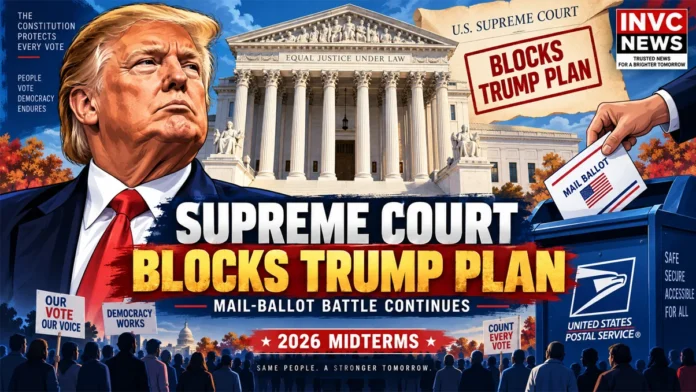
Trump mail ballot Supreme Court battle delivered a major setback to President Donald Trump after the U.S. Supreme Court refused to let his administration enforce sweeping new Postal Service restrictions on mail-in ballots just as voting gets underway for the crucial 2026 midterm elections.
The timing makes the ruling particularly consequential.
Mail ballots are already moving in several states. The November 3 elections will determine control of Congress. Yet the Trump administration wanted states to rapidly adopt a new system governing ballot envelopes, voter information and Postal Service verification.
The Supreme Court said no — at least for now.
Its decision leaves existing mail-ballot procedures largely intact for this year’s midterms while the broader legal fight continues.
Trump Wanted New Rules. The Clock Became His Biggest Enemy
The dispute grew out of an executive order President Trump signed in March as part of his push to tighten mail-voting rules.
The U.S. Postal Service subsequently developed requirements that would force states to provide information about voters receiving mail ballots and use approved ballot-mail envelopes carrying unique barcodes.
Under the plan, USPS could refuse to send ballots that failed to meet the standards or were associated with voters missing from the submitted lists.
That would represent a dramatic change only weeks before Election Day.
Election officials argued they simply did not have enough time to rebuild their systems.
The Supreme Court ultimately agreed that timing mattered.
Supreme Court Delivers Trump a Clear Setback
The Trump administration asked the Supreme Court to lift a lower-court injunction that prevented USPS from enforcing the new requirements.
The justices rejected that request Monday.
In its brief order, the court said the government was unlikely to succeed in challenging the preliminary injunction.
That language makes the decision more significant than a simple scheduling dispute, although it does not represent a final Supreme Court judgment on every legal question surrounding the USPS policy.
For the 2026 midterms, however, the practical result is clear:
Trump’s proposed USPS restrictions cannot take effect under the current court orders.
Voting Has Already Started
This is where the political drama becomes an immediate voter story.
Mail ballots have already begun going out.
AP reported that Alabama, North Carolina and Wisconsin started sending mail ballots during the past week while uncertainty over the proposed system remained unresolved.
Thousands of election offices can now proceed using the processes they had prepared rather than scrambling to comply with a last-minute federal overhaul.
That gives the ruling enormous practical importance.
The country isn’t debating rules for an election months or years away.
The election machinery is already moving.
What Exactly Would Trump’s Rule Have Changed?
The proposed system centered on tighter USPS control over ballot mail.
States would face new requirements involving voter lists and approved ballot envelopes carrying identifying barcodes.
The Postal Service could potentially refuse to process ballots under circumstances in which states failed to meet the new standards.
Critics warned that introducing those requirements so close to Election Day could interfere with legitimate ballots.
The administration presented a very different argument.
Justice Department lawyers said the policy was intended to strengthen election security and prevent the mail system from facilitating voter fraud.
That disagreement now sits at the heart of the larger legal battle.
Two Conservative Justices Wanted Trump to Win This Round
The Supreme Court has a 6-3 conservative majority, making the outcome particularly noteworthy.
Justices Samuel Alito and Clarence Thomas publicly dissented.
Alito argued that the Postal Service has broad authority to regulate the mail and criticized aspects of the challengers’ legal case.
However, no other justice publicly joined the dissent.
That left the administration without enough support to put the restrictions into effect for the approaching midterms.
Brett Kavanaugh Leaves the Door Open for Another Fight
Justice Brett Kavanaugh added an important wrinkle.
Kavanaugh agreed that the rule should not take effect now, but his reasoning suggested the administration’s underlying legal argument may not necessarily be dead forever.
He wrote that there was a “fair prospect” the regulation could fall within USPS authority.
The immediate problem was timing.
State and local election officials did not have sufficient time to reasonably implement such substantial changes before the 2026 election, Kavanaugh concluded.
That means this week’s decision should not be interpreted as the Supreme Court permanently banning the administration from pursuing mail-ballot changes.
The legal war could return.
Trump-Appointed Judge Had Already Blocked the Plan
The administration had encountered another obstacle even before the Supreme Court acted.
U.S. District Judge Carl Nichols in Washington issued a preliminary injunction against the USPS rule.
There is an interesting political detail: Trump appointed Nichols during his first presidential term.
Nichols concluded that key parts of the regulation exceeded the Postal Service’s statutory authority.
A separate federal judge in Boston, U.S. District Judge Indira Talwani, had already blocked the rule on September 4.
The Supreme Court’s latest action therefore leaves those barriers in place.
Why Mail Voting Is Such a Huge U.S. Political Battlefield
Mail voting has become one of America’s most contentious election issues.
Trump has repeatedly questioned its security and has continued advocating tighter restrictions.
His administration argues stronger controls are necessary to protect election integrity.
Opponents say the proposed measures amount to federal interference in election administration and could prevent eligible voters from receiving or casting valid ballots.
The scale makes the debate impossible to ignore.
All 50 states allow some form of mail voting. Reuters reports that 29 states permit voters to request mail ballots without providing an excuse, while eight conduct elections entirely by mail.
AP says mail voting has accounted for nearly one-third of ballots cast.
Millions of Ballots Were at the Center of the Warning
Opponents did not merely argue that the system would be inconvenient.
They warned of potentially enormous consequences.
The Boston-based 1st U.S. Circuit Court of Appeals said the rule would likely disenfranchise millions of voters while delivering little, if any, benefit in fighting voter fraud.
A whistleblower report also raised concerns about technical problems with the proposed verification system and the possibility that large batches of ballots could be affected by errors.
Those concerns became especially serious because states had so little time to redesign their election operations.
November 3 Raises the Political Stakes
This isn’t an ordinary off-year election.
The November 3, 2026 midterms will determine control of Congress for the remaining two years of Trump’s presidential term.
Republicans are fighting to retain their congressional majorities.
That means seemingly technical disputes involving envelopes, barcodes and Postal Service databases carry enormous political consequences.
A change capable of affecting mail voting could matter in closely contested House and Senate races.
What Happens to Voters Now?
For voters, the immediate message is much simpler than the legal battle surrounding it.
States can continue operating their established mail-ballot systems without having to implement the disputed USPS restrictions for this election under the current injunctions.
Voters should still follow the specific registration, identification, application and ballot-return deadlines established by their own states.
The Supreme Court ruling does not eliminate those requirements.
It blocks the administration from imposing the disputed new USPS system while litigation continues.
Trump Lost This Round — But the Mail-Ballot War Is Not Over
The Supreme Court decision unquestionably hands Trump a significant defeat in his attempt to change mail-ballot procedures before the midterms.
Yet the broader legal question remains alive.
Kavanaugh’s position is particularly important because it suggests some conservative justices could view a similar rule differently if an administration attempted to introduce it with sufficient preparation time.
So the story has two endings.
For November 3, 2026, Trump’s last-minute mail-ballot overhaul has hit a Supreme Court wall.
For America’s longer battle over who controls election rules, however, another courtroom showdown may already be waiting.