By Team INVC | INVC NEWS
STOCKHOLM, Sweden | September 15, 2026 —
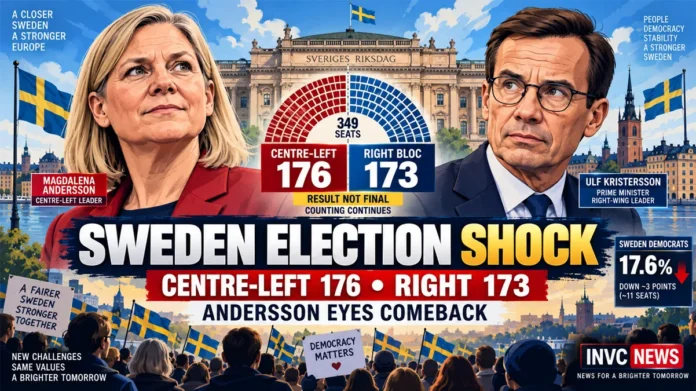
Sweden Election 2026 has delivered one of Europe’s most dramatic political cliffhangers, with Magdalena Andersson’s centre-left opposition holding a razor-thin 176-173 seat advantage over Prime Minister Ulf Kristersson’s governing right-wing bloc as counting continues.
The preliminary result has opened a possible path for Andersson to return as prime minister four years after losing office.
Yet Sweden does not have a confirmed winner.
Late advance ballots, overseas votes and the continuing official count could still alter the balance in the 349-seat Riksdag.
The election has nevertheless produced one clear political shock already: the Sweden Democrats lost ground for the first time in a parliamentary election after years of uninterrupted expansion.
The anti-immigration party is projected at around 17.6% of the vote, roughly three percentage points below its 2022 performance, and could lose about 11 parliamentary seats.
That setback has weakened the right-wing bloc and complicated Kristersson’s hopes of governing for another four years.
For Andersson, the result creates an opportunity — but not an easy road back to power.
Centre-Left Holds a Three-Seat Advantage
Current projections put the four parties supporting the centre-left at 176 seats.
Kristersson’s right-wing bloc stands at 173.
That difference is as narrow as Swedish politics gets.
A parliamentary majority requires 175 seats, meaning the centre-left projection technically places Andersson’s side above the threshold.
However, the two blocs are separated by only around 0.4 percentage points, representing roughly 29,000 votes among about 6.4 million already counted in the latest broad tally.
With margins that small, nobody can safely declare the election finished.
Andersson herself has stopped short of claiming an unconditional victory.
Her message to supporters was carefully phrased: if the result holds, Sweden will get a new government.
Sweden Democrats Suffer Their First National Election Setback
The biggest change from the pre-election expectations comes from the Sweden Democrats.
The party entered the campaign hoping to move closer to direct government power after supporting Kristersson’s minority administration from outside the cabinet since 2022.
Instead, voters cut its share.
The Sweden Democrats are projected to receive approximately 17.6%, down around three percentage points from four years ago.
That marks the first time since entering parliament in 2010 that the party has lost vote share in a national parliamentary election.
Its projected loss of roughly 11 seats has become the central mathematical reason the right-wing bloc currently trails.
The result is particularly striking because nationalist and populist parties have been gaining influence across much of Europe.
Sweden may now be moving against that continental trend — at least temporarily.
Why Did the Sweden Democrats Lose Ground?
Several factors may have contributed.
Tactical voting appears to have played an important role.
Some right-leaning voters may have shifted support toward other parties inside Kristersson’s bloc to protect smaller coalition partners or strengthen the Moderates.
The Sweden Democrats also carried the political cost of supporting the government for four years without formally joining it.
That created an awkward position.
The party influenced policy, particularly on immigration, while still presenting itself as an outsider challenging the political establishment.
After four years of parliamentary influence, some voters may have judged it partly on the government’s record.
Its own aggressive campaign proposals may also have mobilized voters who feared the party would gain cabinet positions for the first time.
Immigration Still Changed Swedish Politics
A Sweden Democrats setback does not mean Sweden will suddenly reverse its tougher immigration policies.
That is one of the most important conclusions from the election.
Swedish politics has already moved significantly toward tighter migration rules.
Kristersson’s government, with Sweden Democrat support, abolished permanent residency for many refugees, tightened welfare conditions and increased expulsions.
Asylum applications have fallen to their lowest level in about four decades.
Even Andersson’s Social Democrats now support a significantly tougher migration approach than the party advocated during the refugee crisis of the 2010s.
A centre-left government may change tone and some policies.
It is unlikely to restore the old open-door model.
Magdalena Andersson Can See Downing Street — But Stockholm Is Complicated
Andersson now has the clearest path toward becoming prime minister.
That does not mean forming a government will be straightforward.
Her potential parliamentary base includes the Social Democrats, Greens, Left Party and Centre Party.
Those parties share one powerful objective: keeping the Sweden Democrats away from government power.
Beyond that, significant disagreements remain.
Tax policy represents one major fault line.
The Greens and Left want wealthier Swedes to contribute more.
The Centre Party opposes proposals such as a billionaires’ tax.
Even more importantly, the Centre Party has resisted serving in the same government as the Left Party.
Andersson may therefore win the seat arithmetic while still facing weeks of difficult negotiations.
Andersson’s Comeback Would Be Remarkable
A return to government would complete a striking political comeback.
Andersson became Sweden’s first female prime minister in 2021 and led the country for about 10 months before losing power after the 2022 election.
Her government also initiated Sweden’s historic application to join NATO after Russia invaded Ukraine.
Sweden completed NATO accession under Kristersson in 2024.
Four years after her defeat, Andersson now stands closer than anyone expected to returning to the prime minister’s office.
Kristersson Refuses to Concede
Prime Minister Ulf Kristersson has good reason to remain cautious.
Sweden experienced a similar drama in 2022.
Early indications then suggested a centre-left victory before later counting shifted the outcome toward Kristersson’s bloc.
The current prime minister has therefore avoided conceding while ballots remain outstanding.
With only three seats separating the blocs, a relatively small number of votes could matter.
The political fight remains alive until the official count removes that uncertainty.
Wednesday’s Count Could Be Crucial
Wednesday will become one of the most important days in the post-election process.
Swedish election committees will count advance ballots that did not reach polling stations by election night.
Late-arriving overseas votes will also enter the count.
These ballots could matter enormously in an election separated by such a narrow margin.
However, Wednesday should not be confused with final certification.
The Swedish Election Authority expects the final Riksdag result to be completed around the weekend after election day.
Until then, seat allocations can still change.
Why the 176-173 Number Matters
Sweden’s Riksdag contains 349 seats.
A bloc effectively needs at least 175 seats to control a majority.
At 176 seats, Andersson’s side currently sits only one seat above that line.
Kristersson’s bloc needs a net shift of only two seats to reverse the parliamentary balance.
That explains why neither camp can relax.
Unlike a landslide election, every late ballot now carries potential political significance.
The Moderates Regain Ground Inside the Right
Another important result is the changed balance within the right-wing bloc.
The Sweden Democrats had become the second-largest party after the previous election and the dominant force on the Swedish right in several policy debates.
Their decline changes that relationship.
Kristersson’s Moderates are positioned to regain greater weight relative to the Sweden Democrats.
Even if the right ultimately fails to retain government, that internal shift could influence how conservative politics develops during the next parliamentary term.
Jimmie Akesson’s Cabinet Dream Takes a Blow
Sweden Democrats leader Jimmie Akesson entered the election hoping for something his party had never achieved: direct government participation.
Kristersson had opened the possibility of Sweden Democrats receiving cabinet posts if the right retained its majority.
That would have completed the party’s journey from political isolation to executive power.
The preliminary result puts that ambition in serious doubt.
If Andersson forms a government, the Sweden Democrats will remain in opposition despite years of growing influence.
Sweden Bucks Europe’s Rightward Momentum
The result also carries meaning beyond Sweden.
Right-wing populist and nationalist parties have expanded their influence across Europe.
Several have entered governments or become essential coalition partners.
The Sweden Democrats appeared positioned to become another example.
Instead, their setback provides a rare counterpoint.
That does not necessarily mean Europe’s rightward movement has reversed.
Swedish analysts have cautioned that tactical voting and local political dynamics may explain more of the result than a broad ideological transformation.
Still, the symbolism will resonate across European capitals.
Ukraine Policy Unlikely to Change Dramatically
A change of government would not transform Sweden’s support for Ukraine.
Kristersson has been strongly pro-Ukraine.
Andersson also supports Kyiv and played a central role in Sweden’s NATO decision after Russia’s full-scale invasion.
The country’s major political blocs share broad agreement on NATO membership and the need to strengthen European security.
Sweden’s defense trajectory is therefore likely to remain strongly aligned with NATO regardless of who becomes prime minister.
Welfare Could Become Andersson’s Bigger Domestic Shift
Where a centre-left government could differ more clearly is domestic policy.
Andersson campaigned on stronger welfare services, greater economic security and social cohesion.
Healthcare, schools and household living costs remain major concerns for Swedish voters.
The centre-left could place more emphasis on public spending and redistribution than Kristersson’s government.
However, Andersson’s coalition partners disagree about exactly how those policies should be funded.
That will make government negotiations critical.
This Was Not a Return to Sweden’s Old Politics
A possible centre-left victory should not be mistaken for a restoration of the Sweden that existed before the rise of the Sweden Democrats.
The political landscape has changed permanently.
Immigration policy is stricter.
Security concerns are greater.
Sweden is now a NATO member.
Gang violence and organized crime have moved law and order higher on the national agenda.
The Sweden Democrats remain a major parliamentary force even after losing support.
And the two traditional political blocs depend increasingly on smaller parties to build governing majorities.
The election may change who governs.
It will not erase the political transformation of the past decade.
What Happens After the Final Count?
If the centre-left lead survives, Andersson must show that she can command enough parliamentary support to become prime minister.
That could trigger difficult negotiations among the Social Democrats, Centre Party, Greens and Left Party.
If late votes move seats toward Kristersson, the right would begin its own coalition talks.
Either way, Sweden could face an extended government-formation process.
Riksdag Speaker Andreas Norlen has already warned that assembling a viable government may prove complicated.
Sweden Election 2026 Has Delivered Its First Verdict — But Not the Final One
The election has already answered one major question.
The Sweden Democrats did not achieve the breakthrough they wanted.
Their first national-election setback has weakened the right and opened the door for Magdalena Andersson.
What Sweden has not yet answered is who will actually walk through that door.
At 176 seats to 173, the centre-left advantage could hardly be smaller.
Wednesday’s late ballots matter.
The final official count matters even more.
And if the numbers remain where they are, Andersson will face another challenge immediately afterward: turning four politically different parties into a workable government.
For now, however, the political momentum belongs to the former prime minister.
Sweden has not yet officially changed governments — but the election has brought Magdalena Andersson within touching distance of one of Europe’s most closely watched political comebacks.