By Team INVC | INVC NEWS
NEW DELHI, India | September 13, 2026 —
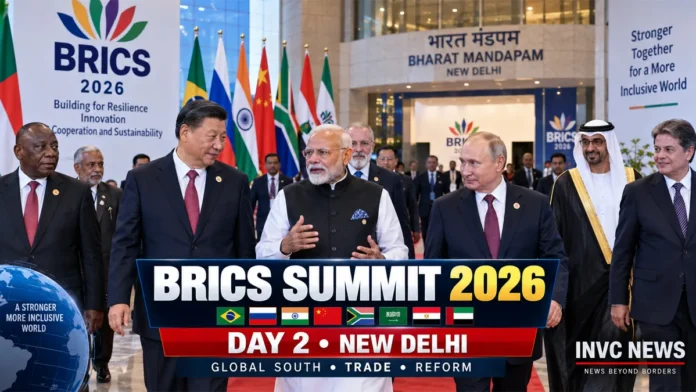
BRICS Summit 2026 entered its second and final day in New Delhi on Sunday as Prime Minister Narendra Modi and leaders of the expanded grouping returned to Bharat Mandapam after adopting the New Delhi Declaration, shifting attention toward implementation, Global South cooperation and the summit’s final diplomatic engagements.
The 18th BRICS Summit is taking place on September 12 and 13 under India’s chairship and the theme “Building for Resilience, Innovation, Cooperation and Sustainability.”
Saturday produced the summit’s central political document after BRICS leaders adopted the New Delhi Declaration by consensus.
Now, the focus turns toward translating that agreement into practical cooperation while leaders complete the remaining summit engagements.
The final day also comes against an unusually difficult international backdrop marked by conflicts, trade tensions, pressure on energy markets and demands from emerging economies for greater influence over global institutions.
BRICS Summit 2026 enters final day
India has used its BRICS presidency to position the expanded grouping as a stronger platform for the Global South.
The summit has brought together major emerging economies with different strategic interests.
Those differences made the adoption of a consensus declaration particularly significant.
Prime Minister Narendra Modi said after its adoption that the declaration provides a clear direction for the grouping’s shared commitments and emphasized that members must now translate those commitments into tangible results.
That implementation challenge moves to the center of attention as the summit enters its concluding phase.
New Delhi Declaration sets the agenda
The New Delhi Declaration covers a broad range of political, economic and development priorities.
BRICS leaders reaffirmed their commitment to sovereign equality, multilateral cooperation, sustainable development and a more representative international order.
The declaration also called for reforms to global institutions so they better reflect contemporary economic and political realities.
For India, that agenda fits directly into its long-standing demand for greater representation of developing countries in global decision-making.
The summit has therefore become another platform for New Delhi to push the Global South higher on the international agenda.
PM Modi pushes reform of global institutions
Prime Minister Narendra Modi has argued that institutions designed for an earlier era cannot adequately manage today’s world.
India has repeatedly called for reform of the United Nations and other multilateral institutions.
The issue has gained urgency as emerging economies account for a larger share of global growth while retaining comparatively limited influence in some international bodies.
BRICS members have also pressed for changes in global economic governance.
Finance ministers and central bank governors from the grouping called for institutions such as the International Monetary Fund and World Bank to become more representative, transparent and accountable.
That economic reform agenda remains one of the summit’s most important long-term themes.
Trade pressure becomes a major BRICS issue
Trade has emerged as another central concern.
BRICS countries have expressed serious concern about unilateral tariffs and non-tariff measures that distort international commerce.
For emerging economies, the issue goes beyond individual trade disputes.
Higher tariffs, financial restrictions and geopolitical fragmentation can disrupt supply chains, increase costs and make cross-border investment more difficult.
BRICS members are consequently looking for mechanisms that can make trade within the grouping more resilient.
However, the bloc has not announced a single BRICS currency.
Claims suggesting that the New Delhi summit has launched a common currency should therefore be treated cautiously.
Cross-border payments remain in focus
BRICS finance officials are instead working on practical payment connectivity.
The grouping’s Payment Task Force has been encouraged to continue exploring faster, cheaper, accessible and secure cross-border payment solutions.
Payment-system interoperability could eventually reduce friction for businesses operating between BRICS economies.
India has particular experience in digital public infrastructure and real-time payments.
That gives New Delhi an opportunity to play an important role in discussions about financial technology and cross-border settlement systems.
Still, greater payment interoperability should not be confused with the creation of a common BRICS currency.
The two ideas are fundamentally different.
Global South becomes India’s central message
India has framed its BRICS presidency around the interests of developing economies.
That includes food security, energy security, climate finance, technology access, development financing and reform of global governance.
New Delhi argues that international institutions must give developing countries a stronger role in decisions that directly affect their economies and populations.
The expanded BRICS structure gives that argument additional weight.
Members span Asia, Africa, the Middle East and Latin America, giving the grouping an unusually broad geographic reach.
At the same time, those members do not share identical geopolitical positions.
Maintaining consensus therefore remains one of BRICS’ biggest tests.
Middle East tensions test BRICS unity
The summit is taking place during severe geopolitical tensions in West Asia.
Iran is a BRICS member, while other members maintain complex political, security and economic relationships across the region.
Those competing interests created a difficult diplomatic environment for negotiators.
Despite those divisions, members reached consensus on the New Delhi Declaration.
The declaration emphasizes diplomacy, dialogue and peaceful approaches to international disputes.
That consensus does not eliminate disagreements among BRICS members.
However, it demonstrates the grouping’s effort to preserve a common platform despite major geopolitical differences.
Terrorism features in New Delhi Declaration
Counterterrorism also received significant attention.
The declaration condemned terrorism in all its forms and manifestations.
It also referred to terrorist attacks including the Pahalgam attack, giving India an important diplomatic outcome on an issue that New Delhi has consistently raised in international forums.
India has argued that countries must reject double standards in dealing with terrorism.
For New Delhi, securing strong language on terrorism within a grouping that includes countries with widely different strategic relationships represents a significant diplomatic objective.
PM Modi-Xi meeting adds weight to summit
One of the summit’s most closely watched bilateral developments came from Prime Minister Narendra Modi’s meeting with Chinese President Xi Jinping.
The talks represented another effort by Asia’s two largest countries to stabilize relations after years of tensions following the 2020 border clash.
PM Modi stressed that peace and tranquility along the border remain essential for the broader relationship.
He also emphasized three principles for managing India-China ties: mutual respect, mutual sensitivity and mutual interest.
Both sides discussed business links, people-to-people exchanges, trade imbalances, supply chains and market access.
President Xi described India and China as development opportunities rather than threats to each other.
The meeting did not resolve the countries’ major disagreements.
Nevertheless, it demonstrated an effort to keep bilateral engagement moving.
China takes BRICS chairship next
The leadership transition is another important part of the summit’s conclusion.
China is set to assume the next BRICS chairship and host the 19th BRICS Summit in 2027.
That means the commitments reached in New Delhi will eventually move into a Chinese-led implementation phase.
For India, the challenge is to ensure that initiatives launched during its 2026 presidency continue after the chairship changes.
Continuity will be especially important in areas such as institutional reform, financial cooperation, technology, climate action and Global South representation.
BRICS pushes IMF and World Bank reform
Economic governance remains one of the clearest areas of agreement.
BRICS finance chiefs have called for emerging-market economies to receive a stronger voice within global development institutions.
Their argument rests on the increasing contribution of developing economies to global output and economic growth.
Reforming the IMF and World Bank has been discussed internationally for years.
BRICS is trying to turn that debate into a sustained collective demand.
The grouping also wants international financial institutions to become more accountable and representative.
Whether those demands produce structural change will depend on negotiations far beyond the summit itself.
Technology becomes another pillar
India has also placed innovation and technology at the center of its BRICS presidency.
Artificial intelligence, digital public infrastructure, fintech, health technology and deep-tech innovation have featured across meetings associated with the summit.
New Delhi wants emerging economies to gain greater access to technologies that can improve development rather than deepen the digital divide.
Human-centric AI has become part of that discussion.
India’s approach emphasizes innovation while also highlighting inclusion, safety and practical benefits for citizens.
That agenda could become increasingly important as AI systems reshape employment, public services and economic competition.
Energy security remains critical
Energy is another unavoidable issue for BRICS.
The grouping includes some of the world’s largest energy producers and consumers.
Geopolitical instability has increased volatility in oil and gas markets, putting pressure on import-dependent economies.
BRICS discussions therefore combine energy security with the longer-term transition toward cleaner sources.
Those priorities can sometimes conflict.
Developing economies need reliable and affordable energy while simultaneously facing pressure to reduce emissions.
India has argued that the transition must remain fair and account for different national development circumstances.
Why the summit matters beyond BRICS
BRICS no longer functions simply as a forum for five major emerging economies.
Expansion has increased its economic and geopolitical reach.
The grouping now brings together countries with enormous populations, major energy resources, large consumer markets and growing technological capabilities.
That does not make BRICS a unified political alliance.
Members frequently disagree on security, trade and regional issues.
Its significance instead comes from the ability of very different emerging powers to coordinate around selected priorities.
Those priorities increasingly include global governance reform, development finance and a larger voice for the Global South.
What to watch on BRICS Summit Day 2
The final day remains a developing story.
The most important developments to watch include additional statements from Prime Minister Narendra Modi and other leaders, engagement with BRICS partner countries, final bilateral meetings and any new implementation commitments announced before the summit concludes.
Any substantive announcement on payment connectivity, institutional reform, technology cooperation or other initiatives would also strengthen the final outcome.
The transition to China’s 2027 chairship will provide another important marker.
INVC NEWS should update this master report as those developments become official rather than create separate generic BRICS Summit pages.
New Delhi Declaration becomes India’s key outcome
Whatever emerges during the remaining hours, the New Delhi Declaration already stands as the central outcome of India’s 2026 summit.
Reaching consensus required members with very different strategic priorities to agree on a common document.
The next test will be implementation.
Prime Minister Narendra Modi has framed that task clearly: declarations must produce tangible results.
As BRICS Summit 2026 moves through its final day, that shift from diplomatic language to practical cooperation will determine how much of New Delhi’s agenda survives beyond the summit itself.