By Team INVC | INVC NEWS
STOCKHOLM, Sweden | September 13, 2026 —
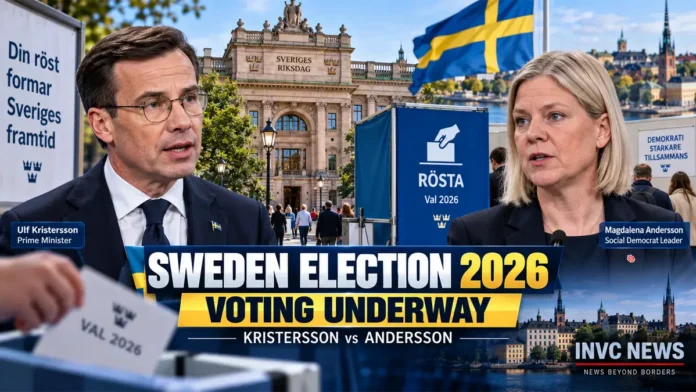
Sweden Election 2026 voting is underway Sunday in a closely fought national election that could return former Prime Minister Magdalena Andersson to power or give incumbent Prime Minister Ulf Kristersson another term while potentially bringing the Sweden Democrats into government for the first time.
Swedish voters are electing all 349 members of the Riksdag, with 175 seats needed for a majority.
The election has developed into much more than a contest between Kristersson and Andersson. Its outcome could reshape Sweden’s political landscape and determine whether the Sweden Democrats move from supporting a government from outside to holding cabinet positions.
Recent polling gives Andersson’s center-left opposition a narrow advantage. However, Kristersson’s bloc has closed much of the gap, leaving the result difficult to predict.
Sweden votes in a political cliffhanger
Sweden entered election day with neither political bloc assured of victory.
Andersson’s Social Democrats remain the country’s largest individual party in polling and lead a center-left grouping that includes the Green Party, Left Party and Centre Party.
Kristersson’s Moderates are fighting alongside the Christian Democrats and Liberals, while the Sweden Democrats remain central to the right-wing bloc.
The Sweden Democrats have supported Kristersson’s minority government during the past four years without formally joining the cabinet.
That arrangement could change after Sunday’s vote.
Kristersson has said the Sweden Democrats could become part of the government if his bloc secures another mandate.
Why the Sweden Democrats matter so much
The Sweden Democrats have become one of the central forces in Swedish politics after spending years outside the political mainstream.
The party built much of its support around tougher immigration policies, crime and Swedish national identity.
Its historical roots and previous links to extremist movements have remained a major source of controversy.
However, the party’s influence has increased significantly.
Since 2022, the Sweden Democrats have supported Kristersson’s government in parliament and helped shape policy without holding ministerial positions.
A right-bloc victory could therefore mark another major step in the party’s political transformation.
Kristersson seeks a second term
Prime Minister Ulf Kristersson is asking voters for another term after four years in office.
His government has pursued tougher immigration rules and stronger measures against organized crime while overseeing Sweden’s new era as a NATO member.
Kristersson argues that his political alliance has delivered greater security and needs another mandate to continue its agenda.
Crime remains an important issue after years of concern over gang violence and shootings.
The government also points to lower asylum numbers and declining shooting deaths as evidence that its policies are producing results.
Critics, however, argue that some measures have gone too far and risk weakening civil liberties and Sweden’s traditionally liberal political culture.
Magdalena Andersson eyes return as prime minister
Magdalena Andersson is trying to return to the prime minister’s office four years after losing power.
She became Sweden’s first female prime minister in 2021 and led the country during the early phase of the security transformation that ultimately brought Sweden into NATO.
Andersson’s campaign has emphasized welfare, economic fairness and social cohesion.
Her Social Democrats have consistently remained the country’s largest party in opinion polling.
Yet winning the most votes does not automatically guarantee that Andersson can form a stable government.
The parties supporting a change of government disagree on several major issues, including taxation, energy and immigration.
Therefore, coalition negotiations could become difficult even if the center-left finishes ahead.
The Liberals could decide who governs Sweden
One smaller party could have an outsized impact on the final result.
Sweden’s Liberals must clear the 4% national threshold required for representation in parliament.
Earlier polls had raised concerns that the party could fall below that level.
More recent polling, however, showed its support recovering above the threshold.
That matters enormously for Kristersson.
If the Liberals enter parliament, their seats could help the right-wing bloc reach a majority.
If they fall below 4%, the mathematics become much harder for the incumbent prime minister.
In an election this close, a relatively small shift in Liberal support could therefore influence who controls the government.
349 seats and a 175-seat majority
Sweden uses a proportional electoral system.
Voters are choosing representatives for the 349-seat Riksdag, while municipal and regional elections are also taking place Sunday.
A bloc needs at least 175 seats to command a straightforward parliamentary majority.
Recent polling has suggested the contest could finish extremely close to that line.
The center-left has generally remained ahead, but its advantage has narrowed substantially during the final stretch of campaigning.
That leaves several possible outcomes, including a narrow Andersson victory, another Kristersson government or prolonged negotiations if neither side can establish a workable majority.
Immigration remains a defining dividing line
Immigration has transformed Swedish politics over the past decade.
Kristersson’s government adopted substantially tougher policies after taking office in 2022.
The Sweden Democrats have pushed for even stricter measures.
Supporters argue that tighter immigration policies are necessary to improve integration, reduce crime and ease pressure on public services.
Opponents contend that the shift has moved Sweden away from its humanitarian traditions.
The issue has also created divisions within Andersson’s potential governing coalition.
Those differences could become especially important during post-election negotiations.
Crime and gang violence shape the campaign
Crime has remained another major concern for Swedish voters.
The country has struggled with gang-related violence, shootings and organized criminal networks.
Kristersson’s government expanded police powers and introduced tougher policies designed to weaken criminal groups.
The government says the strategy is working.
Opposition parties agree that organized crime requires strong action but differ over how far policing and surveillance powers should extend.
The debate has therefore become partly about security and partly about the balance between enforcement and civil liberties.
Economy and cost of living remain important
Economic concerns also sit high on the agenda.
Swedish households have faced pressure from living costs, housing expenses and broader economic uncertainty.
Both blocs have promised measures aimed at improving household finances.
However, they differ substantially over taxation, welfare spending and the role of government.
Andersson’s camp emphasizes stronger public services and economic equality.
Kristersson’s alliance favors lower taxes, security spending and policies designed to encourage economic growth.
NATO membership changes Sweden’s election backdrop
This is also a national election taking place in a fundamentally different security environment from the one Sweden faced only a few years ago.
Sweden abandoned generations of military non-alignment and joined NATO following Russia’s full-scale invasion of Ukraine.
Both major political blocs broadly support Sweden’s NATO membership, stronger national defense and continued support for Ukraine.
Consequently, foreign policy does not create the same sharp division between the two sides as immigration, welfare and domestic security.
Still, the next government will inherit significant responsibilities involving NATO, European security and Sweden’s defense buildup.
What happens when voting ends?
Once polling stations close, attention will immediately shift toward the preliminary count.
Early results should begin establishing the shape of the contest later Sunday evening.
However, extremely close seat margins can complicate the picture.
Final government formation may also take considerably longer than the vote count itself.
A winning bloc must still establish parliamentary support for a prime minister and government.
If Andersson’s opposition wins, negotiations among ideologically different parties could prove particularly complicated.
A Kristersson victory could create a different historic question: whether and how the Sweden Democrats formally enter government.
Why Europe is watching Sweden
The election carries implications beyond Sweden.
Right-wing and populist parties have expanded their influence across several European countries.
A Sweden Democrats entry into government would reinforce that broader trend.
Conversely, an Andersson victory would return the Social Democrats to power and could be interpreted as resistance to the rightward political shift.
Sweden’s membership in both the European Union and NATO gives the outcome additional international importance.
Still, the country’s broad support for Ukraine and NATO means the election is unlikely to produce a dramatic reversal of its core security policy.
Sweden Election Results 2026: what to watch tonight
Five developments will determine how the story evolves after polls close.
First, watch whether Andersson’s center-left bloc preserves its narrow polling advantage.
Second, the Liberals’ performance around the 4% threshold could prove decisive.
Third, the Sweden Democrats’ result will determine their bargaining power inside the right-wing bloc.
Fourth, the final seat count will show whether either side reaches the crucial 175-seat majority.
Finally, attention will turn to coalition negotiations and the identity of Sweden’s next prime minister.
For now, voters have the final say.
The Sweden Election 2026 has become a genuine political cliffhanger between continuity under Ulf Kristersson and a return to power for Magdalena Andersson, with the Sweden Democrats potentially holding the key to one of the most consequential Swedish election outcomes in years.