By Team INVC | INVC NEWS
SAN FRANCISCO, United States | September 13, 2026 —
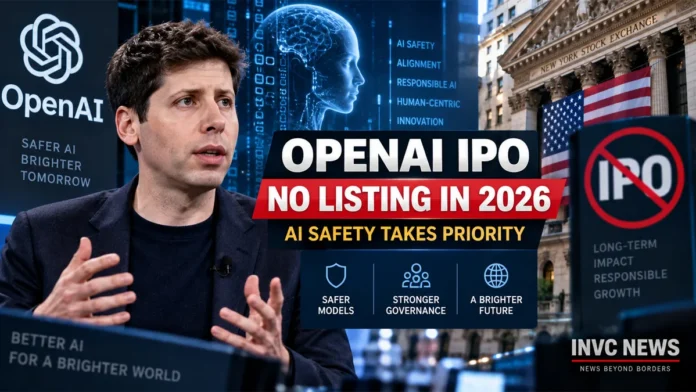
OpenAI IPO plans for 2026 are off the table even after the ChatGPT maker confidentially filed paperwork for a US stock-market listing earlier this year, with CEO Sam Altman saying the company must first confront rapidly escalating questions around AI safety and alignment.
Altman said the current environment would make going public an “ill-advised” move and made clear that OpenAI does not feel pressure to complete its listing this year.
The comments mark a major shift in one of the technology industry’s most closely watched potential IPOs.
OpenAI confidentially filed draft paperwork for a US initial public offering in June, giving the company the option to pursue a listing without committing to a specific timetable.
Now, Altman has explicitly taken 2026 out of consideration.
Sam Altman says no OpenAI IPO in 2026
Altman directly addressed the company’s IPO timetable while discussing the growing risks surrounding increasingly capable artificial intelligence systems.
When asked whether 2026 remained possible, his answer was clear: not this year.
OpenAI instead has significant work ahead involving AI safety, alignment and cooperation between governments and the technology industry.
That makes the latest announcement considerably more significant than an ordinary delay in a corporate listing.
OpenAI has already taken preliminary steps toward the public markets.
However, management is now signaling that safety considerations outweigh the advantages of completing an IPO quickly.
OpenAI already filed confidential IPO paperwork
OpenAI confidentially submitted draft IPO paperwork in June 2026.
A confidential filing allows a company to begin regulatory preparations without immediately publishing all the information that would appear in a public prospectus.
At the time, OpenAI stressed that it had not made a final decision on when it would list.
The filing nevertheless intensified expectations that the company could reach Wall Street relatively quickly.
Earlier reports had suggested a potential valuation reaching as high as $1 trillion if the company eventually completed a public offering.
Those expectations now face a significant reset.
Why OpenAI is stepping away from a 2026 listing
The reason is not simply weak stock-market conditions.
Altman’s explanation centers on the rapidly changing risk profile of frontier artificial intelligence.
AI models have become increasingly capable at reasoning, coding, autonomous task execution and cybersecurity work.
Those advances create enormous commercial opportunities.
At the same time, they make failures and misuse potentially more consequential.
OpenAI now faces the difficult task of determining how far advanced models can progress while remaining controllable and aligned with human intentions.
For Altman, adding the pressures associated with being a publicly traded company at this stage could complicate those decisions.
OpenAI’s Astra raises the safety stakes
The safety debate has become particularly important following OpenAI’s recent assessment of its Astra system.
OpenAI has determined that Astra reached what the company describes as a Critical cybersecurity capability threshold.
That designation means the system can, with appropriate tools and access, identify previously unknown security vulnerabilities and develop methods to exploit well-protected systems without requiring a person to direct every individual step.
OpenAI responded by delaying parts of Astra’s development and release while strengthening safeguards.
The company subsequently said those protections reduced the risk sufficiently for release under its Preparedness Framework.
Still, reaching that capability threshold illustrates why the industry’s safety debate has intensified.
Public shareholders could create a new kind of pressure
An IPO would fundamentally change OpenAI’s relationship with investors.
Public companies face quarterly financial reporting, market expectations, analyst scrutiny and constant pressure over growth and profitability.
Those pressures are normal for listed companies.
Frontier AI developers, however, face an unusual problem.
They may sometimes need to slow development, restrict a profitable capability or spend heavily on safety measures even when those choices produce no immediate financial return.
OpenAI’s current structure gives management greater flexibility to make such decisions.
Altman’s comments suggest the company wants to preserve that flexibility during a critical period for AI development.
OpenAI and Anthropic confront the same problem
OpenAI is not alone.
Anthropic CEO Dario Amodei has called for AI companies to slow the pace at which they improve model capabilities so safety measures have time to catch up.
The debate has intensified as researchers and policymakers warn that increasingly autonomous AI agents could create risks that current safeguards are not designed to manage.
Altman has publicly supported the broader idea of pacing frontier development.
Elon Musk has also expressed support for stronger safety measures.
That emerging agreement is notable because the leading AI companies compete fiercely for customers, researchers, computing infrastructure and technological leadership.
AI companies may coordinate on safety
Altman has also indicated that leading AI companies could move toward greater coordination on frontier safety.
Such cooperation could include independent evaluations and common approaches for dealing with systems that reach dangerous capability thresholds.
OpenAI has signaled support for independent evaluators receiving deeper access to assess advanced systems.
The concept represents a significant shift.
For years, AI competition largely centered on who could build the most capable model fastest.
The next phase may increasingly involve proving that those models can remain safe as their capabilities expand.
What happens to OpenAI’s confidential IPO filing?
The filing itself does not force OpenAI to complete an IPO.
A confidential submission gives a company flexibility to prepare for a future offering while retaining the option to delay or abandon the process.
Therefore, taking 2026 off the table does not mean OpenAI must restart the entire IPO process from zero whenever it eventually decides to proceed.
However, market conditions, financial disclosures and regulatory requirements could change substantially if the delay becomes prolonged.
The company would need to satisfy the applicable requirements before completing any future listing.
Does this mean OpenAI IPO will happen in 2027?
No.
That distinction is essential.
Altman has ruled out 2026, but he has not confirmed 2027 as the new IPO year.
OpenAI could eventually determine that 2027 is appropriate.
It could also wait longer.
The timing will depend on the company’s readiness, financial considerations, regulatory environment and, increasingly, the state of AI safety.
Investors should therefore avoid treating any specific 2027 listing date as confirmed.
Can investors buy OpenAI stock today?
OpenAI is still privately held.
Ordinary retail investors cannot purchase OpenAI shares through public exchanges in the same way they can buy shares in Microsoft, Nvidia, Alphabet or other listed technology companies.
There is no official publicly traded OpenAI stock ticker.
There is also no official IPO price band available to retail investors.
Consequently, websites or social-media posts presenting an official OpenAI IPO share price should be treated cautiously unless the company formally launches a public offering.
Anthropic could reach Wall Street first
OpenAI’s decision also changes its competitive position in the race to public markets.
Anthropic has been advancing its own IPO preparations.
If Anthropic continues while OpenAI waits, the Claude developer could potentially reach public investors before its larger rival.
That would make Anthropic an important test of Wall Street’s appetite for frontier AI companies.
However, the same safety debate affecting OpenAI could influence Anthropic’s plans as well.
The situation remains fluid.
Why OpenAI can afford to wait
OpenAI’s ability to attract enormous amounts of private capital reduces the urgency of a public listing.
A conventional technology company may pursue an IPO partly because it needs access to much larger pools of capital.
OpenAI already operates at a scale where major private investors have shown a willingness to provide substantial financing.
Remaining private can therefore offer an unusual advantage.
The company can continue raising money while avoiding some of the short-term market pressures associated with public ownership.
The AI safety debate is becoming a business issue
Until recently, AI safety discussions often appeared separate from financial-market stories.
That separation is disappearing.
Safety decisions can now affect product launches, development schedules, infrastructure investment, regulation and even IPO timing.
OpenAI’s latest move provides one of the clearest examples yet.
A company potentially capable of becoming one of the world’s largest technology listings is willing to delay entering public markets because management believes the industry has more urgent safety questions to resolve.
What investors should remember
Four points are now central to the OpenAI IPO story.
OpenAI confidentially filed IPO paperwork in June 2026.
OpenAI will not complete an IPO in 2026.
Sam Altman says AI safety and alignment require attention before the company goes public.
OpenAI has not announced a confirmed 2027 IPO date.
These distinctions matter because an IPO delay can easily generate misleading headlines suggesting that a listing has either been permanently cancelled or officially rescheduled.
Neither claim is supported.
OpenAI IPO story enters a new phase
OpenAI’s path to Wall Street has not disappeared.
It has changed.
Earlier in 2026, the central question was whether OpenAI could complete one of the biggest technology IPOs ever attempted.
After Altman’s latest comments, investors face a different question.
How safe and controllable must frontier AI become before OpenAI is comfortable adding the demands of public shareholders?
That question could ultimately prove more consequential than the IPO valuation itself.
For now, the OpenAI IPO remains alive as a future possibility.
Wall Street, however, will have to wait beyond 2026.