By Team INVC | INVC NEWS
SEOUL, South Korea | September 12, 2026 —
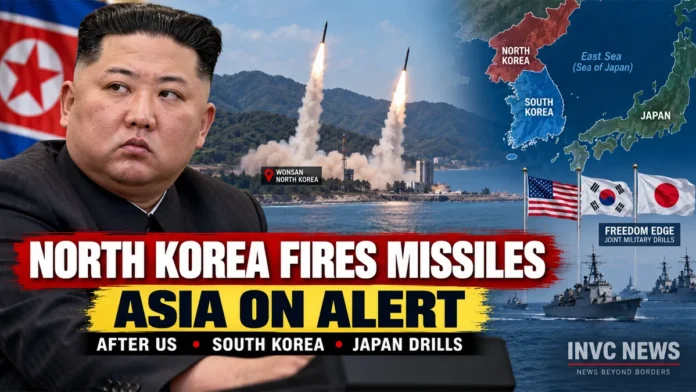
North Korea Missile Launch 2026 tensions surged Saturday after Pyongyang fired multiple short-range ballistic missiles toward the East Sea, just one day after South Korea, the United States and Japan completed a major five-day trilateral military exercise.
South Korea’s Joint Chiefs of Staff detected the launches from the Wonsan area on North Korea’s eastern coast at around 5:20 AM local time.
The missiles traveled approximately 250 kilometers before falling into the sea.
South Korean and US authorities immediately began analyzing their precise specifications, while intelligence officials shared launch information with Japan.
Seoul also increased surveillance for additional missile activity.
The timing has intensified regional concern because North Korea had explicitly condemned the three-country Freedom Edge exercise and warned that it would take countermeasures.
North Korea fires missiles from Wonsan
South Korea’s military said it detected multiple ballistic missiles leaving the Wonsan area early Saturday.
Wonsan sits on North Korea’s eastern coast and has repeatedly featured in the country’s missile-testing activities.
The weapons flew around 250 kilometers.
No confirmed damage or casualties were reported.
South Korea and the United States tracked North Korean activity from an early stage and continued analyzing the weapons after launch.
Japan also received relevant missile information through the trilateral security coordination system.
What missiles did North Korea launch?
The precise weapons involved remain under analysis.
South Korean sources indicated that North Korea may have fired weapons from its Hwasong-11 ballistic missile family alongside rounds associated with 600-millimeter multiple rocket launchers.
However, military authorities have not completed their detailed assessment.
Therefore, the exact missile model should not yet be treated as conclusively established.
The Hwasong-11 family includes short-range ballistic systems that North Korea has developed as part of its expanding tactical weapons arsenal.
The 600-mm launcher system can also fire unusually large guided projectiles over significant distances.
Both categories have attracted close attention from South Korea and the United States because of their potential role in a conflict on the Korean Peninsula.
Launch comes one day after Freedom Edge drills
The timing gives Saturday’s missile launch additional geopolitical significance.
South Korea, the United States and Japan concluded their five-day Freedom Edge exercise on Friday.
The drills took place in international waters east and south of South Korea’s Jeju Island.
Freedom Edge represents an important part of the three countries’ expanding defense cooperation.
The exercise is designed to strengthen their ability to operate together across different military domains.
North Korea sees the drills very differently.
Pyongyang has repeatedly described US-led military exercises around the Korean Peninsula as preparations for confrontation.
North Korea had warned of countermeasures
North Korean Defense Minister Kim Song-gi criticized the Freedom Edge exercise earlier this week.
He warned that Pyongyang would take what he called strong countermeasures if the United States and its allies pushed toward further military confrontation.
Saturday’s launch followed that warning.
However, North Korea had not immediately issued a detailed statement publicly linking each missile fired Saturday to a specific military objective.
The sequence nevertheless fits a familiar pattern.
Pyongyang frequently conducts weapons tests during or shortly after major exercises involving South Korea and the United States.
First ballistic missile launch in 23 days
Saturday’s launch was North Korea’s first ballistic missile test in 23 days.
Pyongyang last fired short-range ballistic missiles on August 20.
That launch took place while South Korea and the United States were conducting their annual Ulchi Freedom Shield exercise.
North Korea reportedly fired more than 10 short-range ballistic missiles during that episode.
Saturday’s action therefore continues a pattern in which Pyongyang responds to allied military exercises with weapons demonstrations.
It also marks North Korea’s 13th ballistic missile launch event this year.
South Korea calls emergency security meeting
South Korea responded quickly.
The presidential National Security Office convened an emergency security review meeting involving defense and security agencies.
Officials assessed the impact of the missile launches and reviewed the country’s readiness.
The presidential office condemned the ballistic missile activity as a violation of United Nations Security Council resolutions.
Seoul urged North Korea to immediately stop such launches.
South Korea’s military also strengthened its surveillance and vigilance posture in case Pyongyang attempts another launch.
US says no immediate threat detected
The United States also acknowledged the launch.
US Pacific Command said Washington was consulting closely with allies and partners.
Its initial assessment found no immediate threat to US personnel or territory.
The command also said it did not currently see an immediate threat to American allies from the event.
At the same time, Washington reaffirmed its commitment to defending the United States and its regional allies.
That assessment provides an important distinction.
The launch represents a serious regional security development, but current US assessments do not indicate that Saturday’s missiles were aimed at American territory or allied population centers.
South Korea, US and Japan share missile data
One of the most important changes in the regional security environment is the growing level of coordination between Seoul, Washington and Tokyo.
The three governments are now sharing information about North Korean missile activity more closely.
That cooperation allows the countries to compare radar and tracking data collected from different geographic positions.
Japan can observe missile trajectories from one direction while South Korean and US systems gather information closer to the Korean Peninsula.
Combined data can improve assessments of missile speed, altitude, range and possible weapon type.
North Korea strongly opposes this trilateral security cooperation.
Trump scaled back separate US-South Korea drills
Saturday’s launch also comes against an unusual diplomatic backdrop.
President Donald Trump recently ordered a reduction in parts of the separate US-South Korea Ulchi Freedom Shield exercise.
Trump argued that some military drills were costly and sent an unnecessarily hostile signal toward North Korea.
The move appeared designed to create space for diplomacy.
However, Pyongyang has shown little indication that it intends to respond by slowing its weapons programs.
The Freedom Edge trilateral exercise involving Japan proceeded as planned.
North Korea condemned it.
Saturday’s missile launch followed immediately afterward.
Kim Jong Un continues expanding weapons capabilities
North Korean leader Kim Jong Un has continued investing heavily in nuclear weapons and ballistic missile development.
Pyongyang has tested weapons across several ranges and categories.
These include short-range systems designed primarily for regional use as well as longer-range missiles potentially capable of reaching much farther targets.
North Korea has also worked on sea-based and tactical nuclear capabilities.
The country’s military modernization makes every new launch important to regional intelligence agencies.
Even short-range tests can provide North Korean engineers with data on guidance, launch procedures and operational reliability.
Why short-range missiles matter
Short-range ballistic missiles may not receive the same global attention as intercontinental ballistic missiles, but they pose a major concern for South Korea.
Seoul and other important military and civilian targets sit within range of several North Korean weapons systems.
Short-range missiles can also be harder to intercept when they use maneuverable trajectories or launch with little warning.
North Korea has increasingly emphasized tactical weapons that could potentially be used against military bases, ports and command facilities during a conflict.
Consequently, Seoul closely tracks even tests that do not threaten the continental United States.
Japan also faces growing security pressure
Japan has become more deeply involved in regional deterrence as North Korea expands its missile arsenal.
Tokyo has invested in missile defense and strengthened security cooperation with Washington and Seoul.
North Korean missile launches have previously passed over or near Japanese territory, reinforcing public concern.
The Freedom Edge exercise reflects this changing environment.
South Korea and Japan have historically faced difficult political relations because of disputes rooted in Japan’s colonial rule of the Korean Peninsula.
However, North Korea’s weapons programs and wider regional security concerns have encouraged closer military coordination.
China remains central to North Korea diplomacy
China remains North Korea’s most important economic and diplomatic partner.
That makes Beijing central to any serious international effort aimed at reducing tensions on the Korean Peninsula.
The latest missile launch also arrives ahead of an expected meeting between President Donald Trump and Chinese President Xi Jinping later this month.
North Korea could become one of the issues discussed.
Washington has repeatedly sought greater Chinese pressure on Pyongyang.
Beijing, meanwhile, argues that military pressure alone cannot solve the Korean Peninsula’s security problems and has called for dialogue.
Russia relationship adds another dimension
North Korea’s relationship with Russia has also deepened substantially.
Pyongyang and Moscow have expanded military and strategic cooperation while Russia’s war against Ukraine has continued.
That relationship has complicated international attempts to isolate North Korea.
It also gives Pyongyang greater strategic room as relations between Russia and Western governments remain deeply strained.
North Korea increasingly operates within a geopolitical environment in which competition between the United States, China and Russia shapes security calculations across Asia.
UN sanctions remain a point of confrontation
United Nations Security Council resolutions prohibit North Korea from conducting ballistic missile tests.
South Korea cited those resolutions when condemning Saturday’s launches.
Enforcing international pressure has become more difficult, however, because divisions among permanent Security Council members have widened.
China and Russia have frequently resisted additional sanctions on North Korea.
The United States and its allies argue that Pyongyang’s continued missile and nuclear development requires stronger deterrence.
That diplomatic deadlock leaves military signaling increasingly prominent.
Could North Korea launch more missiles?
South Korea is preparing for that possibility.
Its military said it had increased monitoring for additional launches.
Pyongyang has previously conducted multiple weapons tests within short periods, particularly during heightened tensions with Seoul and Washington.
Analysts will therefore watch North Korean military sites closely over the coming days.
Any follow-up launch involving longer-range weapons would significantly raise the level of concern.
A nuclear test or intercontinental ballistic missile launch would represent an even larger escalation.
No such development had been confirmed in connection with Saturday’s launch.
What happens next?
The immediate focus will remain on the technical analysis of the missiles.
South Korean and US authorities will attempt to determine their exact type, flight characteristics and launch pattern.
Regional governments will also watch for a formal statement from Pyongyang explaining the political message behind the test.
Meanwhile, Seoul, Washington and Tokyo are likely to continue intelligence sharing and military monitoring.
The central question is whether Saturday’s launches represent a limited response to Freedom Edge or the beginning of another sustained cycle of North Korean weapons testing.
For now, one fact is clear.
The end of the US-South Korea-Japan military exercise has not reduced tensions around the Korean Peninsula.
Instead, North Korea’s latest missile launch has put regional security back at the center of Asia’s geopolitical agenda.