GURUGRAM, India | September 10, 2026 —
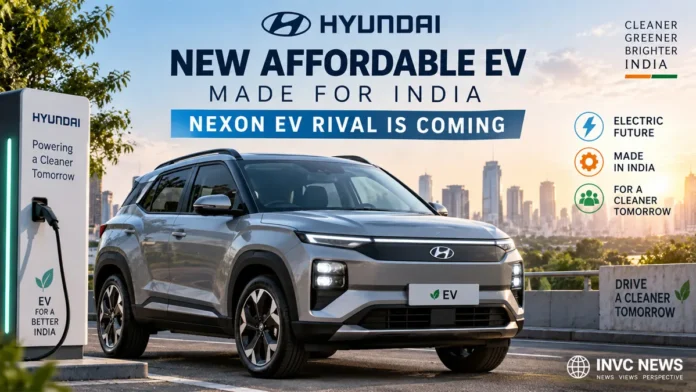
Hyundai Affordable Electric SUV is moving closer to the Indian market, with Hyundai Motor India confirming plans to launch a localized mass-market electric SUV built on a dedicated EV platform.
For Indian electric-car buyers, this could become one of Hyundai’s most important launches yet.
The company currently sells the premium IONIQ 5 and the more mainstream Creta Electric in India. Its upcoming electric SUV, however, is being developed to attack a much larger volume segment where models such as the Tata Nexon EV already compete for family buyers.
Hyundai has not announced the production model’s official name, final price or certified driving range.
Nevertheless, information surrounding the project gives buyers an increasingly clear idea of where the new EV will fit — and why it could substantially change Hyundai’s position in India’s electric-car market.
Hyundai officially confirms its next mass-market EV
Hyundai Motor India confirmed on September 9 that it plans to introduce a localized mass-market SUV EV built on a dedicated EV platform.
The wording is important.
This is not simply an electric conversion of another existing Hyundai petrol SUV.
A dedicated electric architecture allows engineers to design the vehicle around its battery, electric motors, electronics and packaging requirements from the beginning.
That can potentially improve interior space, battery placement and overall efficiency.
Hyundai has also described the vehicle as localized, a crucial factor in India’s price-sensitive automobile market.
Hyundai’s new EV could arrive before 2027
Earlier expectations pointed toward a debut by March 2027.
However, Hyundai Motor India Managing Director and CEO Tarun Garg has indicated that the compact EV could debut earlier, by the end of 2026.
That means buyers considering an electric SUV over the next several months may have another significant option to evaluate before making a purchase.
The exact commercial launch date still requires confirmation.
Until Hyundai announces the final schedule, buyers should treat the end-2026 timing as the current expected debut window rather than a guaranteed showroom-delivery date.
What will Hyundai’s affordable EV be called?
Hyundai has not announced its showroom name.
The project is widely referred to internally as HE1i.
That codename should not be confused with the final badge customers will see at dealerships.
Hyundai could introduce an entirely new nameplate for the vehicle.
The company has already said the localized dedicated EV will mark the debut of a new nameplate in its Indian portfolio.
Dedicated E-GMP (K) platform expected
Industry reporting indicates that the upcoming electric SUV is being developed on Hyundai’s E-GMP (K) architecture.
The platform is also associated with Hyundai’s smaller Inster EV sold internationally.
That does not mean the Indian vehicle will simply be an imported or rebadged Inster.
Hyundai has previously described its Indian compact electric SUV strategy as one designed, engineered and built for Indian customers.
Local adaptation could therefore play a major role in everything from suspension tuning and cabin equipment to thermal management and pricing.
Standard Range and Long Range versions expected
One of the more interesting possibilities is a two-battery strategy.
Industry reporting indicates that Hyundai’s compact EV is expected to offer Standard Range and Long Range versions.
This would make considerable sense for India.
A smaller-battery version could keep the entry price competitive for primarily urban buyers.
Meanwhile, a larger-battery variant could appeal to customers who regularly travel between cities and want greater range flexibility.
However, buyers should be careful with numbers circulating online.
Hyundai has not yet announced the final Indian battery capacities or certified driving ranges for the production model.
What about the reported 355 km range?
Some reports have linked the upcoming vehicle to a range of around 355 km because the international Hyundai Inster uses a related platform and offers different battery configurations.
That figure should not be presented as the confirmed range of Hyundai’s Indian EV.
The Indian vehicle may receive different batteries, tuning, dimensions or specifications.
Its official ARAI-certified range will only become clear when Hyundai releases production specifications.
For now, the most useful information is that multiple range configurations are expected.
Local battery sourcing could become crucial
Localization may determine whether Hyundai can price the vehicle aggressively.
Reports indicate that the new EV will initially use battery cells supplied by Svolt, while Hyundai continues working toward domestic cell sourcing from Exide.
The transition toward locally sourced batteries could eventually reduce exposure to imported components and help Hyundai control costs.
Battery packs remain one of the most expensive components in an electric vehicle.
Even relatively small reductions in battery cost can therefore materially affect the final vehicle price.
Will it be Hyundai’s cheapest EV in India?
Hyundai has officially called the upcoming model a mass-market electric SUV.
Its positioning also points below the Creta Electric.
That makes it reasonable to expect the vehicle to become Hyundai’s most accessible EV in India when launched.
But there is an important distinction.
Hyundai has not announced its price.
Therefore, claims that the vehicle will definitely cost ₹10 lakh, ₹12 lakh or another specific amount remain estimates rather than confirmed information.
The eventual entry price will depend heavily on battery size, localization, equipment and variant strategy.
Tata Nexon EV could be the key rival
The Tata Nexon EV is an obvious benchmark for Hyundai’s upcoming model.
Both target buyers who want the practicality and driving position of a compact SUV without moving into the premium-EV market.
Industry reporting also points toward competition with upcoming or emerging products such as the Mahindra XUV 3XO EV and Kia Syros EV.
That could make this one of India’s most competitive EV segments.
For buyers, greater competition should ultimately mean more choice across range, equipment and price.
Hyundai is preparing dealerships before the car arrives
Perhaps the strongest indication of Hyundai’s ambitions comes from what the company is doing beyond the vehicle itself.
Hyundai says it has already trained more than 10,000 sales personnel to assist EV customers.
More than 2,600 dealership service personnel are also trained for EV maintenance and repairs.
By the end of FY2026-27, Hyundai plans to train another 7,000-plus sales personnel and more than 5,000 service personnel.
Its target is to expand its EV-ready footprint to 820 sales touchpoints and 650 workshops.
That matters enormously for mass-market buyers.
An electric car cannot become genuinely mainstream if customers worry about where it can be serviced after purchase.
Hyundai is also expanding fast charging
Charging is another part of the strategy.
Hyundai inaugurated new 120 kW DC fast-charging stations in New Delhi as part of its World EV Day initiative.
The company currently operates 185 DC fast-charging stations across 105 cities and plans to expand its proprietary network to 600 stations by 2030.
Through partnerships with multiple charging operators, Hyundai says users can also access more than 38,000 charging points through the myHyundai app.
This infrastructure could become an important selling point when the mass-market EV reaches dealerships.
Why service network could matter as much as range
Electric-car comparisons often concentrate almost entirely on battery range.
For real owners, however, the ownership ecosystem can matter just as much.
Customers need convenient charging, trained technicians, battery diagnostics, spare parts, warranty support and roadside assistance.
Hyundai already has a large dealer presence in India.
If it can successfully make that network EV-ready, the company could address one of the biggest concerns among first-time electric-car buyers: long-term ownership confidence.
What features could buyers expect?
Hyundai has not released the complete equipment list.
Therefore, individual features should not be treated as confirmed until the production vehicle is unveiled.
However, reports suggest Hyundai intends to equip the model with its next-generation connected infotainment technology.
Safety will also be critical.
India’s compact-SUV buyers increasingly compare six-airbag availability, electronic stability control, cameras, driver-assistance systems and crash-test performance before making a decision.
Hyundai’s final specification sheet will therefore deserve close scrutiny.
Should you buy a Nexon EV now or wait for Hyundai?
This is the question that gives the upcoming vehicle real consumer relevance.
Buy now if you need an EV immediately and have found a current model that meets your budget, charging needs and required range.
The Tata Nexon EV is already established in the market, meaning buyers can evaluate actual variants, pricing, service experience and ownership feedback today.
Consider waiting if your purchase is flexible and you specifically want to compare Hyundai’s next-generation dedicated EV architecture against existing models.
Waiting could give you another meaningful option.
However, postponing a purchase solely because of speculative price or range claims would be risky.
Hyundai has not yet revealed enough final specifications to declare the upcoming SUV superior to the Nexon EV or any other rival.
Five things buyers should wait for
Before judging Hyundai’s upcoming EV, five official numbers will matter most:
Price. This will determine whether “mass-market” translates into genuinely aggressive positioning.
Battery capacity. It will reveal how Hyundai differentiates Standard and Long Range versions.
ARAI-certified range. This matters more than international range figures attached to related vehicles.
DC fast-charging speed. Faster charging can significantly improve highway usability.
Battery warranty. Long-term warranty coverage can heavily influence EV ownership confidence and resale value.
Until Hyundai reveals these details, any definitive buying verdict would be premature.
Why this EV matters for Hyundai India
Hyundai’s current electric portfolio does not yet give it the same mass-market EV presence that it enjoys in India’s conventional SUV market.
The localized compact electric SUV could change that.
Localization can potentially lower costs.
A dedicated EV platform can improve packaging.
Multiple battery choices can widen the customer base.
Hyundai’s existing dealer footprint can support service.
Meanwhile, an expanding charging network could reduce one of the biggest psychological barriers to EV adoption.
Put those elements together, and this vehicle becomes far more important than simply another electric launch.
The bottom line
The Hyundai Affordable Electric SUV is shaping up to become one of the company’s most consequential Indian launches.
Hyundai has officially confirmed that a localized mass-market SUV EV built on a dedicated platform is coming. Current information points toward a compact model positioned below the Creta Electric, with an expected debut by the end of 2026 and Standard Range and Long Range versions under consideration.
But several crucial details remain unknown.
There is no officially announced price, final battery capacity, certified range or production name yet.
That means the Nexon EV has not suddenly been beaten by a Hyundai that customers cannot yet buy.
Instead, India’s affordable electric-SUV battle is about to become much more interesting.
For buyers who can wait, Hyundai’s upcoming EV is now a vehicle worth watching very closely.