MUMBAI, India | September 10, 2026 —
Stock Market Today opens under another cloud of uncertainty as Brent crude holds above $100 a barrel, global bond yields remain elevated and investors assess the economic fallout from escalating tensions in West Asia.
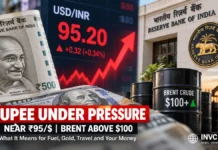
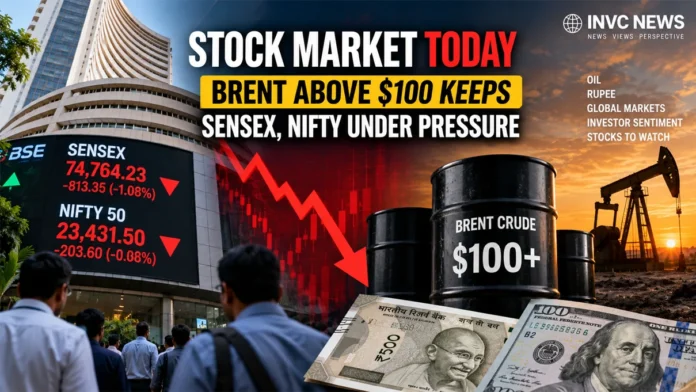
Indian equities enter Thursday’s session after a sharp sell-off on Wednesday. The Sensex dropped 813.35 points, or 1.08%, to close at 74,764.23, while the Nifty 50 fell 203.60 points, or 0.86%, to 23,431.50. The rupee also weakened to around 95.10 against the U.S. dollar as higher crude prices increased concerns about India’s import bill and inflation outlook.
The immediate question for investors is whether the market stabilizes near current levels or extends its decline as oil remains above the psychologically important $100 mark.
Brent above $100 becomes the biggest market risk
India imports more than three-fourths of its crude oil requirement, making the economy highly sensitive to sudden increases in global oil prices.
When Brent rises sharply, India pays more for energy imports. That can widen the trade deficit, pressure the rupee, raise inflation risks and squeeze margins for fuel-intensive industries.
Those concerns have returned quickly.
Brent crude has moved above $100 a barrel amid escalating geopolitical tensions and fears of supply disruption in the Middle East. The Indian crude basket has also moved sharply higher, increasing pressure across the economy.
For equity investors, the problem is not simply whether oil trades at $100 for one session. The bigger issue is how long prices remain elevated.
A prolonged oil shock can change earnings expectations across several sectors.
Sensex and Nifty face another difficult opening
Early indicators point to a cautious start.
GIFT Nifty was trading slightly lower before the market open, while major Asian indices also showed weakness. Rising U.S. Treasury yields added another layer of pressure to global risk sentiment.
The Nifty has already fallen for three consecutive sessions.
Technical traders are now closely watching the 23,300 area as an immediate support zone. If selling accelerates, the 23,070 region could become the next important level.
On the upside, the 23,500–23,600 zone may act as the first significant resistance area if the index attempts a recovery.
These levels are not guarantees. They simply indicate where traders may react more aggressively.
Rupee weakness adds to investor concern
The rupee has become another key market signal.
It closed around 95.10 against the dollar after weakening alongside rising crude prices.
A weaker rupee makes imported oil even more expensive because crude is priced internationally in U.S. dollars.
That creates a difficult combination for India: oil prices rise in dollar terms while the local currency simultaneously weakens.
If both trends persist, inflation expectations could rise further.
The Reserve Bank of India may therefore remain an important factor in currency markets over the coming sessions.
Which sectors face the most pressure?
Higher crude prices do not affect every company in the same way.
Aviation faces higher fuel costs because jet fuel forms a major part of airline operating expenses.
Paint and chemical companies may see pressure because several raw materials are linked to crude derivatives.
Logistics and transport companies face higher fuel and freight expenses.
Automobile companies may also feel indirect pressure if inflation weakens consumer spending or raises transportation costs.
Oil marketing companies deserve special attention as well. Reports indicate that current international crude levels could significantly pressure petrol and diesel marketing margins if retail fuel prices remain unchanged.
On the other hand, selected upstream energy companies may benefit from higher oil realizations depending on production, pricing and government policy.
FIIs remain cautious while DIIs provide support
Foreign institutional investors sold Indian equities worth about ₹583 crore in the previous session.
Domestic institutional investors, however, bought around ₹1,509 crore, providing some support to the market.
This pattern has become increasingly important.
Strong domestic flows can reduce the impact of foreign selling, but they may not fully offset a prolonged global risk-off environment.
Investors will therefore watch both FII and DII activity closely after today’s close.
Stocks to watch today
Several stocks are likely to attract attention because of company-specific developments.
Wipro is in focus after launching a cybersecurity command center with CrowdStrike.
IRB Infrastructure Developers reported strong growth in August toll revenue.
Dilip Buildcon has received a large LPG pipeline project.
ICICI Bank remains in focus following regulatory approval involving its asset management subsidiary.
Hindustan Zinc, Biocon, Indian Bank, Shakti Pumps and Juniper Green Energy are also among the actively watched names today.
Company-specific triggers can create opportunities even when the broader market remains weak.
India VIX signals rising nervousness
India VIX jumped 6.81% to 11.92 in the previous session.
That still does not represent extreme volatility, but the direction matters.
A sustained rise toward the 12–13 zone would indicate growing uncertainty among traders and could amplify intraday swings.
For retail investors, this means larger price movements may become more common.
What investors should watch today
Five indicators matter most during Thursday’s session:
Brent crude: Any move toward $102–$105 could increase pressure on Indian equities.
Rupee-dollar: Further weakness in the rupee could raise concerns about inflation and foreign flows.
Nifty 23,300: A decisive break below this area could attract additional selling.
Banking stocks: Banks remain critical because of their large weight in benchmark indices.
Foreign flows: Continued FII selling may limit any recovery.
The market may also react sharply to fresh geopolitical headlines throughout the day.
Can the market recover?
A recovery remains possible.
Indian equities have already absorbed several sessions of selling, and domestic institutional buying continues to provide support.
If crude prices ease, the rupee stabilizes and global bond yields retreat, investors may attempt a rebound.
But the near-term environment remains fragile.
For now, the biggest market variable is no longer corporate earnings alone.
It is energy.
As long as Brent crude remains above $100, Stock Market Today will remain closely tied to developments in the Middle East, currency markets and global bond yields.