MUMBAI, India | September 10, 2026 —
Rupee Record Low Today remains one of the biggest risks facing Indian financial markets as the currency heads into Thursday under renewed pressure from crude oil above $100 a barrel, dollar demand and rising global bond yields.
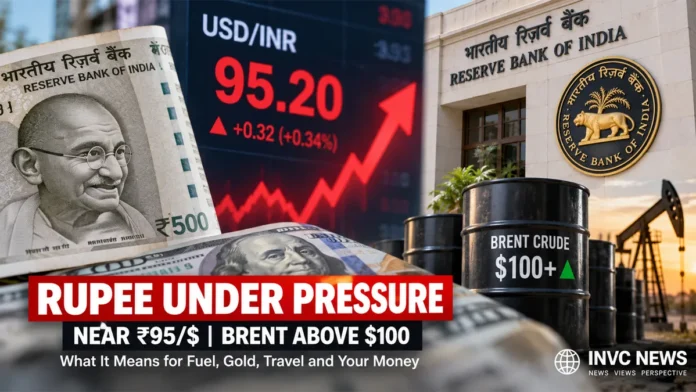
Currency traders expect the rupee to open around ₹95.15-₹95.20 against the U.S. dollar, after it settled at ₹95.1050 on Wednesday. The currency has lost roughly 0.7% over the past two sessions as expensive crude begins to exert much greater pressure on India’s foreign-exchange market.
The Reserve Bank of India has been active in the currency market, according to traders, but intervention has so far appeared more effective at controlling the speed of depreciation than reversing the broader pressure.
For households, this is no longer merely a forex-market story.
A persistently weaker rupee can eventually influence the cost of imported fuel, electronics, overseas education and foreign travel. It can also complicate India’s inflation outlook if high crude prices persist.
Rupee came under heavy pressure on Wednesday
The warning signs were already visible in Wednesday’s trading.
The rupee dropped as far as ₹95.2250 per dollar before recovering after traders reported likely RBI intervention. It eventually settled at ₹95.1050.
Bankers and traders said the central bank appeared to step into the market as rising crude prices and dollar outflows increased pressure on the currency.
The important development is not simply that the rupee weakened.
Its sensitivity to crude oil has increased.
For several earlier sessions, the Indian currency had shown surprising resilience despite rising energy prices. That protection now appears to be fading.
Brent crude above $100 changes the equation for India
Oil is the central problem.
Brent crude was trading around $101.34 per barrel early Thursday, while U.S. West Texas Intermediate stood near $96.55.
Oil markets have surged as the Iran-U.S. conflict creates growing fears of prolonged disruption to energy supplies through the Persian Gulf.
The Strait of Hormuz is particularly important because, before the current conflict, roughly one-fifth of global oil and gas supplies passed through the waterway.
For an oil-import-dependent economy such as India, sustained prices above $100 create several problems simultaneously.
India needs more dollars to pay its energy import bill. That increases demand for the U.S. currency and can put additional pressure on the rupee.
Expensive crude can also raise inflation risks and hurt corporate margins.
RBI intervention is helping — but there are limits
The RBI does not generally defend one publicly declared exchange-rate level.
Instead, the central bank can intervene to contain excessive volatility and disorderly market movements.
Traders reported state-run banks selling dollars during recent sessions, activity widely interpreted as intervention on behalf of the RBI.
On Wednesday, the rupee recovered sharply from its intraday low after the central bank was believed to have entered the market.
However, intervention cannot completely eliminate the effect of a prolonged global oil shock.
If Indian companies continue requiring more dollars for energy imports while foreign capital leaves domestic markets, fundamental demand for dollars can remain elevated.
That is why traders are watching the ₹95 level so closely.
What does a weaker rupee mean for petrol and diesel?
This is the first question many households will ask.
A weaker rupee makes imported crude more expensive in local-currency terms because oil is predominantly priced internationally in dollars.
Suppose crude prices remain unchanged in dollars.
If the rupee weakens, Indian refiners still have to spend more rupees to buy the same dollar-denominated barrel.
When both things happen simultaneously—oil rises and the rupee falls—the pressure becomes considerably stronger.
That does not mean petrol and diesel prices will automatically rise immediately.
Retail fuel pricing also depends on taxes, refining margins, marketing-company decisions and government policy.
Therefore, consumers should not interpret ₹95 per dollar as a guarantee of an imminent fuel-price increase.
It does, however, increase the underlying cost pressure.
Could gold become more expensive?
A weaker rupee can support domestic gold prices because India imports most of its gold requirements.
International gold prices are normally quoted in U.S. dollars.
Consequently, even if the global gold price remains relatively stable, a weaker rupee can increase the price Indian importers pay.
Domestic gold prices are also influenced by import duties, taxes, global interest rates and safe-haven demand.
So the rupee is important, but it is not the only variable.
Foreign travel becomes more expensive
International travellers feel currency depreciation much more directly.
When one dollar costs more rupees, dollar-denominated expenses become more expensive for an Indian traveller.
Hotels, meals, local transport, shopping and other overseas costs can rise in rupee terms even if the foreign price itself does not change.
For example, a $1,000 expense costs ₹95,000 at an exchange rate of ₹95 per dollar before card charges and other conversion costs.
At ₹90 per dollar, the same $1,000 would cost ₹90,000.
That difference becomes substantial on a long international trip.
Students studying abroad could face higher costs
Indian families paying tuition fees overseas face a similar problem.
University fees denominated in dollars, pounds or other foreign currencies become more expensive in rupee terms when the Indian currency weakens against them.
Living expenses can also rise.
Students and families preparing large foreign-currency payments should therefore watch exchange rates rather than focusing only on the headline tuition amount.
Banks and forex providers can also charge conversion spreads and transaction fees, making the effective exchange rate different from the interbank rate seen in financial markets.
What about imported iPhones, laptops and electronics?
A weaker rupee can raise the cost of imported electronics or components.
However, consumers should not expect smartphone and laptop prices to change every time the currency moves.
Companies frequently hedge currency exposure, maintain inventories purchased at earlier exchange rates and adjust pricing based on competitive conditions.
A short-lived currency decline may therefore have little visible effect.
A sustained depreciation is more significant.
If the rupee remains weak for months, manufacturers importing components or finished devices may eventually face higher costs.
Will home-loan EMIs rise because the rupee is falling?
Not directly.
Home-loan EMIs do not automatically increase because the rupee crosses ₹95 against the dollar.
The indirect connection runs through inflation and monetary policy.
If expensive oil and a weaker currency create sustained inflationary pressure, the RBI may have less room to maintain accommodative interest rates.
That can influence borrowing costs over time.
But a single day of rupee weakness is not enough to conclude that home-loan rates will rise.
Borrowers should watch RBI policy decisions and their lender’s benchmark rate rather than the USD-INR rate alone.
Import-heavy companies face pressure
The corporate impact can vary significantly.
Businesses that import crude oil, chemicals, electronics, machinery or other dollar-priced inputs can face higher costs when the rupee depreciates.
Companies may absorb those costs and accept lower margins.
Others may eventually pass some of the increase to customers.
Exporters can experience the opposite effect.
Companies earning substantial revenue in dollars may receive more rupees when they convert foreign earnings into the domestic currency.
That means IT services and some export-oriented businesses can receive a currency benefit, although company-specific hedging arrangements can change the final impact.
Global bond yields add another problem
Oil is not the only pressure point.
The U.S. 10-year Treasury yield has climbed to its highest level since 2023.
Higher U.S. yields can make dollar-denominated assets more attractive and create additional pressure on emerging-market currencies.
Meanwhile, global investors are awaiting fresh U.S. inflation readings ahead of the Federal Reserve’s September 15-16 meeting.
Markets are also watching central-bank decisions in Europe and Japan.
This combination means the rupee is being influenced by oil, geopolitics, foreign investment flows and global interest-rate expectations at the same time.
₹95.20 is not a guaranteed destination
Consumers and investors should be careful with exchange-rate predictions.
The ₹95.15-₹95.20 range represents traders’ expectation for Thursday’s opening, not a guaranteed closing level.
Currency markets can move rapidly.
A fall in oil prices, renewed foreign investment inflows, a weaker dollar or stronger RBI intervention could help the rupee recover.
Further geopolitical escalation could produce the opposite outcome.
That is why INVC NEWS will avoid presenting ₹96, ₹99 or ₹100 as an inevitable next target without credible supporting evidence.
What should consumers do?
Most households do not need to react to a one-day currency move.
People planning overseas travel, tuition payments or large dollar-denominated purchases have a stronger reason to monitor exchange rates.
Businesses dependent on imported inputs may also need to review currency exposure.
Investors should avoid assuming that every company benefits or suffers equally from rupee depreciation.
The impact depends heavily on whether a business imports, exports, borrows in foreign currency or uses hedging contracts.
What to watch today
Three indicators deserve particular attention.
First, the rupee itself. A sustained move beyond Wednesday’s ₹95.2250 intraday low would indicate renewed selling pressure.
Second, Brent crude. Oil holding above $100 for an extended period matters much more to India than a brief intraday spike.
Third, RBI activity. Traders will closely watch state-run banks for signs of additional dollar selling.
Global yields and foreign portfolio flows will provide the broader context.
The bottom line
The Rupee Record Low Today story is ultimately about the combination of two pressures: India is paying more dollars for expensive oil at precisely the time when each dollar is becoming more costly in rupee terms.
RBI intervention can reduce disorderly volatility, but it cannot permanently isolate the currency from global energy prices and capital flows.
For ordinary households, there is no reason for panic.
Petrol prices do not automatically rise because USD-INR moves above ₹95. Home-loan EMIs do not immediately change. Electronics companies do not reprice their products every morning.
But if Brent remains above $100 and the rupee stays weak for a prolonged period, the effects can gradually travel from the currency market into India’s import bill, inflation and household expenses.
That is the risk worth watching now.