By Team INVC | INVC NEWS
MUMBAI, India | September 9, 2026 —
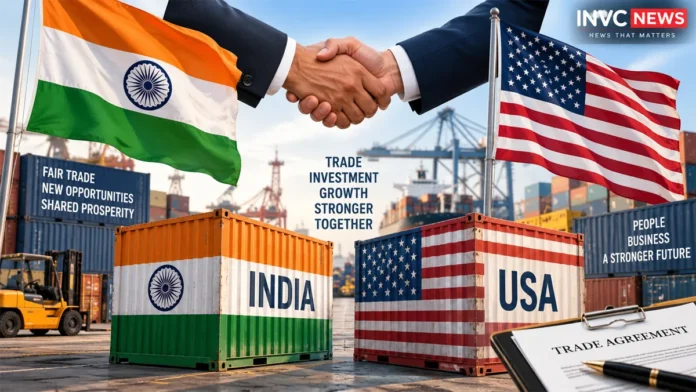
India US Trade Deal negotiations have entered their most advanced stage yet, with Commerce Secretary Rajesh Agrawal saying the proposed agreement is “more or less” finalized as New Delhi and Washington work to build a framework that gives businesses preferential access to each other’s markets.
Speaking to reporters on the sidelines of the Global Fintech Fest 2026 in Mumbai on Wednesday, Agrawal said only a limited number of issues remain under discussion.
However, he stopped short of announcing a signing date.
The agreement, he said, will be formally signed at an appropriate time once the remaining discussions are completed.
The latest comments mark an important step in negotiations between two of the world’s largest economies and could have significant implications for exporters, manufacturers, technology companies and investors on both sides.
India and US Work on Preferential Market Access
The central issue now is how India and the United States will create meaningful tariff advantages for businesses operating under the agreement.
Agrawal explained that India largely works within a Most Favored Nation, or MFN, tariff structure.
The United States, meanwhile, is currently using a system that includes executive tariffs.
Because the two tariff structures differ, negotiators need to create an architecture that produces a clear preferential advantage for products covered by the proposed agreement.
In practical terms, preferential market access could allow qualifying Indian goods to enter the US market on more favorable terms than products from countries without similar arrangements.
US exporters could receive comparable benefits when selling eligible products in India.
Exactly which products receive concessions and the extent of any tariff reductions will depend on the final negotiated text.
Some Issues Still Remain Under Discussion
Despite the progress, Agrawal made it clear that negotiations have not formally concluded.
A few subjects remain under discussion between the two governments.
That distinction is important.
The Commerce Secretary’s comments signal that the broad architecture has largely taken shape, but they do not mean the agreement has already been signed or entered into force.
Businesses will therefore need to wait for the final agreement before assessing the exact tariff concessions, product coverage, implementation dates and rules governing preferential access.
Businesses Already Engaging Across Both Markets
Agrawal said business communities in India and the United States are already engaging actively and appear satisfied with the broad understanding reached between the two governments.
A successful trade framework could potentially deepen commercial ties between the countries by improving market access and reducing some of the tariff disadvantages faced by exporters.
India and the US have substantial economic links spanning goods, technology, services, investment, digital trade and supply chains.
A preferential trade arrangement could add another layer to that relationship if the final agreement creates commercially meaningful tariff differentials.
India-Chile Trade Talks Also Reach Advanced Stage
India is simultaneously pushing forward with other major trade negotiations.
Agrawal said negotiations with Chile have reached an advanced stage, although several issues remain unresolved.
He indicated that the next two to three months could produce significant progress.
India already has a Preferential Trade Agreement with Chile, and the two sides have been working toward a deeper economic arrangement that would expand market access.
Critical minerals, agricultural products and broader tariff access have emerged as important areas in the discussions.
For India, stronger trade ties with Chile also carry strategic importance because of the South American country’s role in global mineral supply chains.
India-New Zealand FTA Could Go Live Soon
The Commerce Secretary also said India wants to operationalize its Free Trade Agreement with New Zealand as quickly as possible.
October could emerge as an important month for implementation.
The agreement is expected to significantly expand market access for Indian exporters while strengthening investment and economic cooperation between the two countries.
Once operational, businesses will be able to begin using the tariff preferences and market-access provisions contained in the agreement.
Government Tackles Rising Freight and Container Costs
Agrawal also addressed concerns over rising global freight costs.
Higher shipping charges can hurt export competitiveness, particularly for businesses dealing in low-margin products or shipping large volumes over long distances.
The government, he said, is working with exporters to ensure adequate availability of ships and containers while reducing cargo delays and logistics expenses.
Despite the pressures, Indian exports have maintained strong momentum.
Agrawal said exports grew by more than 15% during the first four months of the current financial year.
The performance suggests that higher freight costs have not yet caused the scale of disruption initially feared.
India Recorded $863 Billion in Exports in FY26
India entered the current financial year after posting a record export performance.
Total merchandise and services exports reached approximately $863 billion in FY 2025-26.
Services contributed about $421 billion, while merchandise exports accounted for roughly $442 billion.
The numbers highlight the increasingly important role of services in India’s external trade.
However, the government sees concentration within services exports as a long-term challenge.
Services Exports Need Greater Diversification
Agrawal said India cannot rely indefinitely on a narrow group of service industries if it wants to maintain sustainable export growth.
Information technology and IT-enabled services account for roughly half of India’s services exports.
Professional services contribute another substantial share.
Together, these segments form the two main pillars of India’s services export economy.
That strength has helped India build a major presence in global services trade, but excessive dependence on a small number of sectors can also create vulnerability.
Agrawal said India now needs to diversify into additional areas to achieve long-term growth.
Fintech Could Become India’s Next Big Export Opportunity
Financial technology represents one of those opportunities.
India has already built large-scale capabilities in digital payments, lending, insurance technology and trade finance.
The government believes Indian fintech companies can increasingly take those capabilities to international markets, particularly countries across the Global South.
Agrawal pointed to a large gap between the size of the global financial-services market and India’s current share.
That gap gives Indian companies room to expand if they can successfully export digital financial infrastructure, technology and services.
What Happens Next in India-US Trade Talks?
For markets and businesses, attention will now shift to three questions.
First, when will India and the United States formally sign the agreement?
Second, which products and sectors will receive preferential treatment?
And third, how large will the tariff advantage be compared with existing rates?
Those details will determine the agreement’s real commercial impact.
For now, however, the message from New Delhi is clear: negotiations have moved well beyond exploratory discussions.
The India US Trade Deal is approaching the finish line, with preferential market access now at the center of the final-stage negotiations.