NEW DELHI, India | September 8, 2026 —
India Food Safety Crackdown has entered a new and far more aggressive phase as regulators intensify inspections, shut businesses, cancel licences and push for prominent warning labels on packaged foods high in sugar, salt and saturated fat.
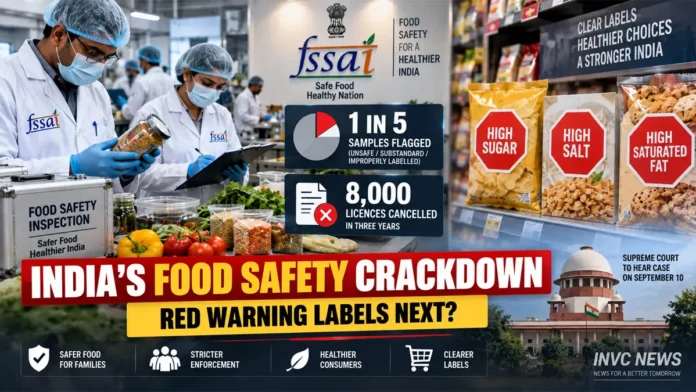
Government data reviewed as part of the latest regulatory assessment shows that food inspectors have tested more than 100,000 samples every year since 2020, with roughly one in five samples found unsafe, substandard or improperly labelled.
At the same time, authorities have cancelled nearly 8,000 food business licences during the last three years, highlighting the scale of enforcement now taking place across restaurants, food factories, warehouses and other businesses.
The crackdown is unfolding alongside another major consumer battle: whether packaged foods containing excessive levels of sugar, salt or saturated fat should carry a clear red warning symbol on the front of the pack.
The issue is now heading back to the Supreme Court, which is expected to review the proposed warning-label framework on September 10.
Why Food Safety Has Suddenly Become a National Issue
India’s food market operates at enormous scale.
More than 1.4 billion people collectively consume an estimated 1.5 trillion meals every year, making food safety enforcement one of the most complex regulatory challenges in the world.
Consumers have long raised concerns about hygiene at restaurants, street-food outlets and food-processing facilities.
Food adulteration scandals also frequently spread across social media, placing pressure on regulators to respond more visibly and quickly.
Now, authorities appear to be moving beyond routine inspections.
FSSAI and state food regulators are increasingly releasing photographs, inspection videos and details of enforcement operations, giving consumers a direct look at hygiene failures and adulteration cases.
That public-facing strategy has also increased awareness of food safety rules.
One in Five Samples Raises Red Flags
The most striking figure comes from official inspection data.
Since 2020, regulators have tested more than 100,000 food samples annually.
Approximately 20% have been classified as unsafe, substandard or not properly labelled.
That does not mean one in every five food products sold across India is dangerous.
The tested samples are not necessarily a random representation of everything consumers eat.
Inspectors often collect samples where they suspect violations or conduct targeted enforcement campaigns.
Still, the failure rate is significant enough to explain why regulators have stepped up action.
Nearly 8,000 Food Business Licences Cancelled
Authorities have also cancelled close to 8,000 food business licences in three years.
Licence cancellation is among the strongest regulatory actions available because it can prevent a business from legally continuing food operations.
Other actions can include temporary suspension, fines, product seizure, prosecution or instructions to correct hygiene and labelling violations.
The surge in enforcement suggests regulators are increasingly willing to act against both small operators and established food businesses when they find violations.
1,300 Kg Paneer Seized in Major Raid
One recent enforcement operation demonstrated the scale of the problem.
Food safety inspectors in Uttar Pradesh seized approximately 1,300 kg of suspected adulterated paneer from an unhygienic facility.
Paneer is consumed extensively across India, particularly among vegetarian households, restaurants and catering businesses.
Cases involving adulterated milk products attract particular concern because the products can enter large distribution networks before reaching consumers.
The regulator has increasingly highlighted such operations publicly to warn businesses and reassure consumers that inspections are intensifying.
Big Restaurant Chains Also Face Surprise Checks
The crackdown is not limited to roadside food stalls or small factories.
Authorities have also conducted inspections involving major restaurant chains and premium establishments.
Maharashtra Food Commissioner Tukaram Mundhe has attracted major public attention for surprise inspections across restaurants and food businesses.
Inspections in Maharashtra have included outlets operated by major fast-food chains as well as upscale clubs and restaurants.
The aggressive inspection model has received considerable public attention because consumers often assume branded restaurants automatically maintain higher food-safety standards.
Regulators are signalling that brand size does not exempt businesses from compliance requirements.
Fake Expiry Labels Raise Another Serious Concern
Another recent investigation focused on a warehouse where authorities found food products allegedly being relabelled with altered expiry dates and nutritional information.
The products involved packaging associated with major global food and beverage companies.
Authorities were examining whether expired or near-expiry goods were being made to appear suitable for export.
The companies whose brands appeared on the products have said they were not involved in or did not authorize the alleged relabelling operation.
The case has drawn international attention because Canadian authorities have assessed whether any affected goods may have entered their market.
The episode demonstrates that food-safety enforcement now extends beyond contamination and hygiene.
Regulators are also targeting food fraud, misleading labels and manipulated expiry information.
Red Warning Labels Could Change Packaged Food Shopping
The next major shift could happen directly on supermarket shelves.
FSSAI has proposed prominent red hexagonal warning labels for packaged foods containing high levels of selected nutrients.
Under the current proposal, the warning would apply when a product exceeds prescribed thresholds in at least two of three categories:
- Added sugar
- Salt
- Saturated fat
The aim is to give consumers a simple visual warning without requiring them to study a detailed nutrition table on the back of the package.
For shoppers, that could fundamentally change how packaged snacks, drinks and processed foods are compared.
Why Health Groups Say the Proposal Is Too Weak
Public-health advocates argue that the proposed rule contains a major loophole.
Under the current first-phase structure, a product that is extremely high in only one concerning nutrient may avoid the red warning if it does not exceed limits for a second nutrient.
For example, critics argue that a product very high in added sugar could still pose significant health concerns even if its salt and saturated-fat levels remain below the threshold.
A nonprofit group has challenged the proposed approach before the Supreme Court.
The petition argues that warning labels should appear when even one concerning nutrient exceeds the relevant limit.
The Supreme Court is expected to examine the issue on September 10.
Food Industry Says Rules Could Go Too Far
Food manufacturers are pushing from the opposite direction.
Industry representatives argue that the proposed thresholds may be too strict.
They fear a very large proportion of packaged foods could receive warning labels, potentially affecting consumer perception and sales.
Sugar, salt and fat are also important ingredients in many traditional Indian foods and packaged versions of familiar snacks.
Manufacturers therefore want regulators to ensure that the thresholds reflect realistic consumption patterns and serving sizes.
This has created an unusual situation.
Health advocates say the proposed labels are not strict enough.
Food companies say they may be too strict.
The Supreme Court will now consider a policy that both sides believe requires significant changes.
India’s Packaged Food Market Is Worth More Than $100 Billion
The debate carries enormous commercial implications.
India’s packaged food and beverage sector is valued at more than $100 billion and continues to expand as urbanization, e-commerce and modern retail change eating habits.
Major domestic and international companies compete across snacks, soft drinks, instant foods, dairy products, confectionery and ready-to-eat products.
A front-of-pack warning system could influence purchasing decisions across this entire market.
Companies could also respond by reformulating products to reduce sugar, salt or saturated fat and avoid warning labels.
That is exactly what public-health advocates hope stronger labels will encourage.
Why Chile Is Being Cited in India’s Debate
Supporters of stronger labels frequently point to Chile.
Chile introduced prominent front-of-pack warnings for products high in nutrients of concern.
Research following the change recorded a substantial decline in purchases of sugary drinks.
Health experts argue that simple symbols can influence behavior more effectively than complicated nutritional tables.
India, however, has a very different food market, enormous regional diversity and a large informal food sector.
That means policymakers must design a system that works not only on paper but also across millions of retail outlets.
Second Phase Could Become Tougher
The government has indicated that the warning-label framework could become stricter in a later phase.
Under a future version, individual warnings could potentially apply separately to each nutrient of concern.
That would mean a food high in sugar could carry a sugar warning even if its salt and saturated-fat levels remained below prescribed limits.
However, no firm timeline has been announced for that second stage.
For now, the Supreme Court’s response could determine how quickly the rules move forward and whether the first-phase design changes.
What Should Consumers Check Right Now?
The proposed red labels have not yet become a universal requirement across packaged foods.
Until any final regulation takes effect, consumers still need to read existing nutrition information carefully.
Key information includes:
Added sugar: Check how much sugar is present per serving and per 100 grams or milliliters.
Sodium: High sodium intake can accumulate quickly when several processed foods are consumed in the same day.
Saturated fat: Compare products rather than relying only on promotional claims on the front of the package.
Serving size: A small serving size can make calorie, sugar or sodium numbers appear lower than the amount a person may actually consume.
Consumers should also check manufacturing and expiry dates and examine packaging for signs of tampering.
Why September 10 Matters
The Supreme Court hearing scheduled for September 10 could become the next major turning point.
The court has already questioned delays surrounding front-of-pack warning labels and emphasized the public-health importance of clear consumer information.
The next hearing may provide greater clarity on whether the proposed two-nutrient trigger is acceptable or whether regulators need to strengthen the framework.
Any major court direction could affect packaged-food manufacturers across India.
India’s Food Safety Drive Is Moving Beyond Raids
The India Food Safety Crackdown is therefore becoming much larger than a series of restaurant inspections.
It now involves four major fronts:
Hygiene enforcement.
Food adulteration.
Fake or misleading labelling.
Nutrition warnings on packaged food.
That combination could significantly change both the way food businesses operate and the way consumers make purchasing decisions.
The immediate numbers are striking: more than 100,000 samples tested each year, roughly one in five raising compliance concerns and almost 8,000 licences cancelled over three years.
But the bigger change could still be ahead.
If prominent red warning labels become mandatory, Indian consumers may soon see sugar, salt and saturated-fat warnings directly on the front of many everyday packaged foods.
And with the Supreme Court preparing to examine the issue again, the next chapter in India’s food-safety push could begin within days.