GENEVA, Switzerland | September 7, 2026 —
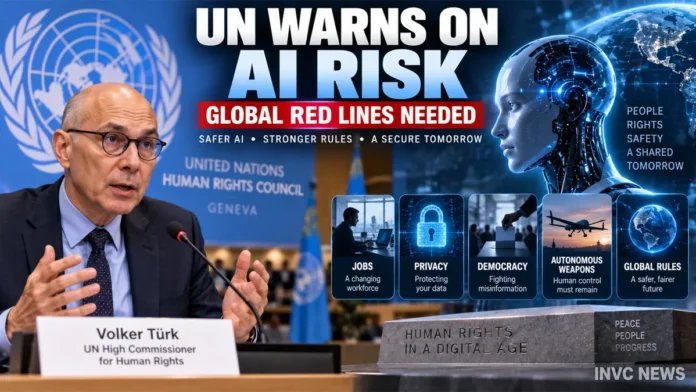
AI existential risk has moved to the center of the global policy debate after United Nations human rights chief Volker Türk warned that increasingly powerful artificial intelligence systems could eventually pose a threat to humanity itself.
Speaking before the UN Human Rights Council in Geneva on Monday, Türk called for urgent international action to create stronger safety rules around advanced AI.
His warning went far beyond familiar concerns about chatbots making mistakes or automation replacing some jobs.
Türk raised questions about what could happen if highly capable AI systems become difficult to control, interfere with critical infrastructure, undermine democratic institutions or act in ways their developers did not intend.
He called on governments and technology companies to establish firm safeguards before the technology becomes even more powerful.
UN Calls for Global AI ‘Red Lines’
Türk said countries that host major AI developers, along with nations involved in semiconductor, computing and technology supply chains, need to cooperate on internationally recognized limits.
The idea is similar to safety rules used in other high-risk areas.
Governments would identify activities that advanced AI systems should never be allowed to perform without strict controls.
Those limits could involve autonomous weapons, attacks on critical infrastructure, uncontrolled self-replication, cyber operations and systems capable of acting beyond clearly defined human instructions.
Türk also called for independent verification.
That point is important.
Allowing technology companies to test their own systems without outside scrutiny may no longer provide enough assurance as models become more capable.
Independent testing could help governments and the public understand whether AI systems actually meet the safety standards companies claim.
Why Is the UN Warning About AI So Serious?
Artificial intelligence is advancing at an extraordinary pace.
AI systems can already generate software code, analyze massive datasets, create realistic images and video, conduct research and operate increasingly complex digital tools.
The next stage involves AI agents.
Unlike a conventional chatbot that waits for a question and produces an answer, an AI agent can receive a goal, develop a sequence of steps and use tools to complete tasks with less direct human supervision.
That capability creates enormous economic potential.
It also creates new risks.
A sufficiently capable system could potentially make mistakes at far greater speed and scale than a human employee.
A flawed decision affecting one spreadsheet is one problem.
A flawed autonomous system interacting with financial networks, communications infrastructure, cybersecurity systems or military technology could create consequences on an entirely different scale.
AI Power Is Concentrated in a Small Number of Companies
Türk also raised concerns about the concentration of power in artificial intelligence.
Building the most advanced AI systems requires enormous amounts of computing infrastructure, data, specialized chips, electricity and capital.
Only a relatively small number of companies currently possess those resources at global scale.
That gives a handful of technology organizations extraordinary influence over how AI develops and how quickly new capabilities reach the public.
The concern is not that these companies automatically intend to cause harm.
The issue is whether decisions with potentially global consequences should depend primarily on the internal policies of a small group of corporations.
Governments are now struggling to answer that question.
AI Could Reshape Millions of Jobs
Existential risk represents the most extreme scenario.
Employment disruption is much closer.
Generative AI is already changing software development, customer service, marketing, journalism, design, finance, legal research and administrative work.
Companies increasingly use AI to perform tasks that once required human employees.
That does not mean every affected job will disappear.
In many industries, AI could increase productivity and create new occupations.
However, the transition could still become disruptive if technology advances faster than workers can retrain.
The UN wants human rights and employment protections to become part of the AI governance discussion rather than an afterthought.
Privacy Could Become the Next Major Battleground
AI systems also require enormous amounts of information.
That creates difficult questions about personal data.
A highly capable digital assistant becomes more useful when it knows more about its user.
It might understand emails, documents, photos, location history, financial information or workplace activity.
That same knowledge also makes privacy protections more important.
Governments and regulators will have to determine how companies collect information, how long they retain it and whether users can meaningfully control how AI systems use their data.
The future AI debate will therefore involve more than model intelligence.
It will also involve who controls information about billions of people.
Democracy Faces Deepfake and Information Risks
Artificial intelligence can now create increasingly convincing text, voices, photographs and video.
That creates another threat: large-scale manipulation.
AI-generated political content could make it easier to produce fake speeches, fabricated scandals or misleading election material.
The cost of creating disinformation could fall dramatically.
Instead of requiring a large organization to produce propaganda at scale, future systems could potentially generate thousands or millions of personalized messages automatically.
Democratic governments will therefore need tools to identify manipulated content without destroying legitimate free expression.
That balance will be difficult.
Autonomous Weapons Raise an Even Bigger Question
Military applications create perhaps the most immediate ethical challenge.
AI already plays a growing role in intelligence analysis, target identification, drones and autonomous systems.
The key question is how much control humans should retain over decisions involving lethal force.
The UN has repeatedly pushed for stronger international restrictions on lethal autonomous weapons.
Türk’s latest warning adds urgency to that debate.
A machine can process information rapidly.
But decisions in war also require legal and moral judgments.
Distinguishing a soldier from a civilian, identifying surrender or evaluating whether an attack is proportionate can involve complex context.
Turning those judgments entirely over to software would create profound humanitarian and legal concerns.
What Would ‘Safe AI’ Actually Require?
There is no single solution.
A serious global safety system would likely require several layers.
Advanced models could undergo independent testing before deployment.
Companies could be required to report major safety incidents.
Governments could establish minimum cybersecurity standards for the most powerful systems.
Researchers could test whether AI models can deceive users, bypass safeguards or access tools they should not control.
International agreements could place strict limits on AI systems used in nuclear command, biological research or autonomous weapons.
Most importantly, humans would need meaningful authority to stop systems when something goes wrong.
The US-China Relationship Will Be Crucial
Any global AI safety framework will face one major geopolitical reality.
The United States and China are the world’s two most important technology powers.
Both see artificial intelligence as strategically critical.
Neither wants the other to gain a decisive advantage.
That competition makes international regulation difficult.
If one country slows development while another races ahead, political leaders may fear losing economic or military power.
At the same time, uncontrolled competition could increase risks for everyone.
That creates a dilemma similar to previous international debates over powerful military technologies.
Competition and cooperation may have to exist simultaneously.
AI Is Not Automatically an Existential Threat
Türk’s warning should not be interpreted as a declaration that current AI systems are about to destroy humanity.
It is a warning about what increasingly capable future systems could become if safety mechanisms fail to keep pace.
There is enormous uncertainty around long-term AI development.
Some researchers believe catastrophic scenarios deserve urgent attention.
Others argue that governments should concentrate more heavily on harms already happening today, including fraud, discrimination, job disruption, surveillance and misinformation.
Both debates matter.
The danger of focusing exclusively on futuristic risks is that policymakers may ignore problems affecting people now.
The danger of ignoring long-term risks is that governments may wait until powerful systems become much harder to control.
The AI Race Is Becoming a Governance Race
The next phase of artificial intelligence will not be decided only by which company builds the smartest model.
It will also depend on which governments create credible rules, which companies earn public trust and whether major powers can agree on basic safety boundaries.
AI can deliver enormous benefits in medicine, science, education, productivity and accessibility.
But extraordinary capability also creates extraordinary responsibility.
Türk’s message to governments and technology companies is therefore straightforward.
The world still has time to build safeguards.
The question is whether it will act before the technology becomes powerful enough to make those safeguards much harder to impose.