WASHINGTON, United States | September 8, 2026 —
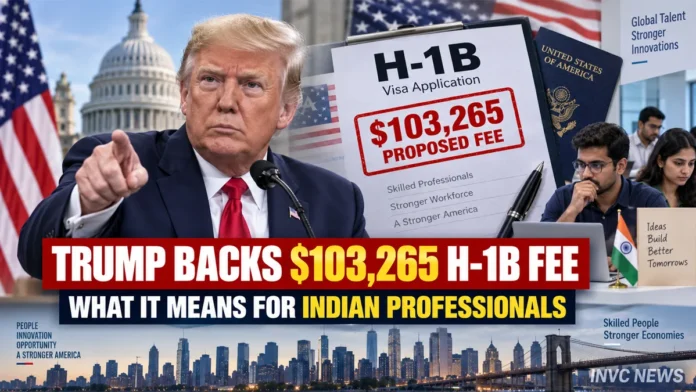
Trump H-1B Visa Fee policy returned to the center of the US immigration debate after President Donald Trump used his Labor Day proclamation to promote a proposed new fee on H-1B visa petitions, arguing that American companies should invest in US workers before looking overseas for skilled labor.
The proposal has major implications for technology companies, employers that depend on specialized foreign talent and Indian professionals, who have historically represented the largest group of H-1B beneficiaries.
However, one distinction is critical: the proposed $103,265 fee is not currently in effect.
The Department of Homeland Security has proposed the charge through the federal rulemaking process. Employers are not required to pay the new amount simply because President Trump endorsed the policy in his Labor Day message.
Trump Puts H-1B Policy at Center of Labor Day Message
President Trump formally proclaimed September 7, 2026, as Labor Day and used the occasion to outline his broader economic strategy centered on American manufacturing, tariffs, domestic investment and worker protection.
Within that message, he also highlighted the H-1B visa program.
Trump said his administration was proposing a new H-1B petition fee designed to encourage companies to invest in qualified American workers before recruiting labor from overseas.
The inclusion of H-1B visas in a Labor Day proclamation gave the politically sensitive immigration program a prominent place in the administration’s wider “American worker” agenda.
Trump also credited tariffs and trade policies with encouraging companies to bring investment and manufacturing activity back to the United States.
He said companies were investing trillions of dollars in the US economy and adding more than 900,000 American jobs.
What Is the Proposed $103,265 H-1B Fee?
The Department of Homeland Security published a proposed rule on August 25 that would establish an additional $103,265 filing fee for H-1B petitions subject to the annual numerical cap.
The proposed charge would apply when an employer files a cap-subject H-1B petition.
It would also cover petitions filed under the advanced-degree exemption, commonly known as the US master’s cap.
The proposed fee would come on top of other applicable immigration filing fees and payments.
Most importantly, the employer filing the petition would face the charge. It is not a $103,265 bill automatically imposed on an individual H-1B worker.
New Fee Is Not Yet in Force
Employers and prospective H-1B applicants should not confuse the proposed rule with a final regulation.
DHS is still conducting the formal notice-and-comment rulemaking process.
The public comment period remains open until September 24, 2026.
Until DHS completes that process and publishes a final rule with an effective date, the proposed $103,265 amount does not become a mandatory filing charge.
That means employers filing H-1B petitions today are not paying the new $103,265 fee under this proposal.
This distinction is particularly important because immigration announcements involving six-figure fees can quickly cause confusion among workers, students and employers.
Which H-1B Petitions Would Be Affected?
The proposal specifically targets cap-subject H-1B petitions.
The H-1B program normally includes a statutory annual cap of 65,000 visas, with another 20,000 slots available under the advanced-degree exemption for qualifying applicants with US graduate degrees.
DHS proposes applying the new fee to petitions across both groups.
Cap-exempt H-1B petitions would not fall under the proposed charge.
That distinction could matter significantly for universities, certain nonprofit organizations, research institutions and other qualifying employers that operate outside the annual H-1B numerical cap.
Why DHS Chose $103,265
The unusually precise figure is not arbitrary.
In its proposed rule, DHS estimated approximately $8.78 billion in immigration-system costs that it seeks to recover through the new mechanism.
The department divided those projected costs by an estimated 85,000 fee-paying H-1B cap petitions.
That calculation produced approximately $103,264.57 per petition, which DHS rounded to $103,265.
The department said the revenue would help cover costs associated with administration of the lawful immigration system across several federal agencies.
Why Indian Professionals Are Watching Closely
Any major H-1B policy change carries particular importance for India.
Indian professionals have long formed the largest nationality group within the H-1B system, especially across technology, engineering, consulting, finance and other specialized occupations.
USCIS data for fiscal 2024 showed that people born in India accounted for roughly seven in 10 approved H-1B beneficiaries.
A six-figure employer filing charge could therefore have an outsized indirect impact on Indian applicants if companies respond by reducing sponsorship, concentrating hiring on a smaller number of highly paid roles or shifting more work outside the United States.
However, those outcomes remain potential consequences rather than confirmed effects because the proposal has not been finalized.
US Tech Companies Could Face a Major Cost Decision
The H-1B program plays an important role in the recruitment strategies of many US technology companies and other employers seeking workers with specialized skills.
If DHS ultimately finalizes the $103,265 fee substantially in its current form, the economics of sponsoring a new cap-subject H-1B worker would change dramatically.
Large companies may have more ability to absorb the additional expense for highly specialized positions.
Smaller employers and startups could face a more difficult calculation.
Companies could also reassess which positions justify H-1B sponsorship and how much they are prepared to spend to recruit talent internationally.
That is precisely the behavioral change the Trump administration says it wants to encourage.
Trump Says Policy Will Put American Workers First
President Trump presented the H-1B proposal as one element of a broader labor and industrial policy.
His Labor Day proclamation emphasized manufacturing growth, domestic investment, tariffs and training American workers.
The administration argues that higher H-1B sponsorship costs could encourage employers to recruit and train more people already in the United States.
Supporters of tighter H-1B rules have long argued that employers should demonstrate a stronger commitment to the domestic workforce before using foreign-worker programs.
Critics, however, have argued that highly skilled immigration helps US companies fill specialized positions, expand innovation and remain competitive globally.
The new proposal is likely to intensify that longstanding debate.
What Happened to Trump’s Earlier $100,000 H-1B Fee?
The new $103,265 proposal is separate from an earlier $100,000 H-1B payment requirement pursued by the Trump administration.
President Trump issued that earlier policy through a presidential proclamation in September 2025.
A federal district court in Massachusetts later vacated the agency guidance implementing the $100,000 payment requirement on June 8, 2026.
The federal government appealed the decision.
The First Circuit subsequently declined to let the administration restore the payment while the appeal proceeded.
As a result, that earlier $100,000 requirement remains blocked while litigation continues.
DHS is pursuing the new $103,265 fee through the formal regulatory process rather than relying solely on a presidential proclamation.
That difference could become important in any future legal challenge.
What H-1B Applicants Should Know Right Now
For Indian professionals, international students and US employers, the immediate takeaway is straightforward.
President Trump has now publicly thrown his support behind a major new H-1B filing fee.
DHS has formally proposed a $103,265 additional fee for cap-subject H-1B petitions.
But the rule remains a proposal.
Employers do not owe the new fee today.
Public comments remain open until September 24, and DHS must complete the federal rulemaking process before any new requirement can take effect.
The next major development will therefore come from the regulatory process rather than the Labor Day proclamation itself.
For thousands of Indian professionals seeking careers in the United States, the final outcome could determine whether H-1B sponsorship becomes dramatically more expensive for employers — or whether legal, regulatory and industry challenges reshape the proposal before it ever takes effect.