MUMBAI, India | September 7, 2026 —
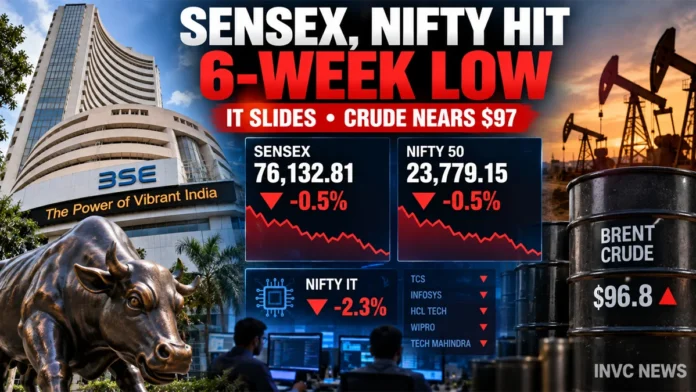
Stock Market Today ended on a weak note as the Sensex and Nifty fell to their lowest levels in six weeks, with information technology stocks leading the decline while crude oil prices approaching $97 a barrel added to concerns over inflation, interest rates and India’s import bill.
The Nifty 50 closed 0.5% lower at 23,779.15, while the BSE Sensex also lost 0.5% to finish at 76,132.81.
Selling spread across most parts of the market, with 14 of the 16 major sectoral indexes ending in negative territory.
The biggest pressure came from technology shares.
The Nifty IT index dropped about 2.3% after stronger-than-expected US employment data increased expectations that the Federal Reserve could raise interest rates in September.
Higher US rates can hurt Indian IT companies because many of them generate a significant portion of their revenue from American clients.
At the same time, rising crude oil prices created another major concern for Indian investors.
Crude Oil Near $97 Adds to Market Pressure
Brent crude futures climbed about 0.6% to $96.8 a barrel as escalating tensions in the Middle East increased concerns about possible disruptions to global energy supplies.
Higher crude prices are particularly important for India because the country imports a large share of the oil it consumes.
A sustained rise in oil prices can increase India’s import bill, put pressure on the rupee and add to inflation.
It can also complicate monetary policy by making it harder for the Reserve Bank of India to keep inflation under control while supporting economic growth.
That combination has made crude oil one of the most closely watched indicators for Indian equity investors.
Sensex and Nifty Extend Four-Week Decline
Monday’s weakness did not come in isolation.
The Nifty has lost approximately 2.7% over the past four weeks, while the Sensex has declined about 2.5% during the same period.
Rising oil prices and higher global bond yields have weighed on investor sentiment.
The latest session pushed both benchmarks to their lowest levels in around six weeks.
The broader market also showed signs of caution.
Mid-cap stocks fell about 0.5%, while the broader small-cap index finished roughly unchanged.
This suggests investors have not completely abandoned risk, but they remain hesitant to take aggressive positions while global uncertainty remains elevated.
Why IT Stocks Fell the Most
Technology shares became the center of Monday’s selloff after strong US labor-market data changed expectations around Federal Reserve policy.
A stronger labor market can give the Fed more room to maintain tighter monetary conditions or raise rates if policymakers remain concerned about inflation.
For Indian IT exporters, that matters for two reasons.
First, higher interest rates can slow corporate spending in the United States.
Second, technology companies often depend heavily on discretionary spending from American clients.
If businesses delay software, consulting or digital-transformation projects, Indian IT companies could face slower revenue growth.
That concern pushed investors toward a more cautious stance on the sector.
Middle East Tensions Keep Investors on Edge
Geopolitical tensions also remain a major risk for global markets.
The latest escalation involving the United States and Iran has increased uncertainty around the Strait of Hormuz, one of the world’s most important energy transportation routes.
Any sustained disruption in the region could push crude prices even higher.
For India, that risk extends beyond energy companies.
Higher oil can affect aviation, paint manufacturers, chemicals, logistics, automobiles and other industries that depend directly or indirectly on petroleum products.
It can also influence inflation expectations and the rupee.
That explains why Indian stocks can react sharply even when geopolitical developments take place thousands of miles away.
14 of 16 Major Sectors End Lower
The selling pressure was broad.
Fourteen of the 16 major sectoral indexes ended the session lower, showing that weakness extended well beyond technology stocks.
Investors reduced exposure as they evaluated several risks at the same time: higher crude oil prices, global interest-rate expectations, Middle East tensions and domestic liquidity conditions.
Analysts are also watching rainfall patterns closely.
Weak rainfall in key agricultural areas can affect crop production, rural demand and food inflation.
If food prices rise while crude oil remains elevated, investors may become more cautious about the inflation outlook.
IPO Activity May Also Be Pulling Liquidity From Stocks
Another factor attracting market attention is the heavy pipeline of initial public offerings.
Strong IPO activity can pull money away from already-listed stocks as investors allocate capital to new issues.
That does not automatically cause a market decline, but it can temporarily reduce liquidity available for the secondary market.
The effect becomes more visible when investor sentiment is already fragile.
India’s primary market remains active, but the combination of IPO demand and broader financial-system liquidity conditions could contribute to short-term volatility.
What Should Investors Watch on Tuesday?
Investors will closely monitor several factors when the market reopens.
Crude oil prices remain the most immediate external risk.
Any move above the $97-$100 zone could increase concerns over India’s inflation and current-account outlook.
US interest-rate expectations will also remain important.
Further signs that the Federal Reserve could tighten monetary policy may continue to pressure technology and other rate-sensitive stocks.
Foreign institutional investor flows will offer another signal.
Persistent foreign selling could keep large-cap indexes under pressure, while renewed buying could provide support after the recent decline.
The rupee and Indian bond yields will also matter because they reflect how markets are responding to higher oil prices and global rate expectations.
Is This a Stock Market Crash?
Despite the weakness, Monday’s move does not qualify as a conventional stock market crash.
The Sensex and Nifty fell about 0.5% during the session.
The more important development is the accumulation of losses over several weeks and the fact that both benchmarks have reached six-week lows.
That distinction matters for investors.
A sharp one-day crash and a prolonged period of gradually weakening sentiment can require very different interpretations.
For now, Indian markets are dealing with multiple pressures rather than a single panic event.
Market Outlook: Volatility May Remain High
The immediate outlook remains sensitive to global developments.
Indian economic fundamentals may provide some support, but higher crude prices, changing US rate expectations and geopolitical uncertainty could continue to create volatility.
Investors may therefore focus more heavily on company earnings, balance-sheet quality and valuations rather than chasing broad market momentum.
The next few sessions could determine whether Monday’s decline develops into a deeper correction or whether buyers return near current levels.
For now, the message from the market is clear: risk appetite has weakened, technology stocks are under pressure and crude oil has once again become one of the biggest variables for Indian equities.