KYIV, Ukraine | September 7, 2026 —
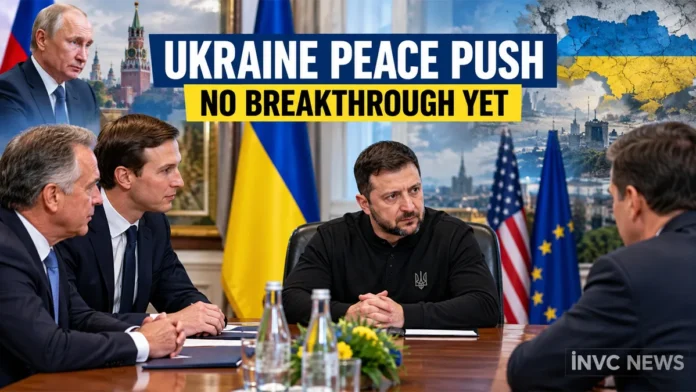
Ukraine Peace Talks have entered a fresh diplomatic phase after U.S. envoys Steve Witkoff and Jared Kushner met Ukrainian President Volodymyr Zelenskyy in Kyiv following more than three hours of discussions with Russian President Vladimir Putin in Moscow.
The renewed U.S. push has restarted direct diplomatic momentum, but Washington, Kyiv and Moscow have not announced a breakthrough. Russia and Ukraine remain sharply divided over territory, security arrangements and the conditions required for a lasting settlement.
Witkoff and Kushner Hold First Official Kyiv Visit
Witkoff and Kushner arrived in Kyiv for their first official visit to Ukraine in their roles as U.S. peace negotiators.
They met Zelenskyy in three rounds of discussions on Sunday. National security advisers from the United Kingdom, France and Germany joined the final round, widening the talks beyond a purely U.S.-Ukraine format.
Zelenskyy described the discussions as highly substantive, while Witkoff said the U.S. delegation felt encouraged by the talks.
However, neither side announced a peace agreement, ceasefire framework or settlement of the most difficult territorial questions.
Moscow Talks Produced New Ideas but No Deal
Before arriving in Kyiv, Witkoff and Kushner met Putin at the Kremlin on Saturday.
The Moscow meeting lasted more than three hours. Kremlin foreign policy adviser Yuri Ushakov characterized the discussions as useful, while the U.S. envoys said Moscow presented new ideas that they subsequently carried into their talks with Ukrainian officials.
Still, neither Moscow nor Washington announced a concrete agreement after the meeting.
The lack of a breakthrough underlines the gap that continues to separate the Russian and Ukrainian positions despite renewed U.S. mediation.
Territory Remains the Biggest Obstacle
Territory remains one of the hardest issues in the Ukraine Peace Talks.
Zelenskyy said the territorial question remains unresolved and argued that the most difficult decisions would ultimately require engagement at the leadership level.
The future of the Donbas region remains particularly contentious.
Russia has demanded that Ukraine withdraw from territory it still controls in parts of eastern Ukraine, while Kyiv has rejected demands that it considers unacceptable concessions.
Zelenskyy has repeatedly emphasized that Ukraine cannot simply abandon territory that its forces continue to defend.
That disagreement makes any immediate comprehensive settlement difficult.
New Trilateral Talks Could Come Next
Despite the unresolved issues, Washington wants to keep the negotiating process moving.
Witkoff said the U.S. hopes a new round of American-mediated talks involving Ukraine and Russia can be announced soon.
Zelenskyy also said Ukraine remains ready for trilateral negotiations.
In addition, Kyiv and Washington agreed on the need for another meeting involving Ukraine, the United States and European partners. As of Monday, officials had not publicly confirmed the location or final timetable for that meeting.
The diplomatic sequence gives the Trump administration another opportunity to test whether Moscow and Kyiv can narrow their positions after months of limited movement.
Ukraine Pushes for Security Guarantees
Kyiv also used the talks to press its case for stronger long-term security guarantees.
Zelenskyy discussed air-defense requirements, economic guarantees and the support Ukraine would need if fighting continues through the winter.
Ukraine specifically raised its need for Patriot air-defense systems and additional protection for critical energy infrastructure.
For Kyiv, security guarantees remain essential because Ukrainian leaders want any peace settlement to deter another large-scale Russian attack.
Zelenskyy has also argued that maintaining a strong Ukrainian military must form part of any future security framework.
Winter Energy Support Enters Peace Discussions
The Kyiv talks did not focus solely on political negotiations.
Ukrainian officials also discussed a winter support package covering air defense and energy infrastructure.
Ukraine expects Russia to continue targeting the country’s power system during the colder months, making energy resilience a major part of Kyiv’s immediate strategy.
That means diplomacy and military support are moving on parallel tracks.
Washington may pursue negotiations while continuing discussions about measures designed to strengthen Ukraine’s ability to defend its cities and infrastructure.
Temporary Pause on Kyiv and Moscow Strikes
The diplomatic mission also produced a limited and temporary reduction in attacks on the two capitals.
Russia said it would pause strikes on Kyiv during the diplomatic visit, while Ukraine said it would refrain from attacking Moscow during the same period.
The arrangement did not amount to a broader ceasefire.
Fighting continued elsewhere along the front, and both countries continued military operations beyond the two capitals.
That contrast illustrates the central challenge confronting negotiators: diplomacy has resumed, but the war itself has not stopped.
What Happens Next in Ukraine Peace Talks?
The next major test will be whether Washington can turn the Moscow and Kyiv meetings into a new round of direct or trilateral negotiations.
Witkoff and Kushner have now carried messages between Putin and Zelenskyy, while European security officials have joined the discussions.
Yet the core questions remain unsettled.
Ukraine wants credible security guarantees and rejects territorial demands it views as surrender. Russia continues to press its own territorial and security conditions.
For now, the diplomatic channel has reopened, but Ukraine Peace Talks have not yet produced the political compromise required to end the war.
The coming discussions will show whether the latest U.S. initiative can move beyond shuttle diplomacy and toward negotiations capable of narrowing the gap between Moscow and Kyiv.