NEW DELHI, India | September 6, 2026 —
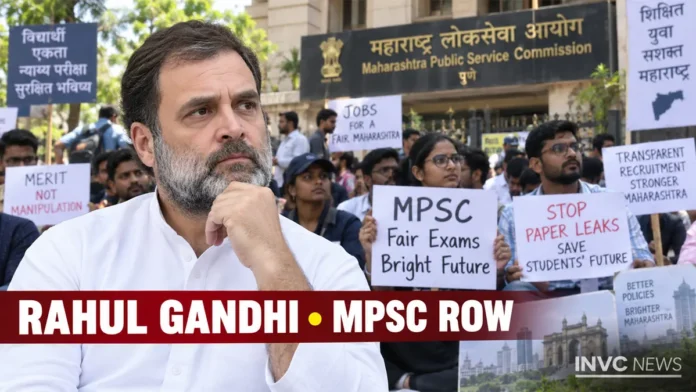
Rahul Gandhi Maharashtra Student Protest row moved firmly into national politics on Sunday after the Leader of Opposition backed students and job aspirants protesting over alleged examination irregularities, recruitment delays and broader concerns surrounding Maharashtra’s competitive examination system.
Rahul Gandhi accused BJP-led governments at the Centre and in Maharashtra of failing to address growing frustration among students over alleged paper leaks, delayed recruitment, rising education costs and problems faced by young people preparing for government jobs.
He argued that the protests were no longer about a single examination or one recruitment process but reflected a wider breakdown of trust among students.
His intervention comes as Maharashtra faces heightened scrutiny over its government recruitment examination system, particularly following allegations surrounding the Maharashtra Public Service Commission Drug Inspector examination.
The controversy has now brought competitive examinations, recruitment transparency and youth employment into the center of the political battle between Congress and the BJP.
Rahul Gandhi Backs Maharashtra’s Protesting Students
Rahul Gandhi said thousands of students were protesting peacefully because they had lost confidence in the system.
He highlighted several grievances raised by students, including alleged paper leaks, stalled recruitment processes, expensive education, poor hostel conditions, concerns over food quality and complaints related to Direct Benefit Transfer schemes.
The Congress leader also targeted the functioning of the Maharashtra Public Service Commission, accusing the BJP-led government of damaging confidence in an institution responsible for conducting some of the state’s most important recruitment examinations.
His allegations immediately expanded what had largely been an examination and recruitment controversy into a national political issue.
For Congress, the Maharashtra protests provide another opportunity to build its wider political campaign around youth unemployment, competitive examinations and recruitment transparency.
MPSC Drug Inspector Exam Under Scrutiny
One of the biggest triggers behind the current controversy involves allegations surrounding the MPSC Drug Inspector Group-B examination.
The screening examination was conducted on March 22 across six divisional headquarters in Maharashtra.
Complaints later alleged that questions or examination material had reached some candidates before the scheduled test.
Authorities subsequently opened a criminal investigation into the alleged breach of examination confidentiality.
Investigators have made several arrests in connection with the case, placing renewed pressure on Maharashtra’s recruitment system.
The episode has become especially sensitive because candidates spend years preparing for competitive examinations and depend on the integrity of the selection process.
Any credible allegation that examination material reached candidates in advance can therefore rapidly undermine confidence in the entire recruitment system.
Maharashtra Forms Seven-Member Exam Reform Panel
The Maharashtra government has responded by setting up a seven-member committee to conduct a comprehensive review of recruitment examinations.
The panel will examine the entire process, from preparation and scrutiny of question papers to their secure handling, transportation, examination-center management, evaluation and declaration of results.
It will also study the use of technology, security protocols, grievance redressal and coordination among agencies involved in conducting examinations.
The committee will seek feedback from students, examinees, parents, teachers, educational institutions, coaching centers, public representatives and other stakeholders.
This gives the government an opportunity to address structural weaknesses rather than treating each alleged paper leak or examination irregularity as an isolated incident.
Paper Leaks Become Major Political Issue
Paper leaks have increasingly moved beyond the education pages and into mainstream national politics.
Competitive examinations directly affect millions of young Indians seeking government jobs.
Candidates often invest several years, substantial family savings and intense preparation into these examinations.
When recruitment gets delayed or examinations face allegations of malpractice, the impact can extend far beyond a single test.
For students, it can mean losing months or years of preparation.
For governments, repeated examination controversies can damage public confidence in recruitment institutions.
Rahul Gandhi is attempting to turn that frustration into a wider political argument about how BJP-led governments handle the aspirations of young Indians.
Rahul Gandhi Links Exams With Jobs and Education Costs
The Congress leader’s latest attack does not focus on the MPSC controversy alone.
He has linked examination integrity with a larger set of concerns involving employment, recruitment and access to affordable education.
This strategy allows Congress to combine several powerful youth issues under one political narrative.
Government-job aspirants frequently raise questions about long recruitment cycles, postponed examinations, delayed results and appointments.
Students also face rising costs for coaching, accommodation and higher education.
By combining these concerns, Congress is seeking to argue that frustration among young people represents a systemic problem rather than isolated administrative failures.
BJP Faces Fresh Youth Politics Challenge
The BJP-led Maharashtra government now faces pressure to demonstrate that its examination reforms can restore confidence among candidates.
Creating a high-level committee gives the administration a formal mechanism to identify vulnerabilities and recommend changes.
However, students are likely to judge the government’s response by implementation rather than announcements alone.
The political challenge therefore extends beyond investigating individual allegations.
Authorities will also need to demonstrate that future examinations can remain secure, transparent and predictable.
Any further controversy involving recruitment examinations could intensify opposition attacks and provide Congress with additional ammunition on youth issues.
Government Seeks More Secure Recruitment Exams
The state government’s review is expected to examine safeguards across the examination lifecycle.
That includes question-paper preparation, creation of multiple sets, printing or digital distribution, confidential transportation, examination-center security, biometric systems, access controls, CCTV monitoring and audit trails.
Officials also want the panel to consider faster and more transparent mechanisms for candidates to raise grievances.
If implemented effectively, such measures could significantly strengthen Maharashtra’s recruitment examination infrastructure.
For candidates, however, confidence will depend on whether reforms prevent future breaches and ensure that honest applicants compete on equal terms.
Student Feedback to Become Part of Review
The government intends to collect suggestions directly from students and other stakeholders before the committee submits its recommendations.
A special feedback mechanism is being established in Pune, while committee members are also scheduled to interact with students and examinees at Savitribai Phule Pune University.
The consultation process could become important because many weaknesses in competitive examinations become visible first to candidates.
Issues involving examination centers, digital systems, grievance mechanisms and communication often affect students directly.
Bringing their experiences into the reform process could therefore help the committee identify practical problems that administrative reviews sometimes miss.
Maharashtra Protest Becomes National Political Battle
Rahul Gandhi’s intervention ensures that the Maharashtra student agitation will no longer remain only a state-level examination controversy.
Congress is increasingly positioning examination integrity and employment as major national political issues.
The BJP, meanwhile, can point to recruitment drives, economic growth, skill-development programs and examination reforms as evidence that governments are responding to the aspirations of young Indians.
That competing narrative is likely to intensify as political parties compete for the support of students, job aspirants and first-time voters.
The immediate focus will remain on Maharashtra’s investigation into alleged examination irregularities and the work of the newly constituted reform committee.
But the broader political question is already much bigger.
For thousands of aspirants, the debate now centers on whether recruitment examinations can deliver what candidates expect most: a secure process, equal opportunity, transparent evaluation and results they can trust.