TAIPEI, Taiwan | September 2, 2026 —
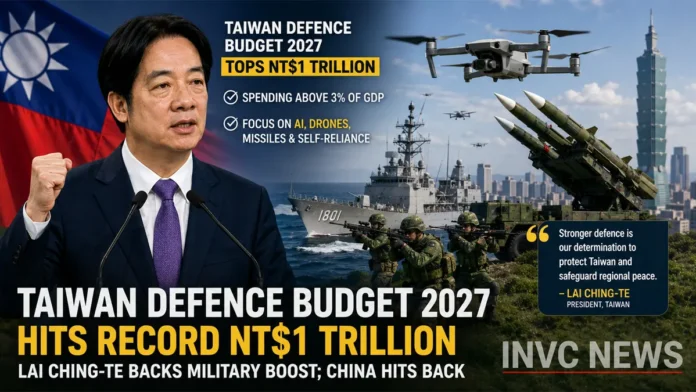
Taiwan defence budget 2027 moved back to the centre of China-Taiwan tensions on Wednesday after President Lai Ching-te said record military spending demonstrates the island’s determination to strengthen its defences, while Beijing accused his government of deliberately escalating cross-strait confrontation.
Taiwan plans to push overall defence spending above NT$1 trillion for the first time in 2027, marking a major expansion of military investment as Taipei accelerates work on drones, artificial intelligence, missiles and domestic defence production.
The proposed spending comes as China continues military and political pressure around Taiwan, which Beijing claims as its territory.
Taiwan rejects that claim and says only its people can decide their future.
Lai Ching-te Puts Record Defence Spending at Centre of Message
President Lai used a military address on Wednesday to argue that stronger defence preparations provide greater security.
He said Taiwan must continue strengthening its military capabilities and deterrence to protect national security and regional peace.
Lai also said the record budget sends an international message about Taiwan’s determination to defend itself.
That statement gives fresh political weight to a budget proposal that Taipei had already been developing.
The 2027 defence package will exceed NT$1 trillion, with official budget calculations putting the overall figure at roughly NT$1.12 trillion when broader defence-related expenditure is included.
Taiwan Pushes Defence Spending Above 3% of GDP
Taiwan’s government wants defence spending to remain above 3% of gross domestic product.
The 2027 proposal places expenditure at around 3% of GDP under the government’s broader calculation.
Lai has also set a longer-term goal of raising defence expenditure toward 5% of GDP by 2030.
That trajectory would represent a major shift in Taiwan’s military spending.
Taipei argues that changing warfare, China’s military modernisation and lessons from conflicts in Ukraine and the Middle East require much faster investment in defence.
AI and Drones Become Major Taiwan Military Priorities
Taiwan does not plan to spend the additional money only on conventional weapons.
Lai said the government will continue developing:
Artificial intelligence
Unmanned vehicles and drones
Domestic defence manufacturing
Asymmetric warfare capabilities
Military technology
Taiwan increasingly views drones as critical because relatively inexpensive unmanned systems can conduct reconnaissance, surveillance and attack missions without exposing pilots.
The wars in Ukraine and the Middle East have demonstrated how dramatically drones can change battlefield tactics.
Taipei wants to apply those lessons directly to defence of the island.
Taiwan Wants Stronger Domestic Defence Industry
Taiwan also wants to manufacture more military systems itself.
Dependence on overseas weapons creates potential vulnerabilities if supply chains become disrupted during a crisis.
A stronger domestic defence industry could allow Taiwan to produce drones, missiles, communications equipment and other military technologies at greater scale.
It could also connect Taiwan’s world-class semiconductor and electronics industries more closely with defence production.
That matters because modern warfare increasingly depends on software, chips, sensors, artificial intelligence and secure communications.
China Fires Back at Lai
Beijing responded sharply to Lai’s remarks.
China’s Taiwan Affairs Office accused his administration of promoting confrontation and wasting public money.
Chinese officials also criticised attempts to strengthen Taiwan’s military as a strategy to resist eventual unification.
Beijing maintains that Taiwan forms part of China and has never renounced the use of force to bring the island under its control.
Taipei strongly rejects Beijing’s sovereignty claim.
Lai says Taiwan already functions as a sovereign democracy and that its future belongs to its 23 million people.
China Keeps Military Pressure Around Taiwan
The defence debate comes against a tense security backdrop.
China regularly sends military aircraft and warships around Taiwan.
Beijing has also conducted major military exercises near the island in recent years.
Taiwan views those activities as an attempt to wear down its forces, intimidate its population and rehearse possible military operations.
China says its exercises respond to what it calls separatist activity and foreign interference.
That cycle has made the Taiwan Strait one of the world’s most closely watched geopolitical flashpoints.
Drones Could Reshape Taiwan’s Defence Strategy
Taiwan has increasingly embraced an asymmetric defence strategy.
Instead of trying to match China weapon-for-weapon, Taipei wants large numbers of smaller, mobile and survivable systems that could make any attack extremely costly.
Drones fit directly into that model.
Taiwan’s parliament recently debated multi-billion-dollar plans to dramatically expand military drone procurement.
Political parties disagree over spending structures and oversight, but there is broad recognition that unmanned systems will play a much larger role in future warfare.
Lai’s latest remarks make clear that AI and drones will remain priorities even as lawmakers debate exactly how the money should be spent.
United States Remains Taiwan’s Key Security Partner
The United States remains Taiwan’s most important international security supporter and arms supplier.
Washington does not maintain formal diplomatic relations with Taipei, but US law requires the United States to provide Taiwan with means to defend itself.
American administrations have also repeatedly encouraged Taiwan to invest more heavily in its own defence.
Higher Taiwanese spending therefore sends a message not only to Beijing but also to Washington.
Taipei wants to demonstrate that it is not relying solely on outside military support.
Semiconductor Industry Makes Taiwan Globally Critical
Any military crisis around Taiwan would have consequences far beyond East Asia.
Taiwan occupies a central position in the global semiconductor supply chain.
Its companies manufacture many of the world’s most advanced chips used in:
Smartphones
Artificial intelligence systems
Data centres
Cars
Military technology
Consumer electronics
A major conflict could therefore disrupt technology supply chains around the world.
That economic importance is one reason every shift in China-Taiwan military relations attracts enormous global attention.
Taiwan Companies Also Deepen US Investment
Taiwan’s strategic relationship with the United States extends beyond defence.
Taiwanese companies are also expanding investment in American semiconductor and technology operations.
Taipei said Wednesday that Taiwanese companies plan another $20 billion in US investment, separate from TSMC’s enormous previously announced expansion.
That links Taiwan’s security strategy increasingly closely with global technology supply chains.
Taiwan wants to remain indispensable to international semiconductor production while diversifying some manufacturing abroad.
Record Spending Still Faces Political Scrutiny
A proposed budget does not automatically mean every dollar will be approved exactly as requested.
Taiwan’s opposition-controlled legislature has challenged parts of the government’s previous defence plans.
Opposition parties generally support stronger national defence but have questioned some spending proposals, procurement methods and special budgets.
That means Lai must fight two political battles simultaneously.
Externally, he must counter pressure from Beijing.
Domestically, his government must persuade lawmakers that the proposed spending delivers measurable military capability.
Why Today’s Taiwan-China Story Matters
The Taiwan defence budget 2027 story has all the ingredients of a major geopolitical issue.
Taiwan is spending record amounts on defence.
China is increasing military pressure.
Taipei is betting heavily on AI and drones.
The United States remains deeply involved in Taiwan’s security.
And the island controls a critical position in the global semiconductor industry.
The newest development came on September 2 when President Lai publicly framed the record budget as proof of Taiwan’s determination to protect itself.
Beijing answered almost immediately.
That exchange makes the dispute much larger than an accounting debate.
It represents two completely different visions of Taiwan’s future — one based on stronger self-defence and democratic self-determination, and the other based on Beijing’s insistence that Taiwan ultimately belongs under Chinese sovereignty.
As Taiwan pushes military spending beyond the NT$1 trillion threshold, the financial cost of that strategic confrontation is becoming increasingly visible.
And with AI, drones and advanced military technology now moving to the centre of Taiwan’s defence strategy, the next phase of the China-Taiwan rivalry could become even more technologically driven.