By Team INVC | INVC NEWS
Published: September 2, 2026 |11 : 02 AM IST
NEW DELHI, India | September 2, 2026 —
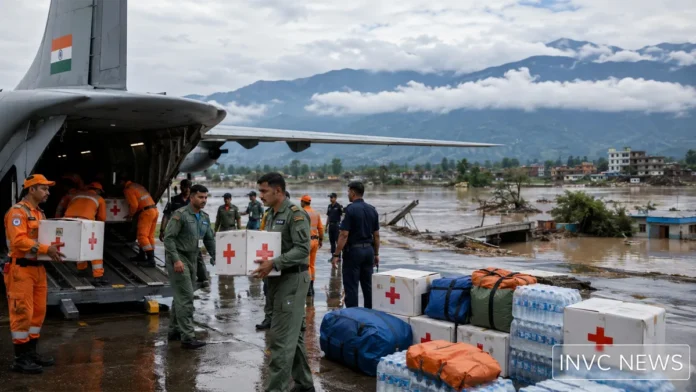
India Nepal flood relief intensified on Wednesday as India dispatched its fifth emergency aircraft to disaster-hit Nepal, carrying an 11-member specialised rescue team, advanced equipment and 5.5 tonnes of essential medicines.
External Affairs Minister S. Jaishankar confirmed the latest mission on September 2 as rescue teams continued racing against time across flood-ravaged areas of Nepal.
The latest Indian deployment comes as Nepal struggles with one of its most devastating natural disasters in recent years. More than 1,000 deaths have been reported, while thousands of people remain missing or cut off in affected regions.
India has steadily expanded its humanitarian operation since the disaster struck, sending relief material, medical assistance, rescue specialists and equipment to help Nepal manage the enormous emergency.
India Sends Fifth Relief Aircraft to Nepal Today
India dispatched the fifth aircraft on Wednesday morning.
The flight carries an 11-member rescue team equipped for specialised operations along with 5.5 tonnes of essential medicines.
The team will support Nepalese authorities working in areas where floodwater, landslides, mud and debris have complicated rescue operations.
The latest deployment strengthens India’s Humanitarian Assistance and Disaster Relief response and reflects New Delhi’s “Neighbourhood First” approach during emergencies in neighbouring countries.
Indian authorities have remained in close coordination with Nepal since the scale of the catastrophe became clear.
Specialised Rescue Team Joins Massive Search Operation
The Indian specialists arrive at a crucial stage.
Rescue teams in Nepal continue trying to reach people believed trapped in tunnels, underground hydropower facilities and isolated mountain locations.
Floods and debris have damaged roads and bridges, cutting off access to several communities.
Heavy mud deposits have made some rescue sites especially difficult to reach.
Teams have deployed excavators, technical specialists and rescue equipment, but unstable terrain and water entering underground structures continue to slow operations.
India’s specialised team will add technical capacity to that effort.
Nepal Flood Death Toll Crosses 1,000
The human cost of the disaster has continued to rise.
Nepalese authorities have reported more than 1,000 deaths as search teams recover bodies from multiple districts.
Thousands of people remain unaccounted for across the wider disaster zone.
The numbers may continue changing as authorities reach previously inaccessible locations and complete identification procedures.
Several districts have suffered extensive destruction.
Floodwater swept away homes, bridges, roads, schools and other infrastructure.
Entire communities now depend on emergency food, shelter, medicines and drinking water.
Hydropower Workers Remain Trapped
One of the most difficult rescue challenges involves workers at hydropower projects.
Floodwater and debris hit several facilities and blocked access to underground powerhouses and tunnels.
Families continue waiting for information about relatives who were working inside those installations when the floods struck.
Rescuers have struggled to penetrate some areas because mud, water and debris continue blocking access points.
Nepal’s mountainous terrain adds another layer of difficulty.
Restoring road connectivity will become essential not only for rescue operations but also for delivering relief to remote communities.
India Had Already Sent Multiple Relief Shipments
Wednesday’s aircraft represents the fifth Indian emergency flight sent during the Nepal disaster.
Earlier Indian shipments carried relief supplies including medicines, food packets, water-purification materials, portable generators and other emergency equipment.
India has also deployed medical personnel and technical teams.
New Delhi has offered additional assistance based on Nepal’s requirements, including support for restoring connectivity.
The rapid sequence of relief flights shows that India has moved from an initial emergency response into a sustained humanitarian operation.
Medicines Become Critical as Disaster Enters Second Week
Medical supplies have become increasingly important as the disaster enters another stage.
Flood survivors face risks from injuries, contaminated water, infections and disrupted access to normal healthcare.
The destruction of roads and local infrastructure can also prevent hospitals and clinics from receiving routine supplies.
India’s latest shipment of 5.5 tonnes of essential medicines therefore addresses one of the most immediate needs on the ground.
Medical teams must also manage the health needs of displaced families living in temporary shelters.
Clean drinking water, sanitation and disease prevention will become increasingly important as relief operations continue.
India and Nepal Coordinate Rescue Efforts
India and Nepal share a long land border and deep social, economic and cultural ties.
That geography allows India to move humanitarian supplies through both air and land routes when major disasters strike Nepal.
Indian agencies have previously supported Nepal during earthquakes, floods and other emergencies.
The current relief operation again demonstrates the importance of disaster-response coordination between the two neighbours.
Indian diplomatic and emergency teams have remained in contact with Nepalese authorities to identify requirements and deploy assistance accordingly.
Indian Teams Also Support Identification Work
The scale of casualties has created another difficult challenge: identifying victims.
Authorities need forensic expertise to identify bodies recovered from flood-affected areas before handing them over to families.
Indian specialists have also supported Nepal in areas connected with victim identification and emergency medical response.
The work carries enormous importance for families waiting for confirmation about missing relatives.
Principal Who Saved 1,600 Students Draws Attention
Amid the devastation, stories of extraordinary individual action have also emerged.
India’s Ambassador to Nepal highlighted the actions of a school principal in Nuwakot whose timely evacuation decision reportedly helped save more than 1,600 schoolchildren before floodwater swept away the school.
Such stories underline how quickly the disaster unfolded.
In many locations, communities had only a short window to escape before water, rocks and debris overwhelmed buildings and roads.
What Triggered the Nepal Disaster?
The catastrophic floods followed a major high-altitude glacial and rock-collapse event in the Himalayan region on August 26.
Huge quantities of rock, ice and meltwater rushed into river valleys, creating destructive downstream surges.
The resulting floodwaters carried debris through vulnerable settlements and infrastructure corridors.
Scientists continue analysing the event and its precise sequence.
The disaster has once again highlighted the risks facing Himalayan regions from unstable glaciers, extreme weather and fragile mountain geology.
India Keeps More Assistance Ready
The fifth relief aircraft may not mark the end of India’s response.
New Delhi has indicated that it remains prepared to provide additional help based on requests from Nepal.
The next priorities could include specialised rescue support, medicines, temporary bridges, infrastructure restoration and assistance for communities cut off by damaged roads.
Restoring connectivity will become increasingly urgent as emergency rescue gradually shifts toward rehabilitation.
Nepal Faces Long Recovery After Rescue Phase
Even after rescuers complete the immediate search operation, Nepal will face a massive rebuilding challenge.
Authorities will need to repair roads.
They will need to rebuild bridges.
Damaged hydropower infrastructure will require assessment and reconstruction.
Families who lost homes will need long-term shelter.
Schools, health centres and local services will also need restoration.
The financial cost could become enormous.
International assistance may therefore remain important long after the emergency phase ends.
India Expands ‘Neighbourhood First’ Response
The India Nepal flood relief operation has now entered a deeper phase.
India first sent emergency supplies.
It then added medical and rescue personnel.
Now the fifth aircraft is carrying another specialised rescue team and 5.5 tonnes of medicines as Nepal continues searching for survivors and victims.
The priority remains clear: save lives while rescue remains possible, support communities facing immediate humanitarian needs and help Nepal restore access to areas devastated by the floods.
With search teams still working across the disaster zone on September 2, India’s latest deployment turns Wednesday into another crucial day in the cross-border rescue effort.