By Team INVC | INVC NEWS
Updated: September 1, 2026 |06 : 48 PM IST
KATHMANDU, Nepal | September 1, 2026 —
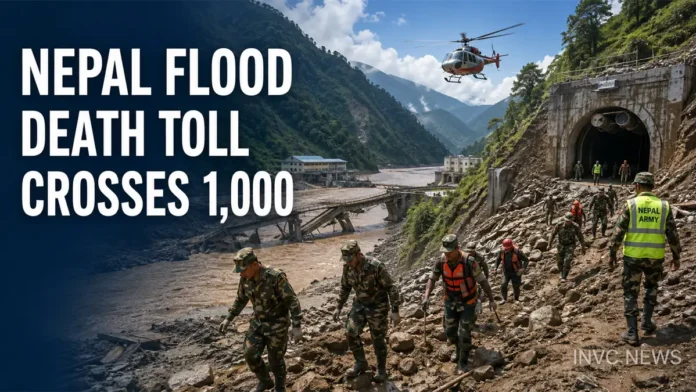
Nepal Flood Death Toll climbed to 1,003 on Tuesday as rescue teams intensified searches along riverbanks, inside damaged hydropower tunnels and across communities cut off by the catastrophic August 26 flood.
Nepal’s National Disaster Risk Reduction and Management Authority said 3,916 people remained missing as of 1:00 PM local time. The missing include 583 foreign nationals, security personnel, government employees and hundreds of workers linked to hydropower projects along the Bhotekoshi and Trishuli rivers.
Search crews have continued recovering bodies and human remains downstream from the disaster’s epicenter in Rasuwa. Authorities warned that the death toll could change as teams enter previously inaccessible areas and complete the identification of recovered remains.
Chinese authorities have separately reported 16 deaths and 546 missing in Tibet. Those figures bring the confirmed cross-border death toll to 1,019 and the number of people missing across Nepal and Tibet to 4,462.
Nepal Flood Disaster: Latest Figures
- Confirmed deaths in Nepal: 1,003
- People missing in Nepal: 3,916
- Foreign nationals missing: 583
- People injured: 279
- People rescued: 11,884
- Security personnel deployed: 21,314
- Hydropower-linked people missing: 639
- Hydropower workers rescued alive: 279
Chitwan Records the Highest Number of Recovered Bodies
The flood swept bodies and debris far downstream through the Bhotekoshi–Trishuli river system, forcing search teams to expand recovery operations across eight districts.
Chitwan reported the highest number of recoveries, with authorities finding 321 bodies and unidentified human remains. Nawalparasi East followed with 216 recoveries.
Officials recorded another 170 recoveries in Nawalparasi West, 95 in Nuwakot, 65 in Gorkha, 57 in Dhading, 41 in Rasuwa and 38 in Tanahun.
The district totals reached 1,003 after authorities added bodies and human remains recovered during the latest searches.
Many victims traveled considerable distances through flooded rivers before rescue teams found them. Consequently, districts outside the initial impact zone have become central to the recovery and identification operation.
Nearly 4,000 People Remain Missing
NDRRMA said authorities remained unable to contact 3,916 people.
The missing-person list includes 1,558 people from Nuwakot and 865 from Rasuwa. It also includes 639 people associated with hydropower projects and 583 foreign nationals.
Members of Nepal’s security services and government agencies also remain unaccounted for. The list includes 45 Nepali Army personnel, 25 Nepal Police officers, 13 Armed Police Force members and 15 Customs Office employees.
Immigration officials, Langtang National Park personnel and quarantine employees are also among those reported missing.
Officials continue to revise the lists as families contact emergency centers, survivors reach safe areas and authorities identify recovered bodies.
Rescuers Push Into Flooded Hydropower Tunnels
Hydropower installations along the Bhotekoshi and Trishuli rivers have become a major focus of the rescue operation.
Nepali Army teams and foreign specialists are working at Chilime Hydropower, Langtang Hydropower, Upper Trishuli-1, Upper Trishuli-3A and other damaged sites.
At Chilime, rescuers entered about 50 meters into a debris-filled tunnel. Teams searched approximately 150 meters inside the Langtang Hydropower tunnel and about 200 meters into the Upper Trishuli-1 tunnel.
At Upper Trishuli-3A, crews located a tunnel entrance and began pumping air inside. They also started draining floodwater while excavators cleared an alternative access route.
Security personnel and technical experts have located the entrance at Upper Trishuli-3B and are using heavy equipment to open a path through mud, rocks and debris.
The unstable terrain, damaged machinery and flooded tunnels have slowed progress. Nevertheless, joint teams continue working with excavators, rock breakers, compressors and water pumps.
Army Says 279 Hydropower Workers Were Rescued Alive
The Nepali Army said emergency teams rescued 279 people alive from hydropower and energy-project areas during the first phase of the response.
The rescues included:
- Two people from Rasuwagadhi Hydropower
- 33 from Upper Trishuli-1
- 221 from Upper Trishuli-3A
- Two from Upper Trishuli-3B
- Nine from Mailung Hydropower
- Four from Nuwakot Solar Power
- Three from Trishuli Hydropower
- Five from Devighat Hydropower
However, 639 people connected to different hydropower sites remain missing. Authorities fear that some workers may still be trapped in tunnels blocked by mud and debris.
More Than 21,000 Security Personnel Join Rescue Mission
Nepal has mobilized 21,314 security personnel for search, rescue, relief and recovery work.
The deployment includes 9,199 Nepali Army personnel, 7,912 Nepal Police officers and 4,203 Armed Police Force members.
Teams are using helicopters and other aircraft to reach communities isolated by destroyed roads and bridges. They are also clearing blocked routes, transporting injured survivors and delivering food, water and emergency supplies.
The Army has airlifted 273 foreign nationals and 359 Nepali citizens. Military helicopters completed 592 flights, including 41 on September 1, while private operators conducted additional missions from Kathmandu.
Authorities said they had rescued 11,884 people since the disaster began.
Hundreds Injured as Medical Teams Expand Operations
The number of injured people stood at 279, according to the latest government update.
Hospitals have discharged 168 patients, while others continue receiving treatment. Nepali Army medical teams have provided care to 2,740 people across the affected region.
Emergency crews are simultaneously treating survivors, evacuating vulnerable residents and documenting information about people who remain missing.
Nepal Faces a Massive Identification Challenge
Authorities have moved unidentified bodies and human remains to 21 designated locations for examination and management.
Identification teams are collecting DNA samples, photographs and distinguishing information. They are assigning reference numbers to remains so families can identify and claim their relatives later.
The scale of the disaster has placed severe pressure on hospitals, morgues and local administrations. Search teams are still finding bodies along riverbanks nearly a week after the flood struck.
Authorities have asked families searching for missing relatives to provide photographs, medical information and DNA samples where requested.
What Triggered the Nepal Flood Disaster?
The disaster began on August 26 after a Himalayan glacial collapse sent a powerful surge of ice, rock, mud and meltwater into valleys near the Nepal-Tibet border.
The resulting flood moved rapidly through the Bhotekoshi and Trishuli river systems. It destroyed settlements, roads, bridges, border infrastructure and hydropower facilities.
Scientists examining satellite images said the event appeared to involve the failure of bedrock beneath a glacier. The collapse generated enough force to register as a magnitude 5.2 seismic event.
Nepalese officials have linked the disaster to rising climate risks across the Himalayan region. However, rescue agencies remain focused on reaching missing workers, reopening roads and identifying victims before beginning the longer recovery process.
With 3,916 people still missing, Nepal’s search operation remains active across river corridors, remote settlements and damaged hydropower tunnels.