By Team INVC | INVC NEWS
Published: September 1, 2026 |12 : 59 PM IST
BISHKEK, Kyrgyzstan | September 1, 2026 —
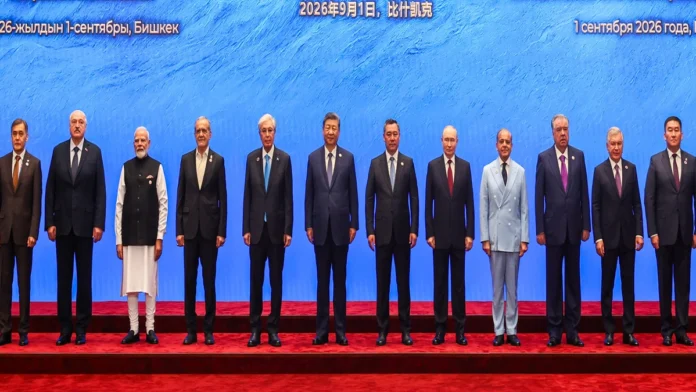
PM Modi SCO Summit 2026 remarks placed terrorism, regional security, sovereign connectivity and dialogue-driven diplomacy at the center of India’s message to the Shanghai Cooperation Organisation on Tuesday, as Prime Minister Narendra Modi addressed leaders including Chinese President Xi Jinping, Russian President Vladimir Putin and Pakistan Prime Minister Shehbaz Sharif in Bishkek.
Speaking at the 26th SCO Summit, which marks 25 years of the organization, PM Modi called on member states to convert decades of dialogue and cooperation into measurable results over the next quarter-century.
His address outlined India’s broader vision for the Eurasian grouping through three priorities — Security, Connectivity and Opportunity — while arguing that peace and security must remain the foundation for economic integration and regional development.
The speech also carried a firm counterterrorism message in the presence of Pakistan’s leadership, with PM Modi rejecting selective approaches to extremist violence and calling for coordinated action against the entire network that enables terrorism.
PM Modi Sets a 25-Year Road Map for SCO
PM Modi said the SCO has built a strong tradition of dialogue and cooperation across the vast Eurasian region during its first 25 years.
He said member countries had contributed not only to the welfare of their own populations but also to broader human development.
However, the Prime Minister argued that the next phase must go further.
The organization, he said, should now focus on converting the institutional foundations created over the past quarter-century into visible and practical outcomes during the next 25 years.
That approach reflects India’s effort to position the SCO not simply as a diplomatic forum, but as a grouping capable of producing tangible security, connectivity, economic and people-to-people benefits.
Security, Connectivity and Opportunity Define India’s SCO Vision
PM Modi returned to an interpretation of the SCO acronym that he has previously used to explain India’s priorities.
For India, he said, S stands for Security, C for Connectivity and O for Opportunity.
The Prime Minister said the challenge now is to move these three pillars from vision to outcomes.
Security comes first because trade, investment, infrastructure and economic opportunities cannot flourish in an environment threatened by terrorism, extremism, organized crime and instability.
That security-first approach also links India’s counterterrorism position with its broader economic ambitions across Central Asia and Eurasia.
Strong Terrorism Message With Shehbaz Sharif Present
One of the most closely watched sections of PM Modi’s address came on terrorism.
With Pakistan Prime Minister Shehbaz Sharif among the leaders attending the summit, PM Modi called for collective action against more than individual terrorists or isolated attacks.
He argued that countries must work together to dismantle the wider ecosystem that sustains terrorism.
That includes terror financing, recruitment networks, radicalization mechanisms and safe havens used by extremist organizations and their supporters.
PM Modi said there could be “no room for double standards” on an issue as serious as terrorism.
He also warned countries against treating terrorism as an instrument of policy or as a strategic advantage.
The message reflected India’s longstanding position that counterterrorism cooperation cannot succeed if governments distinguish between extremist organizations according to political convenience.
Rather than limiting the response to action after attacks occur, PM Modi called for the infrastructure supporting terrorism to be disrupted at its roots.
Drug Trafficking Poses Threat to Youth and Regional Security
PM Modi also highlighted narcotics trafficking as a significant cross-border security challenge.
He said drug trafficking should not be viewed merely as a conventional criminal activity because its consequences extend to young people, social stability and regional security.
The Prime Minister welcomed SCO efforts to strengthen institutional mechanisms dealing with emerging and transnational threats.
He referred to work involving security threats, organized crime, information security and narcotics as areas where greater coordination among member countries can produce practical benefits.
The emphasis is particularly significant for the SCO because its geographic footprint connects Central Asia, South Asia, China, Russia and other regions affected by major trafficking routes and organized criminal networks.
PM Modi Backs Dialogue and Diplomacy Over Battlefield Solutions
The Prime Minister then broadened his address from regional security to conflicts affecting the wider world.
PM Modi said recent developments in West Asia had demonstrated that a conflict in one region does not remain confined within geographic borders.
Instead, wars can quickly affect global energy security, maritime commerce, transportation corridors and international supply chains.
The consequences are often especially severe for Global South economies that depend heavily on stable energy prices, uninterrupted trade routes and predictable supply networks.
Against that backdrop, PM Modi reiterated India’s preference for resolving conflicts through dialogue and diplomacy rather than allowing military confrontation to become the primary mechanism for settling disputes.
The position is consistent with messages he has delivered during India’s engagements with other major powers, including Russia and Iran.
Connectivity Must Respect Sovereignty, PM Modi Says
Connectivity was another major element of India’s message at the summit.
PM Modi said India supports initiatives that connect markets, facilitate trade and create new avenues for economic growth.
However, he added an important condition: regional connectivity projects must respect the sovereignty and territorial integrity of participating countries.
The Prime Minister linked that principle to the fundamental spirit of the SCO Charter.
For India, the sovereignty clause carries particular strategic significance because connectivity has emerged as an important subject in its engagement with China and across Eurasia.
New trade corridors can generate substantial economic benefits, but India has consistently maintained that infrastructure and connectivity initiatives must respect internationally recognized sovereignty.
That makes connectivity both an opportunity for India-China economic engagement and an area where strategic differences remain important.
People-to-People Ties Are SCO’s Biggest Asset
Beyond strategic competition and security challenges, PM Modi emphasized the civilizational dimension of the SCO.
He described ties among the people of member countries as one of the grouping’s most valuable assets.
For India, the SCO region represents an intersection of ancient civilizations, cultures, intellectual traditions and historic trading relationships stretching across Asia.
PM Modi therefore argued that people-to-people engagement should become a central pillar of SCO cooperation during the next 25 years.
Such cooperation can include cultural exchanges, academic interaction, tourism, education, scientific collaboration and greater engagement among young people.
The goal, according to the Prime Minister’s broader message, should be to ensure that the benefits of multilateral cooperation reach citizens rather than remaining limited to government-level meetings.
Youth Opportunities Should Become the Test of SCO Success
PM Modi said the success of regional cooperation should ultimately be measured by how it improves people’s lives.
That includes the opportunities created for young people, new markets opened for entrepreneurs, access to technology for farmers and improvements in living standards across member countries.
The Prime Minister’s emphasis placed economic opportunity alongside national security as a core measure of whether the SCO can remain relevant during its next phase.
It also fits India’s push to use technology, startups and entrepreneurship as instruments of international engagement.
India Wants SCO Cooperation to Become ‘People Driven’
PM Modi called for the SCO’s engagement to become more people-driven rather than exclusively government-driven.
He welcomed the emphasis on youth engagement during Kyrgyzstan’s chairmanship and highlighted several initiatives India has promoted within the SCO framework.
These include the Startup Forum, Young Authors Conclave and Young Scientists Forum, all intended to connect emerging entrepreneurs, researchers, innovators and younger generations across member countries.
The Prime Minister also referred to India’s proposal for an SCO Civilizational Dialogue Forum.
Following discussions around the initiative, its first session is expected to be held in India this year.
PM Modi said active participation by SCO member states could turn the forum into a meaningful platform for sustained civilizational and cultural dialogue.
India Positions Itself Between Security and Strategic Connectivity
The overall message from PM Modi SCO Summit 2026 was broader than a single warning on terrorism.
India used the Bishkek platform to place security, sovereign connectivity, economic opportunity, youth engagement and dialogue-based conflict resolution within one strategic framework.
The presence of Xi Jinping, Vladimir Putin, Shehbaz Sharif and other regional leaders gave the speech additional geopolitical significance at a time when Eurasia is being reshaped by conflicts, trade competition, energy security pressures and changing alignments among major powers.
India’s position remains distinctive.
It wants stronger regional connectivity and larger markets, but insists that sovereignty must be respected. It supports multilateral dialogue with China, Russia, Pakistan and Central Asian states, while continuing to demand a unified stance against terrorism.
At the same time, New Delhi is presenting cultural exchange, startups, scientific collaboration and youth opportunity as equally important components of long-term regional cooperation.
For PM Modi, the measure of the SCO’s next 25 years will therefore not be the number of declarations its leaders adopt, but whether the organization can transform security cooperation, connectivity and opportunity into practical improvements for the people of its member countries.