
By Team INVC | INVC NEWS
Published: September 1, 2026 |11 : 43 AM IST
MUMBAI, India | September 1, 2026 —
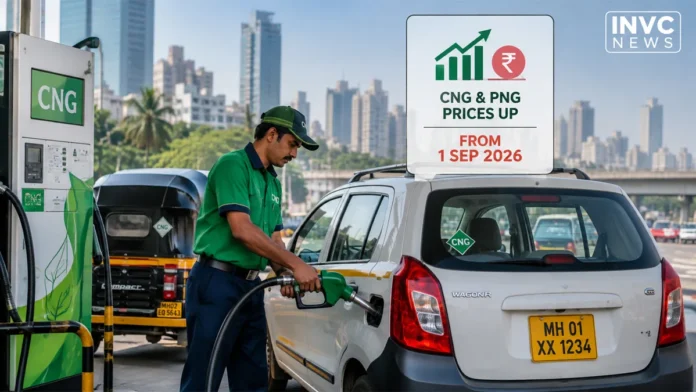
Mumbai residents are waking up to higher fuel and household gas costs from today as Mahanagar Gas Limited has increased CNG prices by ₹2 per kg and domestic PNG prices by ₹1 per standard cubic metre across the Mumbai Metropolitan Region.
The revised Mumbai CNG price is ₹88 per kg, while domestic piped natural gas now costs ₹53 per SCM, with the new rates taking effect from September 1.
MGL has attributed the revision to rising input-gas costs amid the continuing West Asia crisis and higher dependence on expensive spot regasified liquefied natural gas, or RLNG.
The increase will affect motorists using CNG cars, autorickshaws, taxis and commercial vehicles, while households connected to MGL’s piped-gas network will also see higher cooking-gas bills.
Mumbai CNG and PNG Prices From September 1
The latest MGL price revision means:
- CNG: ₹88 per kg — increase of ₹2
- Domestic PNG: ₹53 per SCM — increase of ₹1
- Effective date: September 1, 2026
- Region affected: Mumbai and areas served by Mahanagar Gas
- Reason cited: Higher input-gas and RLNG costs amid West Asia tensions
For consumers, the immediate impact will depend on how much gas they use every month.
A private CNG-car owner may see only a moderate increase on each refill, but the cumulative cost can become more significant for taxis, autorickshaws and commercial vehicles that cover long distances every day.
Why Has Mahanagar Gas Raised CNG Prices?
MGL has linked the price increase to the rise in the cost of natural gas used to meet growing demand.
The company said continuing instability in West Asia has pushed up gas costs linked to international benchmarks.
At the same time, part of the additional CNG demand has to be met through spot RLNG, which can be considerably more expensive than domestically allocated gas.
That increases the average cost of supplying CNG and PNG.
MGL said the latest price revision is intended to partially offset the higher input costs while maintaining uninterrupted gas supplies to customers.
Nearly 13 Lakh CNG Vehicles Could Feel the Impact
The price rise has a particularly large impact because CNG is widely used across the Mumbai Metropolitan Region.
Around 12.93 lakh vehicles are estimated to operate on CNG supplied by MGL, including autorickshaws, taxis, private cars and vehicles used by transport operators.
For high-mileage commercial drivers, even a ₹2-per-kg increase can add noticeably to monthly operating expenses.
That creates another question: whether higher CNG costs eventually translate into pressure for transport-fare revisions.
For households, meanwhile, the ₹1-per-SCM PNG increase will raise monthly cooking-gas bills depending on consumption.
How Much More Will a CNG Car Owner Pay?
The actual increase depends on the quantity filled.
If a motorist purchases 10 kg of CNG, the latest hike adds approximately ₹20 to the refill cost compared with the previous rate.
A vehicle consuming 100 kg in a month would face around ₹200 in additional fuel expenditure, assuming usage remains unchanged.
For taxis and other commercial vehicles with significantly higher monthly consumption, the effect could be much larger.
This is why CNG prices matter not only to private motorists but also to Mumbai’s broader transport economy.
PNG Households Will Also Pay More
Domestic PNG customers are also affected.
At ₹53 per SCM, households will pay ₹1 more for every standard cubic metre consumed.
The monthly increase for an individual family may initially appear small, but it arrives at a time when urban households are already dealing with higher expenses across transport, food, electricity, housing and other services.
For consumers with piped-gas connections, PNG continues to offer the convenience of continuous supply without cylinder booking or delivery.
Also Read – : PNG Drive 3.0 Could End LPG Cylinder Booking Hassles as Wider Piped Gas Rollout May Begin in September
West Asia Crisis Is Reaching Indian Household Budgets
The latest gas-price increase is also another example of how geopolitical tensions thousands of kilometres away can affect household expenses in India.
India imports a significant portion of its energy requirements.
When international oil and gas markets become volatile, higher costs can eventually flow through to airlines, transport operators, industries and consumers.
The West Asia crisis has already intensified concerns around global energy supplies and shipping routes.
For city-gas distributors, higher imported RLNG prices can become particularly important when domestic gas allocations are insufficient to meet growing demand.
That vulnerability is now visible in Mumbai’s new CNG and PNG prices.
CNG Still Matters to Mumbai’s Transport System
Despite the latest increase, CNG remains deeply embedded in Mumbai’s transport network.
Thousands of taxis and autorickshaws rely on it, while many private buyers have shifted toward factory-fitted CNG cars because of fuel-economy considerations.
Automakers have also expanded their CNG portfolios as consumers look for alternatives to petrol.
However, the economics can change when CNG prices rise repeatedly.
For a potential car buyer, the relevant comparison is no longer only the fuel price per litre or kilogram.
Vehicle price, mileage, maintenance, insurance, driving distance and the price difference between CNG and petrol all determine the final cost of ownership.
Also Read – : Tata Motors Price Hike: Cars and SUVs to Cost Up to ₹25,000 More From September 1
September Begins With Higher Energy Costs
The MGL hike is not happening in isolation.
September has opened with multiple changes in energy-related prices, increasing attention on household and business expenses.
For consumers, the important point is to distinguish between different fuels and suppliers.
The ₹88 CNG and ₹53 domestic PNG rates discussed here apply to the MGL-served Mumbai market. Rates can differ in Delhi-NCR and other cities because city-gas distributors, taxes, sourcing costs and local market conditions vary.
Therefore, consumers should check the applicable rate in their own city rather than assuming Mumbai prices apply nationwide.
Will CNG and PNG Prices Rise Again?
That will largely depend on input costs.
If international gas prices remain elevated and distributors continue relying heavily on costly imported RLNG, upward pressure could persist.
On the other hand, softer global gas prices or improved availability of lower-cost domestic gas could provide relief.
For now, Mumbai consumers have a clear new benchmark from September 1:
CNG at ₹88 per kg and domestic PNG at ₹53 per SCM.
The increase may look modest on a single refill or monthly gas bill, but across nearly 13 lakh CNG vehicles and a huge household customer base, the cumulative economic impact is substantial.