By Team INVC | INVC NEWS
Published: September 1, 2026 |11 : 33 AM IST
NEW DELHI, India | September 1, 2026 —
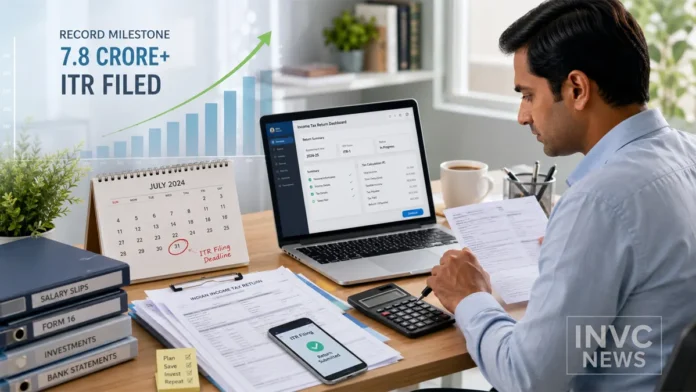
India has set a fresh income-tax filing record, with more than 7.8 crore Income Tax Returns filed for Assessment Year 2026-27 by August 31, according to the Income Tax Department.
The milestone comes after the revised statutory deadline for non-audit business and professional taxpayers ended at midnight on Monday.
However, taxpayers who missed their applicable return-filing deadline have not necessarily lost the opportunity to file.
Eligible taxpayers can still submit a belated Income Tax Return for AY 2026-27 until December 31, 2026, although late-filing fees and interest may apply.
The development is particularly important for individuals, professionals and small-business taxpayers who were unable to complete their return before the applicable due date.
Record 7.8 Crore ITRs Filed for AY 2026-27
The Income Tax Department said more than 7.8 crore ITRs had been filed for AY 2026-27 as of August 31.
The total includes more than 5.9 crore ITR-1 and ITR-2 returns filed by the earlier July 31 deadline.
The latest number exceeds the more than 7.3 crore returns filed by the extended deadline during the previous assessment year.
The rise reflects continued growth in electronic tax filing and the increasing use of pre-filled tax information, Annual Information Statements, Form 26AS and online verification.
Who Had the August 31 ITR Deadline?
The August 31 deadline did not apply equally to every taxpayer.
It primarily covered taxpayers with business or professional income who were not required to undergo a tax audit.
Depending on eligibility, such taxpayers may file forms including:
- ITR-3
- ITR-4
- ITR-5
- ITR-7
Most salaried individuals and other taxpayers filing ITR-1 or ITR-2 had an earlier due date of July 31.
Meanwhile, taxpayers whose accounts require audit generally have later statutory deadlines.
Therefore, before assuming that a deadline has been missed, taxpayers should first identify which filing category applies to them.
Income Tax e-Filing Portal: https://www.incometax.gov.in/
Missed the ITR Deadline? You Can Still File
A taxpayer who failed to submit the return within the applicable due date can generally file a belated return under Section 139(4) of the Income Tax Act, 1961.
For Assessment Year 2026-27, the Income Tax Department states that a belated return may be filed on or before:
December 31, 2026
or before completion of assessment, whichever occurs earlier.
This gives eligible taxpayers additional time to complete their compliance.
However, filing late can involve additional costs.
How Much Is the Late Filing Fee?
Under Section 234F, taxpayers filing after their applicable due date may have to pay a late-filing fee.
The prescribed fee is:
- ₹1,000 if total income does not exceed ₹5 lakh
- ₹5,000 in other applicable cases
The exact amount depends on the taxpayer’s income and filing circumstances.
Interest may also become payable if tax remains outstanding.
Therefore, taxpayers who have missed the deadline should avoid unnecessarily delaying the return until December.
Filing earlier can reduce the risk of additional interest, notices or last-minute portal problems.
Interest May Apply on Unpaid Tax
The late-filing fee is not necessarily the only financial consequence.
If a taxpayer still has unpaid tax liability, interest may apply under relevant provisions of the Income Tax Act.
The amount depends on factors such as:
- Outstanding tax liability
- Advance tax already paid
- TDS or TCS available
- Date of filing
- Nature of income
Taxpayers should carefully reconcile their tax credits before submitting the return.
Form 26AS and the Annual Information Statement should be checked to ensure that salary, interest, securities transactions and other reported income have been correctly reflected.
Can You Still Claim an Income Tax Refund?
A taxpayer entitled to a refund may still be able to claim it through a valid belated return, subject to applicable tax provisions.
However, filing late can create disadvantages compared with filing within the original due date.
Refund processing also depends on successful verification of the return and matching of tax information reported by employers, banks and other entities.
Therefore, taxpayers expecting a refund should complete the return and verification process as early as possible.
Do Not Forget to Verify the ITR
Submitting the return is only part of the filing process.
The taxpayer must also complete verification through one of the permitted methods.
These can include:
- Aadhaar OTP
- Net banking
- Bank account verification
- Demat account verification
- Other approved electronic verification methods
If the return is not properly verified within the prescribed period, it may be treated as invalid.
Taxpayers should therefore check the final filing status after submission instead of assuming the process is complete.
What If You Made a Mistake in an Already Filed ITR?
Taxpayers who filed their return on time but later discover an error may be able to submit a revised return.
For AY 2026-27, the Income Tax Department’s guidance states that a revised return can generally be filed up to March 31, 2027, subject to applicable conditions and provided assessment has not already been completed.
This can help taxpayers correct errors such as:
- Missing income
- Incorrect bank details
- Wrong deductions
- Capital-gains reporting errors
- Incorrect tax-credit information
However, taxpayers should not revise a return without first checking exactly what needs correction.
Different Taxpayers Have Different Due Dates
It is important not to assume that August 31 was the final tax deadline for everyone.
Different categories continue to have separate compliance schedules.
For example, taxpayers whose accounts are required to be audited generally have a later return-filing deadline, while taxpayers subject to transfer-pricing requirements may have an even later date.
Accordingly, taxpayers should check their own category before filing a belated return unnecessarily.
How to File a Belated ITR
Taxpayers can use the official Income Tax e-Filing portal.
The basic process includes:
- Log in to the Income Tax e-Filing portal.
- Select the relevant Assessment Year 2026-27.
- Choose the appropriate return form.
- Enter or confirm income details.
- Reconcile TDS, TCS and advance tax.
- Calculate any outstanding tax, interest or late fee.
- Pay the amount due, if applicable.
- Submit the return.
- Complete e-verification.
The correct ITR form depends on the taxpayer’s income sources and legal status.
Selecting the wrong form can lead to defects or further compliance issues.
Why the 7.8 Crore ITR Record Matters
The record number of returns highlights the rapid digitisation of India’s tax system.
Over the past several years, the government has expanded pre-filled returns, online tax payments, electronic verification and data matching across banks, employers and investment platforms.
That has made filing easier for many taxpayers, while also increasing the amount of financial information available to the tax administration.
As reporting systems become more integrated, mismatches between declared income and information available in government databases can become easier to identify.
Therefore, accurate filing is becoming increasingly important.
What Taxpayers Should Do Now
If you missed your applicable ITR deadline, the most important step is not to panic — but also not to ignore the return.
First determine whether your due date has actually passed.
If it has, check whether you are eligible to file a belated return.
Then reconcile your income, deductions, TDS and tax payments before filing.
With the December 31, 2026 belated-return deadline still available for AY 2026-27, taxpayers have time to complete compliance.
However, delaying until the last few days could increase the risk of mistakes, interest costs and technical problems.
The record 7.8 crore-plus ITR filings show that India’s tax-filing system is handling unprecedented volumes. For those who missed the deadline, the next priority should be simple: verify the applicable rules, calculate any fee or tax due and complete the return as early as possible.