By Team INVC | INVC NEWS
Published: September 1, 2026 |09 : 58 AM IST
WASHINGTON, D.C., United States | September 1, 2026 —
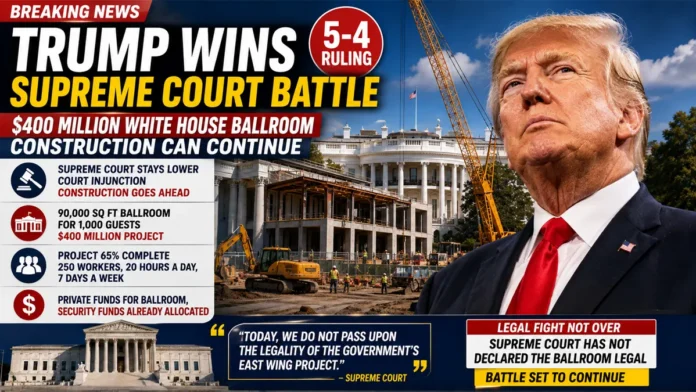
President Donald Trump has scored a major victory at the US Supreme Court, clearing the way for construction of his controversial $400 million White House ballroom project to continue despite an ongoing legal challenge.
In a dramatic 5-4 decision, the Supreme Court blocked lower-court orders that threatened to halt major above-ground construction at the White House East Wing site.
The ruling immediately removes one of the biggest legal obstacles facing Trump’s signature White House expansion project.
But there is a catch.
The Supreme Court has not declared the ballroom legal. Instead, the justices allowed construction to continue while the deeper constitutional fight plays out.
Trump Gets the Green Light — For Now
The legal battle began after the National Trust for Historic Preservation challenged the project, arguing that President Trump lacked authority to push ahead with such a massive construction project without explicit approval from Congress.
Lower courts had raised serious questions about that argument.
On August 7, a federal appeals court kept restrictions in place that could have stalled above-ground work on the project.
Trump’s administration then turned to the Supreme Court.
Now, the administration has won.
The Supreme Court concluded that the government has a strong chance of defeating the case on a threshold legal issue: whether the National Trust has the right, or standing, to bring the lawsuit in federal court at all.
That technical legal point has now handed Trump a very practical victory—construction can continue.
Chief Justice John Roberts Breaks Ranks
The 5-4 split produced one of the most striking moments in the case.
Chief Justice John Roberts joined the Court’s three liberal justices—Sonia Sotomayor, Elena Kagan and Ketanji Brown Jackson—in dissent.
Roberts argued that the ballroom project was likely being built without the congressional authority required under federal law.
That placed him directly against the Court’s five-member majority that allowed Trump’s administration to proceed.
For Trump, however, the immediate political message is simple: the courts are no longer stopping the project.
Supreme Court Stops Short of Calling Project Legal
The ruling is a victory—but not the final word.
The Court deliberately avoided deciding whether Trump had the legal power to build the ballroom without Congress formally approving the project.
That question remains alive.
The administration must still defend the project as the underlying case moves forward.
So while Trump can keep building, opponents can still argue that the entire project was launched without proper legal authority.
That distinction could become crucial if the dispute returns to the Supreme Court for a full hearing.
What Exactly Is Trump Building?
The project has grown far beyond the idea of a ceremonial ballroom.
The White House announced the plan in July 2025, and demolition work at the East Wing began later that year.
The replacement complex is expected to cover roughly 90,000 square feet and include a ballroom capable of hosting around 1,000 guests.
The administration has also tied the project to extensive underground military, medical and security infrastructure.
That has allowed the White House to argue that stopping construction would not merely delay an event space—it could disrupt sensitive national-security work.
Construction Already 65% Complete, Administration Says
Trump officials have told the courts that the project is already approximately 65% complete.
Around 250 workers are reportedly involved in the construction effort, with teams working as much as 20 hours a day, seven days a week.
That aggressive schedule has transformed the legal fight into a race against time.
The further construction advances, the more difficult it becomes for opponents to seek an order capable of practically reversing the work.
Critics, however, have questioned whether the administration’s 65% completion estimate accurately reflects the full scope of the project.
The $400 Million Question: Who Is Paying?
The financing of the ballroom remains one of the most politically explosive parts of the controversy.
President Trump has repeatedly said private donors will finance the ballroom.
But federal security money has also been allocated around the broader East Wing redevelopment.
The administration says public funds are being used for legitimate Secret Service, military and security requirements—not for the ballroom itself.
Critics argue that because the private and government-funded elements are physically integrated into the same complex, the line between the two is becoming increasingly difficult to define.
That dispute is likely to follow the project long after the latest Supreme Court ruling.
A Big Win for Trump — But the Legal War Is Not Over
For now, President Trump has exactly what he wanted: the bulldozers, cranes and construction crews can keep working.
The National Trust failed to stop the project at this stage, and the administration can continue pushing the White House expansion toward completion.
But the Supreme Court has left the biggest constitutional question unanswered:
Can a president undertake a project of this scale on federal property without explicit approval from Congress?
That legal battle is still alive.
Trump has won the round.
The fight over the ballroom is far from finished.
Also Read – : Trump Leaves Bigger Iran Strikes on Table, Claims Full US Control of Hormuz
Also Read – : H-1B Visa Crackdown Proposed: Trump Allies Push 3-Year Ban Bill
Also Read – : Trump to Visit China for High-Stakes Talks With Xi