By Team INVC | INVC NEWS
Published: September 1, 2026 |09 : 47 AM IST
MUMBAI, India | September 1, 2026 —
Stock Market Today India opened September on a cautious note as investors weighed India’s stronger-than-expected 7.8% GDP growth against surging crude oil prices, renewed US-Iran tensions and persistent global bond-market pressure.
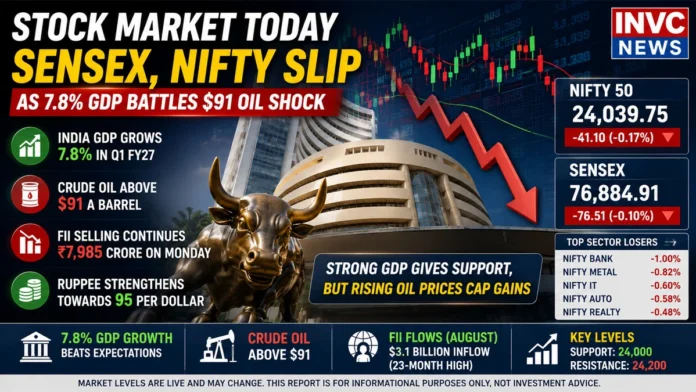
In early Tuesday trade, the Nifty 50 slipped around 0.17% to 24,039.75, while the BSE Sensex traded about 0.1% lower at 76,884.91.
The market avoided a deeper selloff as India’s powerful economic-growth numbers provided domestic support, but rising oil prices prevented bulls from taking control.
Bank Stocks Drag as Most Sectors Turn Red
The weakness was broader than the relatively small decline in the headline indices suggested.
Around 12 of the 16 major sectoral indices were trading lower during early trade.
Banking stocks were among the weakest pockets, with the banking index falling around 1% after outperforming in the previous session.
The broader market also remained under pressure.
Mid-cap shares fell roughly 1%, while the small-cap index declined around 0.2%, signalling that risk appetite remained cautious beyond the Sensex and Nifty.
India’s 7.8% GDP Growth Stops a Bigger Market Fall
Domestic economic data provided the biggest positive trigger.
India’s economy expanded 7.8% year-on-year during the April-June quarter of FY2026-27, beating the roughly 7.1% expectation of economists and the Reserve Bank of India’s 7% projection.
Strong investment, manufacturing activity and domestic consumption helped deliver the better-than-expected performance.
For equity investors, the number strengthens the argument that India’s underlying economy remains resilient even as international conditions become increasingly difficult.
The GDP surprise may therefore be one reason the Sensex and Nifty have not reacted more severely to the latest global risk-off environment.
Crude Above $91 Becomes the Biggest Threat
The problem for Dalal Street is oil.
Global crude prices climbed above $91 a barrel as tensions between the United States and Iran intensified.
Expensive crude is particularly important for India because the country imports most of its oil requirement.
Higher energy costs can increase inflation, widen India’s import bill, pressure the rupee and squeeze margins for fuel-sensitive businesses.
A sustained rise in oil can therefore become a significant headwind for aviation, paints, chemicals, logistics, tyres and other energy-intensive sectors.
Also Read – : Crude Oil Surge Seen Pressuring Indian Markets: Sensex, Nifty May Face Volatility
Global Bond Selloff Adds Another Headache
Oil is not the only problem.
A global bond selloff has pushed sovereign yields sharply higher.
The US 10-year Treasury yield rose to approximately 4.78%, approaching a 20-month high.
Higher bond yields can make equities relatively less attractive and increase global funding costs.
Asian markets also remained under pressure, adding to cautious sentiment in India.
FIIs Sold Nearly ₹8,000 Crore on Monday
Foreign flows remain another major factor to watch.
Foreign institutional investors sold approximately ₹7,985.88 crore worth of Indian equities on Monday.
Domestic institutional investors provided significant support by buying around ₹4,588.88 crore.
That domestic buying helped absorb some of the foreign selling pressure.
Interestingly, the larger monthly picture is improving.
Foreign portfolio investors pumped roughly $3.1 billion into Indian equities during August, marking the strongest monthly foreign buying in around 23 months.
The recovery has been helped by improving corporate earnings expectations and reduced concerns around rupee volatility.
Rupee Strengthens Towards 95 Per Dollar
The Indian rupee offered another small positive signal.
The currency strengthened towards 95.0250 per US dollar in early trade, compared with its previous close of 95.1625.
Market participants said RBI intervention likely helped support the currency before the domestic market opened.
A relatively stable rupee is important for equities because persistent currency weakness can discourage foreign investors and increase India’s imported inflation risk.
Nifty 24,000 Becomes the Key Level to Watch
For traders, 24,000 has emerged as the crucial immediate support zone for the Nifty.
A sustained break below this level could increase pressure and potentially bring the 23,900-23,800 region into focus.
On the upside, the index faces immediate resistance near 24,200, followed by a stronger hurdle around 24,300-24,400.
These are technical market levels and should not be treated as investment recommendations.
Why Monday’s Close Matters
Indian benchmarks entered Tuesday after a weak Monday session.
The Nifty had ended at 24,080.40, down 95.25 points or around 0.39%, while the Sensex lost roughly 307 points.
Higher crude oil prices and geopolitical uncertainty had already started weighing on sentiment before Tuesday’s session began.
Also Read – : Stock Market Today: Sensex, Nifty Struggle as Crude Nears $94
What Investors Should Watch Today
Three forces are now pulling the market in opposite directions.
First, India’s 7.8% GDP growth and improving corporate earnings provide fundamental support.
Second, crude oil above $91 and escalating Middle East tensions raise inflation and currency risks.
Third, foreign flows remain unpredictable despite August’s strong comeback.
If crude begins cooling and geopolitical tensions ease, India’s strong GDP numbers could quickly return to the centre of the market narrative.
However, if oil rises further and the Nifty decisively loses 24,000, volatility could increase.
For now, Dalal Street appears caught between India’s strong domestic growth story and an increasingly difficult global environment.
Market levels are live and may change rapidly during the trading session. This report is for informational purposes and does not constitute investment advice.