By Team INVC | INVC NEWS
Published: August 30, 2026 | 12:47 PM IST
KATHMANDU, Nepal | August 30, 2026 —
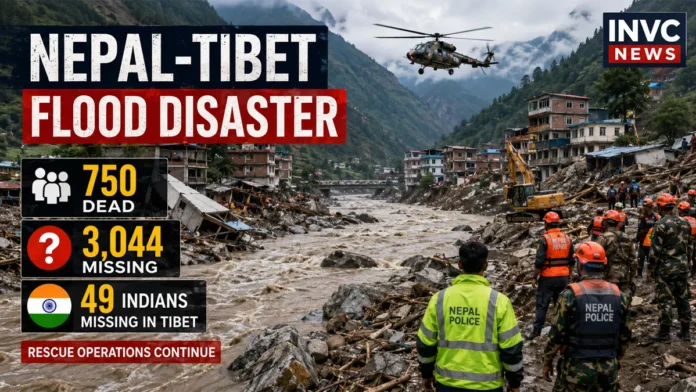
The Nepal-Tibet flood disaster has deepened into one of the Himalayan region’s deadliest recent natural catastrophes, with the combined death toll reaching 750 and 3,044 people still missing as rescuers battle rising rivers, unstable slopes and damaged infrastructure.
The latest Nepal government figures show 734 people dead and 2,498 missing in the country. Authorities say 8,186 people have been rescued, including 227 foreign nationals. Across the border in Tibet, Chinese authorities have reported 16 deaths and 546 people missing.
For India, the most worrying new development is the first detailed nationality breakdown from the Tibetan side. Of 261 foreign nationals from 23 countries reported missing in Tibet, 49 are Indians. The list also includes 104 Nepalis, 33 Latvians, 18 Americans and 15 British nationals.
49 Indians Missing in Tibet as Search Intensifies
The figure of 49 Indians relates specifically to people reported missing on the Tibetan side of the disaster zone.
It should not be confused with the wider number of foreign nationals missing in Nepal, where authorities say 589 foreigners remain unaccounted for. Nepal has not yet published a complete nationality-by-nationality breakdown of that group.
This distinction is critical because the disaster has affected travellers, workers, local communities and people moving through the wider Nepal-Tibet Himalayan corridor.
The Embassy of India in Kathmandu is working with Nepali authorities and Nepal Police to identify Indian nationals among victims and ensure identified mortal remains are handed over to their families.
Nepal Says 734 Dead, 2,498 Still Missing
Nepal’s National Disaster Risk Reduction and Management Authority said in its Sunday morning update that 734 bodies and human remains had been recovered across affected districts.
Another 2,498 people remain missing, including 933 workers connected with hydropower projects and hundreds of foreign nationals.
Nearly 19,900 security personnel have been deployed for search, rescue and relief operations, while 8,186 people have been brought to safety.
The scale of the catastrophe stretches far beyond the immediate border zone. Floodwaters and debris have swept downstream through river systems, damaging settlements, roads, bridges and hydropower infrastructure.
Hundreds Feared Trapped Around Hydropower Tunnels
Rescue teams are now giving particular attention to hydropower facilities, where hundreds of workers have been listed among those missing.
The torrent of water, ice, rock, mud and debris overwhelmed parts of the Himalayan river system with extraordinary force. Difficult terrain and unstable conditions have repeatedly complicated access to affected sites.
Indian and Chinese technical experts are assisting Nepal in specialised operations, including attempts to access affected tunnels. Nepal has said that while it can manage much of the general rescue operation, it needs international technical expertise in areas such as tunnel rescue, DNA testing and forensic identification.
Fresh Rain Raises Fear of Another Flood
The danger has not ended.
Fresh rainfall caused water levels in the Trishuli River to rise again on Sunday, forcing residents and some rescuers toward higher ground.
Authorities are also closely monitoring new pools and temporary dams created by landslides and debris. A large upstream lake that earlier threatened rescue operations had substantially drained, but another landslide was detected downstream, creating a fresh accumulation of water.
Nepal’s Department of Hydrology and Meteorology continues to issue weather and flood information as search operations continue.
What Caused the Nepal-Tibet Disaster?
The disaster began on August 26 after an enormous mass of ice, rock and debris collapsed in the high Himalayan region and sent destructive floodwaters through the Bhote Koshi-Trishuli river system.
However, Nepal’s Foreign Ministry has cautioned that the precise cause has not yet been fully determined.
Chinese authorities have linked the glacier instability to the longer-term effects of global warming and say the episode illustrates growing risks across the Tibetan Plateau’s frozen mountain environment. Scientists are continuing to examine the precise sequence that led to the collapse.
India Sends Multiple Tranches of Relief to Nepal
India has been supporting Nepal since the early stage of the catastrophe.
Prime Minister Narendra Modi spoke with Nepal Prime Minister Balendra Shah on August 26 and said India was ready to provide all possible humanitarian assistance. Indian teams have been coordinating with Nepali authorities on rescue and relief operations.
The Indian Embassy has since handed over several consignments of humanitarian assistance. Supplies have included food, medicines, water-purification material, portable generator sets and dignity kits.
Also Read – : Kailash Mukti Yatra Roars From Delhi to Gangotri as Supporters Call for Kailash Corridor
Also Read – : Nepal Tightens Border Rules: What Indian Travellers Should Know
Indian Embassy Helpline Numbers
Indian nationals seeking information or assistance related to the Nepal floods can contact the Embassy of India in Kathmandu on:
+977 985 131 6807
+977 970 910 7500
+977 981 032 6117
Email: eoikathmandufloodsupport@gmail.com
The Embassy says the emergency numbers are also available on WhatsApp.
Embassy of India, Kathmandu — Official Flood Assistance Information
Nepal Foreign Ministry — Official Bhote Koshi Flood Briefing
Rescue operations remain active and the figures could change rapidly as more missing people are located and victims are identified.