By Team INVC | INVC NEWS
Published: August 29, 2026 | 13 : 46 PM IST
MUMBAI, INDIA | August 29, 2026 —
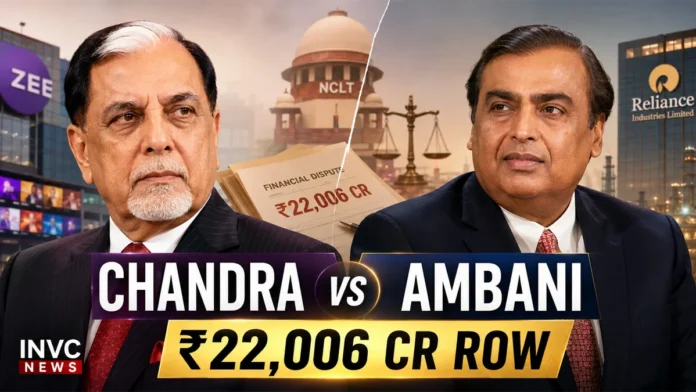
A high-stakes corporate dispute involving Zee founder Subhash Chandra and Reliance Industries Chairman Mukesh Ambani has burst into the open, transforming an already controversial insolvency case into a personal battle between two of India’s best-known business figures.
Chandra has directly accused Reliance-linked media entities of spreading what he described as “wrong propaganda” about his personal insolvency proceedings and has revived allegations surrounding the old Zee-Invesco corporate battle.
Reliance has rejected the accusations as baseless, saying its media businesses have never been used to target individuals and that the group continues to hold Chandra in high regard as an entrepreneur.
And at the center of the entire confrontation is one eye-popping set of numbers:
₹22,006.57 crore in admitted claims — and a repayment plan involving roughly ₹6.5 crore.
But those numbers need context before conclusions are drawn.
Why ₹22,006 Crore vs ₹6.5 Crore Has Exploded
On August 25, the National Company Law Tribunal approved a repayment plan in the personal-guarantor insolvency proceedings involving Chandra.
The proceedings involve approximately ₹22,006.57 crore in admitted creditor claims, while the approved plan provides approximately ₹6.25 crore for creditors, plus around ₹25 lakh toward insolvency-process costs.
Creditors supporting the repayment plan represented about 80.81% of voting value, according to the tribunal proceedings.
On the surface, that produces a recovery of roughly 0.03%.
That is why descriptions of a 99.97% haircut have dominated the discussion.
But there is a crucial distinction.
The ₹22,006 crore figure should not simply be described as money personally borrowed by Subhash Chandra.
The proceedings arise substantially from personal guarantees Chandra provided for loans taken by Essel Group-linked companies.
Chandra has strongly objected to coverage that, in his view, makes it appear that he personally borrowed ₹22,000 crore and is now walking away after paying ₹6.5 crore.
Chandra Takes the Fight Directly to Mukesh Ambani
The dispute became far more dramatic when Chandra addressed Mukesh Ambani directly in a video message.
He urged Ambani to “stop the wrong propaganda” against him and his group, while questioning the way his insolvency case was being presented by Reliance-linked media outlets.
Chandra specifically objected to the impression that the NCLT had simply erased a ₹22,000-crore personal loan in return for ₹6.5 crore.
But he did not stop there.
The Zee founder reopened an older and much more explosive chapter involving Zee Entertainment, Invesco and Reliance.
The Old Zee-Invesco Battle Is Back
In 2021, major Zee shareholder Invesco sought changes to Zee Entertainment’s board.
During that corporate struggle, discussions also took place over a potential transaction involving Reliance’s media businesses and Zee.
Reliance later acknowledged that such discussions had occurred, although no transaction was ultimately completed.
Zee later pursued its high-profile merger with Sony, which eventually collapsed in January 2024.
Chandra is now linking that old battle with his current accusations.
He has alleged that interests associated with Reliance sought influence or control over Zee through the Invesco episode and has questioned whether the proposed arrangement would have protected Zee’s minority shareholders.
Those are Chandra’s allegations.
They have not been independently established as fact.
Chandra Also Revives 2019 Zee Share-Price Allegations
Chandra has gone further by revisiting the dramatic fall in Zee-related shares during his group’s financial crisis in 2019.
He alleged that entities associated with Ambani played a role in the market activity surrounding that episode and raised allegations involving entities he described as difficult to trace.
Again, these are serious allegations made by Chandra, not findings by a regulator or court.
Reliance has broadly rejected his accusations as unfounded.
For INVC NEWS, that distinction is critical:
Allegation is not proof.
Reliance Hits Back: Claims Are ‘Baseless’
Reliance’s response has been unusually direct.
The group said it was dismayed by Chandra’s statements and strongly denied allegations involving its media businesses.
Reliance said its media brands have never been used to attack anyone and would not be used for such a purpose.
At the same time, the group struck a relatively restrained personal tone, saying it continued to hold Chandra in high regard as a businessman and entrepreneur.
So while Chandra’s comments were personal and combative, Reliance’s response focused on denying the accusations rather than matching the rhetoric.
Is the ₹22,006-Crore Haircut Really That Simple?
No.
This is where the story becomes more complicated than the viral number.
Chandra has argued that the total ₹22,006-crore figure combines claims arising from guarantees for several corporate borrowers and should not be equated with his own personal borrowing.
He has separately said that claims relating to lenders challenging the resolution amount to around ₹3,992 crore, not the full ₹22,006 crore headline figure.
At the same time, lenders have legitimate reasons to question the extremely low recovery from Chandra’s personal estate.
The tribunal process therefore raises two separate issues:
How much can realistically be recovered from the personal guarantor?
and
What rights do creditors retain against the original borrowing companies and their assets?
Those are not the same question.
HDFC Bank and LIC Housing Finance Could Keep the Battle Alive
The insolvency controversy may also be far from over.
HDFC Bank and LIC Housing Finance are among lenders reported to be preparing challenges to the NCLT-approved resolution arrangement because of the low recovery available under the repayment plan.
That means the legal battle could continue even while the corporate war of words escalates publicly.
The case could therefore develop on two tracks at the same time:
Courtroom: disputes over the insolvency resolution.
Corporate battlefield: Chandra versus Reliance over media coverage and the history of Zee.
Who Exactly Is Subhash Chandra Today?
It is also worth being precise with terminology.
Subhash Chandra is Zee Entertainment’s founder and Chairman Emeritus and the founder of Essel Group.
He should not simply be described as the current “owner of Zee.”
Zee’s own corporate leadership materials identify Chandra as Chairman Emeritus.
That distinction matters because Chandra himself has emphasized that Zee Entertainment is a listed company and should not be treated as his personal property.
Why This Fight Matters Beyond Two Billionaire-Era Businessmen
This is bigger than a personal exchange.
It brings together:
India’s insolvency system
personal guarantees by promoters
bank recovery
media ownership
corporate takeover battles
minority shareholder interests
and the extraordinary power that large business groups can wield in public narratives.
It also raises an uncomfortable public-policy question:
When enormous corporate borrowing is backed by a personal guarantee, what does that guarantee actually deliver if the guarantor’s recoverable personal assets are limited?
That question may ultimately matter much more than the war of words.
For now, however, the ₹22,006-crore controversy has become something much more dramatic.
A complicated insolvency proceeding has turned into a public confrontation between Subhash Chandra and Mukesh Ambani—with Zee, Reliance, Invesco and one of India’s biggest corporate battles suddenly back in the spotlight.