By Team INVC | INVC NEWS
Published: August 29, 2026 |13 : 21 PM IST
BENGALURU, INDIA | August 29, 2026 —
India’s Global Capability Centre boom is creating a new career opportunity—but the hiring market is no longer rewarding generic technology skills the way it once did.
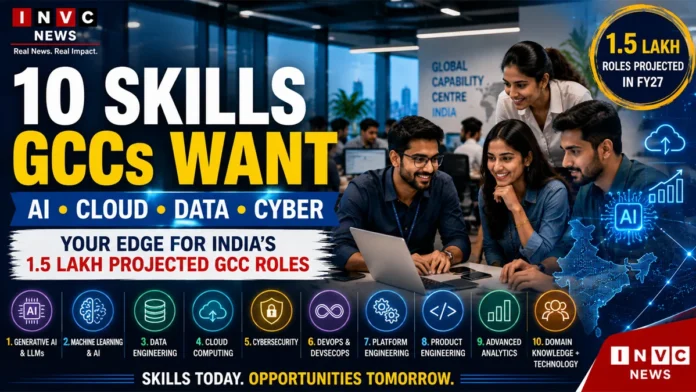
With around 1.5 lakh new GCC roles projected for FY27, candidates with expertise in artificial intelligence, cloud, cybersecurity, data and product engineering could have a significant advantage as global companies expand high-value operations in India.
The latest GCC hiring outlook shows that 52% of centres plan to increase headcount, while employers also report a growing gap between the skills candidates claim and what they can actually demonstrate. Nearly half of surveyed GCCs said more than a quarter of their open positions now require AI-related capabilities.
That means the question for job seekers is changing.
It is no longer simply:
“Which company is hiring?”
It is increasingly:
“Which skills are companies willing to hire for?”
1. Generative AI and Large Language Models
Generative AI is moving rapidly from experimental projects into day-to-day enterprise systems.
GCCs increasingly need professionals who understand:
- Large Language Models
- Prompt design
- Retrieval-Augmented Generation
- Model evaluation
- AI agents
- Enterprise AI integration
Candidates do not necessarily need to become AI researchers.
But software engineers, analysts and product professionals who can use GenAI inside real business workflows are becoming more valuable.
2. Artificial Intelligence and Machine Learning
Traditional machine-learning capabilities remain essential even as GenAI dominates headlines.
High-demand skills include:
- Python
- Machine-learning pipelines
- Natural Language Processing
- Computer vision
- Model deployment
- MLOps
Taggd identifies AI and ML engineers among the high-demand roles as Indian GCCs move from support operations toward innovation and product ownership.
3. Data Engineering
AI cannot work effectively without reliable data.
That is why data engineering is becoming one of the foundations of the GCC technology stack.
Employers increasingly need professionals who can build:
- Data pipelines
- Data warehouses
- Data lakes
- Real-time data systems
- Data quality frameworks
- Cloud-based analytics infrastructure
For many professionals, data engineering may offer a broader employment opportunity than becoming a pure AI specialist.
4. Cloud Computing
As global companies shift more workloads to cloud infrastructure, GCCs need professionals who understand platforms such as:
AWS, Microsoft Azure and Google Cloud.
Useful skills include:
- Cloud architecture
- Cloud-native applications
- Containers
- Kubernetes
- Infrastructure automation
- Multi-cloud environments
Cloud expertise is increasingly being combined with security and DevOps rather than treated as a standalone skill.
5. Cybersecurity
More digital systems mean more attack surfaces.
Cybersecurity therefore remains one of the strongest defensive technology hiring areas.
Important capabilities include:
- Cloud security
- Zero-trust architecture
- Identity and access management
- Threat detection
- Security operations
- Application security
- AI-related security risks
As GCCs take ownership of global platforms and sensitive business data, cybersecurity becomes a core business requirement rather than simply an IT support function.
6. DevOps and DevSecOps
Companies want software to move from development to production faster—but without compromising stability or security.
That creates demand for:
DevOps engineers, DevSecOps specialists and automation professionals.
Relevant capabilities include:
- CI/CD
- Docker
- Kubernetes
- Infrastructure as Code
- Automation
- Monitoring
- Security integration
These skills are particularly useful for software engineers looking to move into infrastructure and platform roles.
7. Platform Engineering and Site Reliability Engineering
Platform engineering is gaining importance as companies try to make software development faster and more standardized.
Site Reliability Engineers, meanwhile, help ensure that large digital platforms remain available and resilient.
Taggd highlights both platform-related capabilities and site reliability as valuable roles as GCCs mature technologically.
8. Product Engineering and Full-Stack Development
Coding is not disappearing.
But the market increasingly rewards engineers who understand complete products, not just isolated programming tasks.
Strong candidates can combine:
- Backend development
- Frontend development
- APIs
- Cloud
- Databases
- System design
- AI-enabled features
India’s product-engineering talent market is becoming increasingly competitive as GCCs take responsibility for products from design through global deployment.
9. Advanced Analytics
Companies have enormous amounts of data but still need professionals who can convert it into useful decisions.
Advanced analytics roles can involve:
- Predictive analytics
- Business intelligence
- Data visualization
- Statistical modelling
- Customer analytics
- Financial analytics
This is especially useful for professionals who combine technical skills with knowledge of industries such as banking, retail, healthcare or manufacturing.
10. Domain Knowledge + Technology
This may ultimately become the most valuable skill combination.
Companies increasingly want professionals who understand both technology and the business problem it is supposed to solve.
Examples include:
AI + Banking
Data + Healthcare
Cybersecurity + Financial Services
Cloud + Retail
Software + Automobile Engineering
Analytics + Supply Chain
This creates an opportunity even for professionals who do not come from pure computer-science backgrounds.
Generalist Hiring Is Giving Way to Specialist Hiring
The broader change is important.
GCCs are moving away from the older model of mass recruitment built largely around cost advantages.
More centres are looking for professionals who can directly contribute to:
innovation, product development, automation, resilience and global decision-making.
Taggd describes this as a shift from hiring for scale toward hiring specialized capabilities such as AI, cloud engineering, cybersecurity, data science and advanced product functions.
Also Read – : Jobs & Careers News: Hiring, Layoffs, Exams and Opportunities
Freshers Still Have an Opportunity
The shift toward specialization does not mean fresh graduates have been shut out.
Current GCC projections suggest freshers could represent around 16% of hiring, while professionals with one to five years of experience may account for another 30%.
Together, that means nearly half of projected recruitment could involve freshers or relatively early-career professionals.
The challenge is demonstrating practical ability.
Candidates who can show:
projects, internships, GitHub work, certifications, portfolios or real problem-solving experience
may stand out more than applicants relying only on degree titles.
The Career Lesson From Layoffs and Hiring
The employment market in 2026 contains two apparently contradictory stories.
Companies are eliminating thousands of traditional positions.
At the same time, they are struggling to recruit professionals with advanced capabilities.
Also Read – : Volkswagen Layoffs 2026: 50,000 Job Cuts and September 4 Showdown
That is why job seekers should not interpret every layoff announcement as evidence that technology employment is disappearing.
A large part of the workforce is being reconfigured around different skills.
For candidates targeting India’s expanding GCC ecosystem, the biggest advantage may therefore come from combining one strong technology capability with meaningful business knowledge.
The future job market may reward fewer generalists.
But for specialists who can demonstrate what they know, the opportunities could be substantial.