By Team INVC | INVC NEWS
Published: August 29, 2026 | 10 : 21 AM IST
TOKYO, JAPAN | August 29, 2026 —
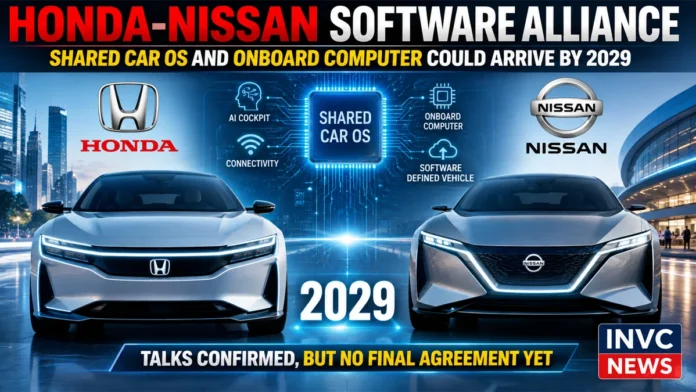
The Honda Nissan software alliance is suddenly back in the spotlight, with the two Japanese auto giants moving toward a potentially major agreement to jointly develop the digital brain of their future cars.
Honda and Nissan are discussing a shared vehicle operating system and common onboard computer architecture that could begin appearing in new vehicles as early as 2029.
An agreement could reportedly be reached as soon as Monday.
But there is one important caution:
Honda and Nissan have confirmed the talks, but no final agreement has been signed yet.
If the deal goes ahead, it would mark one of the strongest signs yet that the two companies still see each other as strategic technology partners—even after abandoning their much bigger merger plan.
Merger Failed, But Honda-Nissan Partnership Is Not Dead
Honda and Nissan stunned the auto industry in February 2025 when they ended talks that could have created a massive combined automotive group.
But the collapse of the merger did not end cooperation between them.
The companies explicitly kept their strategic partnership alive, particularly around:
- Electrification
- Software-defined vehicles
- Artificial intelligence
- Connectivity
- Advanced driver-assistance systems
- Next-generation vehicle platforms
Now software appears to be emerging as the area where cooperation could become much deeper.
Also Read – : Global Automotive Market Is Changing Fast as EVs, AI and Software Reshape the Industry
The Real Prize: One Digital Brain for Future Cars
Modern cars are rapidly becoming computers on wheels.
Instead of dozens of separate electronic control units independently managing different vehicle functions, automakers are moving toward more powerful centralized computers controlled by sophisticated software.
Honda and Nissan are now considering jointly developing two crucial pieces of that future architecture:
A common vehicle operating system
and
A shared onboard computer.
The operating system could manage functions ranging from infotainment and connectivity to driver assistance and vehicle controls.
The onboard computer would provide the processing power behind those functions.
Together, they could form the backbone of future software-defined vehicles, or SDVs.
Why Honda and Nissan Need Each Other
Developing automotive software is expensive.
Automakers are competing not only with each other but increasingly with technology-heavy rivals from China and companies such as Tesla.
Software now determines how quickly manufacturers can add features, improve autonomous-driving systems, update vehicles remotely and integrate AI.
Building separate software ecosystems requires billions of dollars and large engineering teams.
By sharing development, Honda and Nissan could:
- Cut research and development costs
- Speed up new vehicle launches
- Share software engineers and expertise
- Improve AI and autonomous-driving capabilities
- Standardize electronic architecture
- Respond faster to Chinese EV competition
The alliance therefore has a simple commercial logic:
Share the expensive digital backbone, while continuing to sell cars under separate brands.
Mitsubishi Could Also Enter the Picture
Mitsubishi Motors has previously participated in the broader strategic framework involving Honda and Nissan.
That means the software platform could eventually become larger than a two-company project.
A shared architecture used across multiple brands would create greater scale and could reduce component and development costs further.
However, the exact role Mitsubishi could play in the newly reported software plan has not yet been finalized.
2029 Could Be the Turning Point
The proposed timeline is aggressive.
Reports suggest vehicles using the jointly developed software and onboard computer could arrive as early as 2029.
That would give Honda and Nissan only a few years to move from cooperation discussions to production-ready technology.
The clock matters because global competition is moving extremely quickly.
Chinese automakers are rolling out vehicles with advanced connected services, AI-powered cockpits and frequent over-the-air software updates.
Traditional manufacturers can no longer afford development cycles that take most of a decade.
What Could This Mean for India?
India could eventually become an important market for the technology—but no Indian rollout has been announced.
Honda already signaled the strategic importance of India’s digital ecosystem earlier this year when it established Honda Digital Innovation India Private Ltd. in Bengaluru.
The company said India would serve as an important growth market and highlighted the country’s AI talent and digital capabilities.
That creates an interesting possibility.
A future Honda-Nissan software ecosystem could eventually involve Indian engineering talent, digital services or locally sold vehicles.
But for now, consumers should not assume that a specific Honda or Nissan model sold in India will receive the new operating system in 2029.
Also Read – : India Electric Passenger Vehicle Registrations Jump 90% as EV Demand Accelerates
Honda Confirms Talks—But Says Nothing Is Final
This is the most important distinction in the story.
Honda has acknowledged that discussions are continuing over possible areas of cooperation.
Nissan has also confirmed that it is exploring collaboration.
But neither company has announced a final agreement for the shared operating system and onboard computer.
Therefore:
2029 is a target under discussion—not a confirmed launch date.
The next major development could arrive as early as Monday if the companies formalize the arrangement.
From Merger Failure to Software Comeback
The Honda-Nissan relationship has gone through an extraordinary transformation.
First came strategic cooperation.
Then came merger talks.
Then the merger collapsed.
Now both companies appear ready to pursue something potentially more practical:
Build the technology together without becoming one company.
If the agreement is finalized, Honda and Nissan may have found a middle path—remaining fierce competitors in showrooms while joining forces behind the dashboard.
And in the emerging era of software-defined cars, the code running inside the vehicle could ultimately become just as important as the badge on its hood.