By Team INVC | INVC NEWS
Published: August 29, 2026 | 10 : 15 AM IST
KATHMANDU, NEPAL | August 29, 2026 —
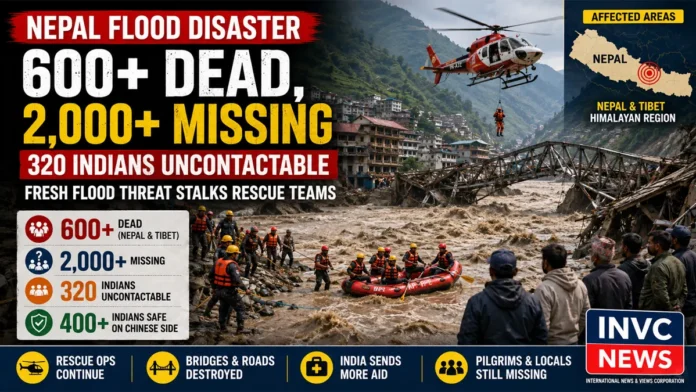
The Nepal flood disaster has entered an even more desperate phase, with the combined death toll across Nepal and Tibet rising above 600, more than 2,000 people still unaccounted for, and hundreds of Indian families waiting for news of relatives caught in the Himalayan catastrophe.
For India, the most alarming number remains 320 Indian nationals who were still missing or uncontactable in the latest official update.
More than 100 people of Indian origin were also reported missing, while around 400 Indian nationals stranded on the Chinese side were confirmed safe.
The disaster, triggered after a catastrophic glacier collapse unleashed rock, ice, mud and water through Himalayan river systems, has destroyed settlements, bridges, roads and hydropower infrastructure near the Nepal-China border.
And the danger is not over.
Rescue teams are still dealing with unstable terrain, blocked rivers and the threat of secondary flooding.
320 Indians Still Uncontactable
India has intensified efforts to trace citizens caught in the disaster, many of whom were travelling through the region as part of Kailash Mansarovar pilgrimage groups.
The Ministry of External Affairs said the number of Indian nationals who remained uncontactable had risen to 320 in its latest update.
At the same time, there has been some relief.
Around 400 Indians on the Chinese side of the border have been confirmed safe, while dozens of rescued Indians have already crossed back into Nepal or returned home.
Twenty-one rescued residents of Tamil Nadu were among those who arrived in New Delhi from Kathmandu.
But for hundreds of families, the wait continues.
India Sends More Aid and Medical Support
India has stepped up relief support for Nepal.
Additional humanitarian supplies and a medical team have been sent as authorities shift from immediate rescue toward increasingly complex recovery operations.
Indian assistance includes medical personnel, relief material and support for specialized rescue work.
Nepal has also requested Bailey bridges to restore critical transport links where bridges have been swept away.
The destruction of roads and bridges has made it extremely difficult to reach some affected communities by land.
Also Read – : Kailash Mukti Yatra Calls for Easier and Safer Access to Kailash Mansarovar
Nepal Says It Can Handle General Rescue—But Needs Technical Help
Kathmandu has taken an unusual position on international rescue assistance.
Nepal says its own army, police and rescue agencies can handle general search-and-rescue operations.
But Foreign Minister Shisir Khanal says the country urgently needs foreign technical assistance in areas where Nepal lacks specialist capability.
These include:
- Rescuing people trapped inside tunnels
- DNA identification of bodies
- Preserving bodies for longer periods
- Reopening destroyed transport links
- Restoring communications
- Building temporary bridges
Reports indicate that some people may still be trapped inside tunnels at damaged hydropower facilities.
That has created a new race against time.
Hospitals Struggle as More Bodies Are Recovered
The human toll is continuing to rise far from the original flood zone.
Bodies swept downstream have reportedly been recovered in areas including Chitwan and Nawalparasi, around 100 km from the worst-hit region.
Some hospitals are struggling with the number of bodies arriving and do not have enough refrigeration capacity for long-term preservation.
Authorities expect additional victims to be found as rescue teams reach previously inaccessible areas.
That means the current death toll may not be final.
More Than 2,000 People Still Missing
The scale of the missing-person crisis remains extraordinary.
More than 2,000 people were still unaccounted for in the latest international updates.
The missing include Nepalese residents, Chinese nationals, Indian pilgrims and visitors from several other countries.
France, Australia, South Korea and other governments are also attempting to trace citizens who were in the disaster zone.
The Gyirong border crossing—an important route between Nepal and Tibet and a gateway used by many Kailash Mansarovar travellers—was among the areas devastated.
Fresh Flood Threat Keeps Rescue Teams on Edge
Even as rescuers search through mud and debris, authorities are monitoring unstable lakes and blocked waterways in the mountains.
The original glacier collapse created massive debris flows capable of blocking rivers and forming temporary lakes.
If one of those natural barriers fails suddenly, another wall of water can surge downstream.
That threat has already interrupted rescue operations.
More than 90,000 people have been directly affected by the wider Himalayan disaster, according to humanitarian agencies.
Health officials are also warning about sanitation problems, contaminated water and the possibility of infectious disease outbreaks among displaced populations.
Entire Infrastructure Network Has Been Torn Apart
The catastrophe has damaged far more than houses.
Authorities have reported destruction involving:
- Roads
- Bridges
- Schools
- Hospitals
- Hydropower facilities
- Communication networks
- Border infrastructure
About two dozen bridges have been destroyed in affected areas.
The damage to hydropower plants could become particularly significant because Nepal relies heavily on hydroelectricity.
Even after the search for missing people ends, reconstruction could take years.
Kailash Mansarovar Route Faces Major Disruption
For Indian travellers, the disaster has also raised urgent questions about movement through Nepal and Tibet.
The border region is closely connected with pilgrimage and tourism routes used by travellers heading toward Mount Kailash and Lake Mansarovar.
Families with relatives travelling in the region should rely on official government and tour-operator confirmation rather than unverified social-media lists.
Also Read – : Amarnath Yatra 2026 Guide: Routes, Registration, Health Certificate and Safety Rules
The Rescue Operation Is Becoming a Recovery Operation
Three days after the glacier collapse, the nature of the emergency is changing.
Helicopters are still moving survivors.
Search teams are still digging through debris.
Families are still scanning lists for familiar names.
But with more bodies being recovered far downstream and entire settlements destroyed, authorities are increasingly preparing for a long-term recovery and reconstruction effort.
Nepal says international support will be particularly important for rebuilding schools, hospitals, energy facilities, bridges and transport infrastructure.
For India, the immediate priority remains tracing the hundreds of citizens who are still out of contact.
More than 600 dead.
More than 2,000 missing.
320 Indians still uncontactable.
Those numbers explain why the Himalayan disaster remains one of Asia’s biggest unfolding emergencies today.