By Team INVC | INVC NEWS
Published: August 29, 2026 | 09 : 27 AM IST
JALNA, INDIA | August 29, 2026 —
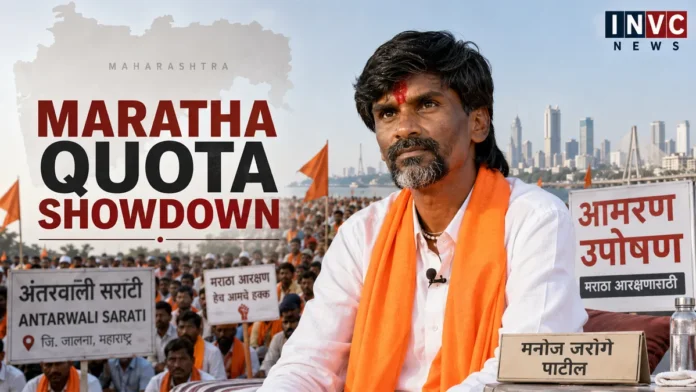
The Manoj Jarange hunger strike has pushed Maharashtra’s Maratha reservation battle back into confrontation mode, with the activist beginning what he calls his “final and decisive” fast at Antarwali Sarati on Saturday and warning that the agitation could eventually move to Mumbai if the state government fails to act.
Jarange’s immediate demand is clear: eligible Marathas whose genealogical links to historical Kunbi records have already been established should receive Kunbi caste certificates and validity documents without further delay.
The protest comes after another round of talks with the Maharashtra government failed to produce a settlement acceptable to Jarange.
And this time, he is raising the pressure.
If the government does not move, Jarange says the movement may move to Mumbai.
‘Come Out to Save Your Children’s Future’
Ahead of the fast, Jarange appealed to Maratha community members to gather at Antarwali Sarati in large numbers.
His message was particularly directed at families who say their historical Kunbi records have been traced but certificates have still not been issued, as well as applicants whose requests have allegedly not been accepted.
Jarange has accused the government of moving too slowly despite assurances given during earlier rounds of the agitation.
He has also directly targeted Chief Minister Devendra Fadnavis, Deputy Chief Minister Eknath Shinde and Maratha reservation cabinet subcommittee chief Radhakrishna Vikhe Patil, intensifying the political temperature around the protest.
The 58-Lakh Kunbi Records Battle
At the heart of the latest confrontation is a number that has become politically explosive:
58.90 lakh Kunbi-related historical records.
According to a government status report presented to Jarange, authorities have traced 58,90,145 records containing Kunbi-related references across Maharashtra.
But that does not mean 58.90 lakh people automatically qualify for OBC certificates.
The state argues that officials must first establish an applicant’s genealogical relationship with the person named in a historical record.
Government data cited in the latest discussions shows that since October 2023:
- 14,31,634 applications for Kunbi caste certificates have been received.
- 14,24,639 certificates have been issued.
- 5,248 applications have been rejected.
- 1,747 applications remained pending in the latest status report.
Jarange’s argument is that the government is focusing on the number of records discovered while eligible families are still struggling to convert those records into actual certificates.
Government Says Genealogy Cannot Be Bypassed
The Maharashtra government disputes the idea that finding an old Kunbi entry should automatically result in a certificate.
Its position is that officials must verify the family lineage connecting an applicant to the historical record before OBC documentation can legally be issued.
Taluka-level committees headed by tehsildars are carrying out that process.
The government has also extended the work of genealogy-verification committees and says officials have been instructed to deal with pending applications more quickly.
That creates the central conflict:
Jarange wants faster certificates.
The government says legal verification still has to happen.
Jarange Warns: Next Stop Could Be Mumbai
The politically explosive part of Jarange’s latest announcement is his warning over Mumbai.
He has said that if the Mahayuti government does not accept the community’s demands, Maratha supporters could move toward Mumbai in phases.
A similar agitation in Mumbai last year drew thousands of supporters and severely disrupted parts of the city.
Jarange eventually withdrew that protest after the government agreed to implement several demands, including a process linked to historical records and the Hyderabad Gazette.
One year later, Jarange says implementation remains incomplete.
Why August 29 Is Symbolically Important
The timing of the latest fast also carries political symbolism.
The agitation comes around the anniversary period of the 2023 Antarwali Sarati police lathi-charge, an episode that transformed the Maratha reservation campaign into a statewide political issue.
Jarange subsequently emerged as the most recognizable face of the movement.
Since then, Maratha reservation has repeatedly tested successive Maharashtra governments and complicated the balance between Maratha demands and concerns among existing OBC communities.
OBC Politics Makes the Issue Even More Explosive
Granting Kunbi status matters because Kunbis are included within Maharashtra’s OBC framework.
For eligible Marathas, obtaining Kunbi certification could therefore provide access to OBC reservation benefits.
But OBC organizations and political leaders have repeatedly argued that existing reservation benefits should not be diluted.
That means the government faces pressure from both directions.
Moving too slowly risks intensifying the Maratha agitation.
Moving too broadly risks triggering a counter-mobilization among OBC groups.
This is why the dispute is no longer merely administrative.
It has become one of Maharashtra’s most sensitive political balancing acts.
What Happens Next?
The immediate focus is now Antarwali Sarati.
Authorities have increased security around the protest site as supporters gather and the hunger strike gains momentum.
Three developments will determine how quickly the confrontation escalates:
First: whether the Maharashtra government sends another delegation for negotiations.
Second: whether Jarange announces a timeline for moving supporters toward Mumbai.
Third: whether the government issues a fresh GR or administrative order addressing pending Kunbi certificate cases.
Until then, neither side appears ready to retreat.
Jarange has described this as his “final” agitation.
Whether it ends in another negotiated settlement—or brings Maharashtra’s reservation battle back onto the streets of Mumbai—could now become one of the state’s biggest political stories of the coming days.