SEOUL, South Korea | August 27, 2026 —
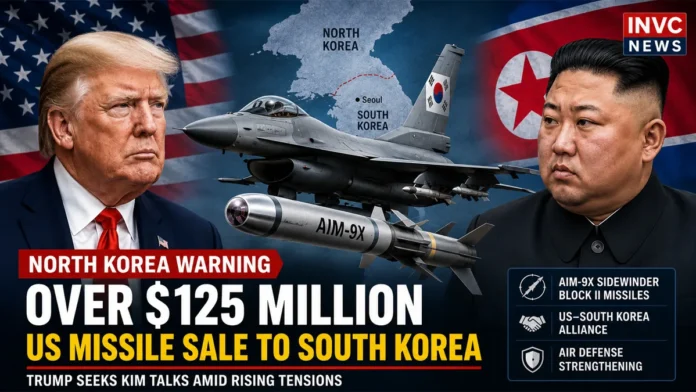
North Korea US arms sale tensions escalated sharply on Thursday after Pyongyang condemned Washington’s proposed $125 million sale of advanced AIM-9X Sidewinder missiles to South Korea and warned that it would deliver a “serious, immediate and powerful response” to what it considers hostile actions.
The warning was issued by a spokesperson for North Korea’s Foreign Ministry and carried by state media KCNA on August 27. Pyongyang described the proposed weapons package as a new threat to its security environment and accused the United States of continuing a hostile policy toward the Democratic People’s Republic of Korea.
The confrontation comes at a sensitive moment because U.S. President Donald Trump has renewed interest in direct diplomacy with North Korean leader Kim Jong Un, raising the prospect of another high-level meeting even as military tensions on the Korean Peninsula remain unresolved.
What Weapons Is the US Planning to Sell South Korea?
The U.S. State Department approved a possible Foreign Military Sale worth an estimated $125 million on August 21.
South Korea has requested:
- 103 AIM-9X Sidewinder Block II tactical missiles
- 10 AIM-9X Sidewinder Block II tactical guidance units
- Training and weapon-system support
- Spare parts
- Technical and logistics assistance
- Related equipment
The principal contractor would be RTX Corporation.
Importantly, this is a proposed Foreign Military Sale, not a completed delivery. The package is subject to the U.S. congressional notification and review process.
Official U.S. State Department information:
Why North Korea Is Angry
Pyongyang argues that the missile sale strengthens South Korea’s offensive and defensive military capabilities while increasing U.S.-South Korean military integration.
North Korea said Washington has approved several advanced weapons packages for Seoul this year and warned that deeper military cooperation among the United States and its allies could worsen the regional security environment.
The North Korean statement characterized the Sidewinder package as evidence that Washington’s underlying policy toward Pyongyang remains hostile despite diplomatic signals from the Trump administration.
That contrast is what makes today’s development politically important.
Washington is simultaneously keeping open the possibility of renewed dialogue while expanding military support for Seoul.
What Is the AIM-9X Sidewinder?
The AIM-9X Sidewinder Block II is an advanced short-range, infrared-guided air-to-air missile used by fighter aircraft.
It is designed to engage hostile aircraft and can contribute to defense against certain airborne threats.
For South Korea, the purchase would strengthen air-defense capability and improve interoperability with U.S. forces.
The U.S. State Department says the proposed sale is intended to help Seoul meet current and future threats, strengthen deterrence and expand its air-defense capabilities. It also says the sale would not alter the basic military balance in the region.
Trump Wants Another Opening With Kim Jong Un
The military dispute is unfolding while President Donald Trump continues to signal interest in renewed contact with Kim Jong Un.
Trump has previously held historic face-to-face meetings with Kim and has again expressed interest in reopening communication.
However, there is currently no confirmed new Trump-Kim summit.
North Korea has shown little public indication that it is ready to restart formal negotiations on Washington’s terms.
That creates an unusual diplomatic equation:
Trump is signaling dialogue, while Pyongyang is warning Washington of a powerful response.
Could North Korea Launch a Missile in Response?
North Korea has not announced a specific missile test or military operation in today’s statement.
This distinction is important.
Pyongyang warned of a strong response to hostile actions, but it did not specify:
- A missile-launch date
- A nuclear test
- An artillery operation
- A military mobilisation
- A target
Therefore, headlines claiming North Korea has already ordered a military strike would be inaccurate.
The next major signal will be whether the warning remains rhetorical or is followed by a concrete military action.
South Korea Is Strengthening Air Defense
Washington says the Sidewinder package would strengthen South Korea’s ability to respond to current and future security threats.
Seoul already operates sophisticated fighter aircraft and works closely with U.S. forces under the longstanding U.S.-South Korea alliance.
The proposed missile sale therefore fits into a much broader effort to improve:
- Air defense
- Fighter interoperability
- Deterrence
- Joint military readiness
- Response to missile and drone threats
Also Read – : South Korea and US Reaffirm North Korea Denuclearization Goal Amid Rising Nuclear Threats
North Korea-US Relations Remain Frozen
Despite intermittent diplomatic signals, the fundamental disagreements between Washington and Pyongyang remain unresolved.
North Korea continues to expand its strategic weapons capabilities, while the United States remains committed to its military alliances with South Korea and Japan.
Washington has also continued to insist on addressing North Korea’s nuclear and missile programmes.
Pyongyang, meanwhile, argues that U.S. military deployments, exercises and weapons sales demonstrate why it needs stronger deterrence capabilities.
That cycle has repeatedly made negotiations difficult.
Why This Matters Beyond the Korean Peninsula
Any escalation involving North Korea has consequences beyond Seoul and Pyongyang.
The Korean Peninsula sits at the intersection of major strategic interests involving:
United States — South Korea — China — Japan — Russia
A serious military confrontation could affect regional markets, supply chains, aviation, shipping and semiconductor production.
South Korea is also home to some of the world’s largest technology and electronics companies, making stability on the peninsula economically important far beyond Northeast Asia.
Trump-Kim Diplomacy Faces a New Test
The political question now is whether Trump’s renewed diplomatic outreach can coexist with continued American military support for South Korea.
For Washington, the two policies are not necessarily contradictory.
The United States can pursue negotiations with Pyongyang while continuing to strengthen an ally’s defenses.
North Korea, however, is signaling that it views those weapons sales as proof that American intentions remain hostile.
That difference in perception could make any future Trump-Kim diplomatic opening much harder.
What Happens Next?
Three developments deserve close attention.
1. North Korea’s Next Military Move
Any missile launch, weapons test or military exercise following today’s warning would significantly escalate the story.
2. Trump’s Response
Any direct statement from Donald Trump addressing North Korea or Kim Jong Un could immediately change the diplomatic angle.
3. Progress of the $125 Million Sale
The weapons package still has to proceed through the U.S. Foreign Military Sales process.
The final value and configuration could differ from the maximum figures announced in the notification.
North Korea Warning: The Key Takeaway
Today’s development does not mean war has begun.
It does not mean North Korea has announced a missile strike.
And it does not mean the $125 million weapons package has already been delivered to South Korea.
What has changed today is Pyongyang’s political response.
North Korea has publicly condemned the proposed U.S. missile sale and warned that future actions it considers hostile could bring an immediate and powerful reaction.
That puts fresh pressure on an already difficult equation for Donald Trump:
How to pursue another opening with Kim Jong Un while simultaneously strengthening America’s military alliance with South Korea.