NEW DELHI, India | August 27, 2026 —
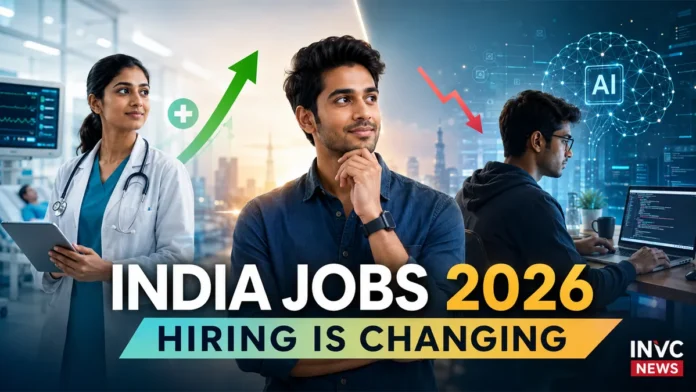
India job market 2026 is showing a striking split: overall hiring demand has returned to growth, but software and traditional IT roles are moving in the opposite direction as healthcare expands and artificial intelligence becomes a requirement across an increasingly broad range of occupations.
Job postings on Indeed in India increased 1.2% month over month in July, ending a three-month slide, while postings were 8.3% higher than a year earlier.
Yet the recovery is far from uniform.
Over the latest three-month period, postings for software development fell about 17.5%, IT infrastructure, operations and support declined 24.3%, and data and analytics roles dropped 14.3%.
Healthcare and care-economy jobs, meanwhile, recorded some of the strongest increases.
The message for job seekers is becoming clearer: India is still hiring, but the skills and sectors attracting that hiring are changing.
India Hiring Returns to Growth After Three-Month Slide
July’s 1.2% increase ended a period of sequential weakness in online recruitment.
Compared with July 2025, job postings remained 8.3% higher, while Indeed data indicates formal hiring activity is still substantially above pre-pandemic levels.
That is an important distinction.
The latest numbers do not suggest that India has entered a broad jobs recession.
Instead, they point toward a rotation in hiring demand.
Companies continue to recruit, but healthcare, care services, logistics and other specialized occupations are gaining momentum while several traditional technology categories soften.
Indeed Hiring Lab:
Healthcare Jobs Are Emerging as the Biggest Winners
Healthcare-related occupations stood out sharply in the latest data.
Over the recent three-month period:
- Medical technician postings rose about 30%
- Childcare jobs increased about 26%
- Physician and surgeon postings rose about 26%
- Therapy roles increased about 25%
- Logistics-support roles rose about 22%
The shift suggests that India’s hiring market is becoming broader than the traditional IT-services story.
Healthcare expansion, growing demand for diagnostic services, an aging population, urbanization and rising spending on medical services can all support longer-term employment demand.
For students choosing career paths, that makes healthcare and allied services increasingly important areas to watch.
Software Development Jobs Fall About 18%
Technology tells a very different story.
Over the latest three-month period, Indeed data showed declines of approximately:
IT infrastructure, operations and support: 24.3%
Software development: 17.5%
Data and analytics: 14.3%
IT systems and solutions: 11.2%
The decline does not mean software jobs have disappeared.
Technology postings remain above pre-pandemic levels, and separate hiring indicators continue to show strong demand for specialized AI and machine-learning talent.
Instead, the data suggests companies are becoming more selective about the types of technology workers they need.
Routine coding, support and traditional operational roles appear to be under more pressure than specialized AI-enabled positions.
Also Read – : 6 Transformative Job Market Trends Shaping Careers and Lifestyles in 2026
Is AI Responsible for the Software Hiring Slowdown?
AI is almost certainly part of the transformation, but it would be too simplistic to say that AI alone caused an 18% drop in software job postings.
Companies are simultaneously dealing with:
- Cost controls
- Automation
- Changing global technology spending
- Productivity improvements
- Different skill requirements
- Greater use of AI coding tools
- Movement toward smaller specialist teams
Generative AI can automate or accelerate parts of software development, testing, documentation and support.
That may reduce demand for some repetitive tasks.
However, it can also create new demand for engineers capable of designing, integrating, supervising and securing AI systems.
So the bigger trend is not simply “AI replacing software engineers.”
It is AI changing what employers expect software engineers to do.
AI Is Moving Into Non-Tech Jobs
Perhaps the most important finding for workers outside technology is how quickly AI language is spreading into ordinary job descriptions.
Indeed’s analysis found 349 distinct normalized job titles in India—about 6.6% of titles tracked—containing meaningful AI mentions during the March 2026 quarter.
That number has roughly doubled over the past year and nearly quadrupled over two years.
Even more strikingly, approximately 42% of these AI-touched job titles now come from non-tech occupations, up from 39% a year earlier and 29% two years earlier.
That means AI skills are increasingly appearing in jobs connected to areas such as:
- Marketing
- Logistics
- Operations
- Finance
- Healthcare
- Sales
- Business analysis
- Management
For job seekers, AI literacy is becoming less of a specialist qualification and more of a general workplace skill.
What Skills Could Become More Valuable?
The changing hiring pattern suggests workers may benefit from combining domain expertise with AI capability rather than pursuing AI knowledge in isolation.
For a healthcare professional, that could mean understanding AI-assisted diagnostics or digital-health systems.
For a marketer, it could involve AI-powered research, analytics and campaign automation.
For a software engineer, employers may increasingly value architecture, system design, cybersecurity, model integration and the ability to review AI-generated code.
For analysts, the advantage may shift toward asking better questions, interpreting data and making business decisions rather than simply producing routine reports.
In short, AI proficiency plus real-world expertise may become more valuable than either skill alone.
Entry-Level Tech Workers Could Face the Toughest Adjustment
The shift could be particularly important for fresh graduates.
Many entry-level technology jobs historically involved tasks such as:
- Basic coding
- Testing
- Documentation
- Support
- Data preparation
- Routine analysis
These are exactly the kinds of tasks AI tools can increasingly accelerate.
That does not eliminate graduate hiring, but it may raise the minimum skill level employers expect from new candidates.
Freshers may need stronger project portfolios, practical AI-tool experience and evidence that they can solve real business problems rather than relying only on a degree.
Also Read – : Meta Plans Major Workforce Restructuring as 7,000 Employees Shift Toward AI Teams
Does This Mean Students Should Avoid Computer Science?
No.
A three-month decline in job postings is not a reason to conclude that computer science has lost its long-term value.
Digital infrastructure, cloud computing, cybersecurity, AI, data centers, semiconductors and enterprise software remain major investment areas.
The more useful conclusion is that generic technology skills may no longer be enough.
Students entering the sector may need to specialize more deeply in areas such as:
- AI and machine learning
- Cybersecurity
- Cloud architecture
- Data engineering
- AI governance
- Robotics
- Product engineering
- Industry-specific technology
The technology market is becoming more demanding, not irrelevant.
What Does the Hiring Rebound Mean for Salaries?
The new data does not by itself prove that salaries across India are rising.
Job-posting growth measures employer demand, not actual compensation.
Salary outcomes will vary sharply by sector, location, experience and scarcity of skills.
However, when demand rises rapidly in specialized areas such as healthcare or AI-related work, employers can face greater competition for qualified candidates.
That can eventually increase bargaining power for workers with scarce skills.
Conversely, weaker hiring in more crowded categories can reduce that leverage.
Candidates should therefore focus on where demand is growing, not simply on the overall hiring number.
India’s Jobs Story Is Becoming Less About “Tech vs Non-Tech”
The most interesting part of the 2026 labor market may be that the distinction between technology and non-technology jobs is becoming less useful.
Healthcare companies need digital systems.
Logistics companies use automation.
Banks deploy AI models.
Marketing teams use generative AI.
Manufacturers increasingly depend on data and software.
That means the future job market may reward workers who can combine a profession with technology rather than workers who identify themselves exclusively as “tech” or “non-tech.”
What Job Seekers Should Do Now
For workers planning a job switch in the coming months, five practical signals stand out.
Watch sectors, not just headline hiring. Overall postings are rising, but the strongest opportunities are concentrated in specific occupations.
Add AI literacy to your existing profession. You do not necessarily need to become an AI engineer.
Build demonstrable skills. Projects, portfolios, certifications and practical experience increasingly matter.
Do not assume every software role is shrinking. Specialized technology roles can behave very differently from routine IT jobs.
Keep healthcare and care-economy careers on the radar. They are currently among the strongest parts of formal online hiring.
India Hiring 2026: The Bottom Line
India’s formal online job market has returned to growth.
But the recovery does not look like the hiring booms of the past.
Healthcare is surging. Traditional technology recruitment is under pressure. AI is spreading into jobs that previously had little connection with artificial intelligence.
For job seekers, that creates both a warning and an opportunity.
The warning is that yesterday’s degree or job title may no longer guarantee tomorrow’s demand.
The opportunity is that AI is not creating change only inside technology companies.
It is reshaping jobs across the economy.
And workers who combine human expertise, domain knowledge and practical AI skills may be best positioned for the next phase of India’s hiring market.
Indeed job-posting data primarily reflects online recruitment in the formal economy and should not be interpreted as a complete measure of employment across India.