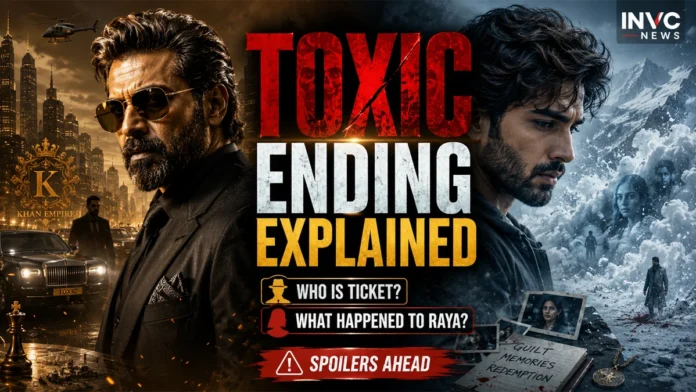
BENGALURU, India | August 27, 2026 —
Toxic Ending Explained has become one of the biggest questions surrounding Yash’s newly released gangster epic after director Geetu Mohandas closes the film with a twist that forces viewers to reconsider much of what they have just watched.
SPOILER ALERT
Major spoilers for Toxic: A Fairy Tale for Grown-Ups follow. Do not continue reading if you have not watched the film and want to experience its final twist in theaters.
Yash plays both Raya and Ticket, initially presented as father and son locked in a deeply personal conflict.
But the climax reveals that their relationship is far more complicated than a conventional revenge story.
The key to understanding Toxic’s ending is this: Ticket is not simply the adult son who has returned to destroy Raya’s empire. The Ticket seen through much of the story exists through Raya’s damaged perception of reality.
That revelation changes the meaning of the film.
Who Is Ticket in Toxic?
For much of Toxic, Ticket appears to be Raya and Nadia’s son.
He also functions as an important narrator, leading viewers through events surrounding Raya’s rise, relationships and increasingly violent criminal empire.
Ticket appears to grow into a man consumed by anger toward his father.
He challenges Raya, interferes with the empire Raya has built and eventually appears capable of destroying everything his father values.
That makes Toxic initially look like a story about a father confronting the consequences of raising an estranged and vengeful son.
The climax reveals something much darker.
Was Ticket Really Alive?
The ending indicates that Raya had actually killed Ticket years earlier.
Raya apparently changed his mind and tried to save his son, but it was already too late.
Unable to live with what he had done, Raya carried his guilt for years.
The adult Ticket viewers encounter throughout much of the film can therefore be understood as a manifestation created by Raya’s fractured mind.
That means the conflict between Raya and Ticket was never simply father versus son.
It was also Raya versus himself.
Ticket becomes the embodiment of Raya’s guilt, trauma, regret and the part of himself that he has been unable to escape.
Did Ticket Really Destroy Raya’s Empire?
This is where the film deliberately becomes less straightforward.
If Ticket exists primarily within Raya’s fractured perception, then many events attributed to Ticket can potentially be reinterpreted.
The implication is that Raya himself may have been responsible for much of the destruction he believed Ticket was causing.
His criminal empire, relationships and family begin collapsing as his psychological state deteriorates.
The story therefore shifts from gangster revenge into something closer to psychological tragedy.
Raya spends years believing he is fighting an external enemy.
In reality, the enemy may have been the guilt he carried inside him.
Also Read – : Yash’s Toxic Creates Box Office Storm Before Release as Advance Booking Surges
Why Are Ganga and Nadia Important to the Ending?
Raya’s psychological collapse cannot be separated from the people he loses.
Ganga, played by Nayanthara, is central to Raya’s rise and his pursuit of power.
Nadia, played by Kiara Advani, represents another crucial part of his emotional life and is Ticket’s mother.
As the consequences of Raya’s decisions accumulate and people close to him disappear from his life, his ability to distinguish guilt, memory and reality appears to deteriorate further.
Ticket ultimately becomes the face of everything Raya cannot undo.
That makes the final confrontation far more emotional than a traditional gangster showdown.
What Does the Avalanche Scene Mean?
The final avalanche is perhaps Toxic’s most symbolic moment.
Raya finally appears to confront the truth about Ticket and what has happened to his life.
Instead of continuing to fight or escape, he appears to accept the presence of the son he spent years mentally resisting.
As the avalanche approaches, Raya symbolically embraces Ticket.
The film then cuts away without giving viewers a conventional explanation of Raya’s fate.
The simplest interpretation is that Raya has finally stopped running from his guilt.
Throughout the story, he fights rivals, builds power and attempts to control the world around him.
But he cannot control the consequences of his own actions.
The avalanche becomes an external representation of something that has already happened internally: Raya’s world has collapsed.
Does Raya Die at the End of Toxic?
The film does not provide a conventional on-screen confirmation that allows the question to be answered with absolute certainty.
The avalanche racing toward Raya strongly suggests death or destruction.
But Geetu Mohandas leaves the final moment open enough for viewers to interpret it symbolically as well.
What matters more than Raya’s physical survival is his psychological surrender.
By finally accepting Ticket rather than fighting him, Raya acknowledges the guilt he had suppressed for years.
Whether Raya physically survives becomes almost secondary to the fact that the man who built his identity around control has finally lost it.
Why Is Ticket the Narrator?
Making Ticket the narrator is one of the climax’s cleverest devices.
Throughout the film, viewers naturally assume they can trust the person telling them the story.
Once Ticket’s true nature is revealed, that assumption collapses.
The audience is forced to ask:
How much of what we saw actually happened?
That does not necessarily mean the entire film is imaginary.
Instead, it means some events may have been filtered through an unreliable perspective.
Memories, guilt, hallucinations and reality potentially overlap.
That is why Toxic’s final twist encourages viewers to mentally revisit earlier scenes after leaving the theater.
What Does Toxic’s Ending Really Mean?
At its core, Toxic is not merely asking whether Raya can defeat another gangster.
It is asking whether a man can escape the consequences of what he has become.
Raya spends his life chasing power.
But power cannot restore his son.
It cannot repair his relationships.
And it cannot erase guilt.
Ticket therefore represents far more than another Yash character.
He represents the consequence Raya cannot kill, intimidate or outrun.
That gives the movie’s title another possible meaning.
The most “toxic” force in Raya’s world may ultimately be Raya himself.
Is There More Than One Interpretation?
Yes—and that appears intentional.
One interpretation is straightforward: Ticket died years earlier, Raya psychologically recreated him, and the final scenes reveal the extent of Raya’s breakdown.
A broader interpretation is that Ticket represents Raya’s conscience and unresolved trauma rather than simply a hallucinated person.
Because parts of the story are filtered through an unreliable narrator, viewers can also question exactly where objective reality ends and Raya’s perception begins.
That ambiguity is precisely why the ending is generating discussion after release.
Also Read – : Yash’s Toxic Movie: ₹600 Crore Pre-Release Business, Budget and Cast Details
Toxic Ending Explained: Final Take
The climax transforms Toxic from a conventional father-son gangster conflict into a story about guilt, trauma and self-destruction.
Ticket appears to be Raya’s enemy.
But the final revelation suggests Raya has been fighting himself.
The son he believed was destroying his empire represents the guilt Raya created when he destroyed his own child.
And when the avalanche finally arrives, Raya no longer runs.
He accepts Ticket.
He accepts his past.
And the film leaves viewers with one uncomfortable question:
Was Ticket ever Raya’s greatest enemy—or was Raya always destroying himself?
That unanswered question may prove to be Toxic’s most memorable twist.