NEW DELHI, India | August 25, 2026 —
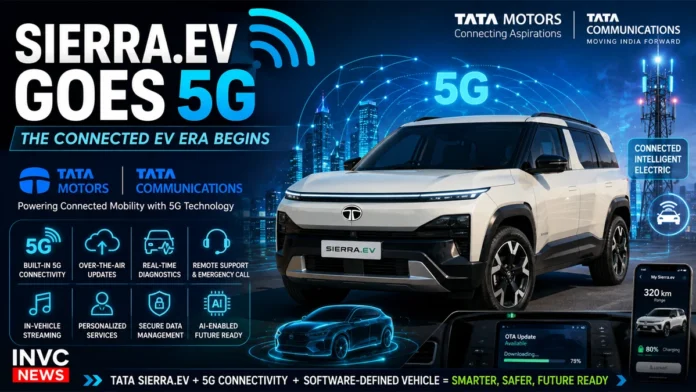
Tata Sierra.ev 5G connectivity is set to push India’s electric-car market further into the software-defined era, with Tata Motors Passenger Vehicles and Tata Communications joining forces to give the electric SUV built-in 5G cellular connectivity.
Under the partnership announced Tuesday, the Tata Communications MOVE™ Connected Vehicle Platform will integrate with Tata Motors’ new N.IO software-defined vehicle platform, creating the digital backbone for connected services, faster software updates, remote diagnostics and future AI-enabled applications.
The move is important because the race between electric-car manufacturers is increasingly shifting beyond battery range and charging speed. Connectivity, software upgrades, personalization and digital services are becoming major differentiators as vehicles increasingly behave like continuously evolving technology platforms.
What 5G Will Bring to the Tata Sierra.ev
The built-in 5G system is designed to keep the Sierra.ev connected without depending entirely on a driver’s smartphone connection.
According to the companies, the system will support several practical functions, including:
- Faster over-the-air software updates
- Real-time remote vehicle diagnostics
- Emergency calling
- Remote customer support
- Secure in-vehicle content streaming
- Digital subscription management
- Personalized connected services
- Future AI-enabled applications
The platform is also designed to allow new features and services to be added during the vehicle’s lifecycle rather than limiting the car to the software installed when it leaves the factory.
Tata’s Sierra.ev product information already lists an iRA.ev Connected Suite with Advance 5G, offering 70 connected features including phone-based vehicle controls, charging functions, trip planning and OTA updates. Tata also lists a four-year complimentary connected-services subscription for the system.
What Is a Software-Defined Vehicle?
The bigger story here is not simply that the Sierra.ev has a faster internet connection.
A software-defined vehicle, or SDV, relies increasingly on centralized software to control, improve and add functions throughout the car’s life.
Instead of waiting for a workshop visit for every software-related improvement, an SDV can potentially receive new software, fixes and feature enhancements remotely through OTA updates.
Tata Communications’ MOVE platform is designed for this type of connected-car environment. The company says the automotive platform already supports millions of connected vehicles and provides connectivity management, OTA support and network management across multiple markets.
That makes the Sierra.ev collaboration part of a broader industry shift toward cars that can continue evolving after purchase.
Why This Matters for India’s EV Market
India’s electric passenger-vehicle market is already expanding rapidly.
Passenger EV registrations rose sharply during the first quarter of FY27, while Tata Motors remained one of the leading players in the segment. INVC NEWS previously reported how [India’s electric passenger vehicle registrations surged in Q1 FY27]India’s electric passenger vehicle registrations surged in Q1 FY27 as manufacturers expanded their electric portfolios.
The next stage of competition is likely to involve more than driving range.
Automakers are increasingly competing on connected features, infotainment, advanced driver-assistance systems, OTA software, battery management, digital services and artificial intelligence.
That could make built-in high-speed connectivity an increasingly important selling point, particularly in premium and technology-focused electric SUVs.
Sierra.ev Fits Tata’s Wider Connected-EV Strategy
The Sierra.ev also arrives as Tata Motors expands its electric portfolio and attempts to combine EV technology with a more software-driven ownership experience.
The company’s current electric lineup includes vehicles such as the Nexon.ev, Punch.ev, Curvv.ev, Harrier.ev and Sierra.ev.
For buyers considering a Tata vehicle, pricing will also be worth watching. INVC NEWS recently reported that [Tata Motors is raising prices across its passenger vehicle portfolio from September 1]Tata Motors is raising prices across its passenger vehicle portfolio from September 1, with electric vehicles included in the revision.
That makes technology, pricing, range and ownership costs increasingly interconnected factors for EV buyers.
Why Tata Communications Is Important to the Deal
Tata Communications brings more than conventional mobile connectivity to the partnership.
Its MOVE platform is designed to manage connectivity across vehicles, networks and markets while supporting secure data exchange and software delivery.
The company says its automotive connectivity ecosystem already supports functions such as software-over-the-air optimization, predictive maintenance, connected services and network switching.
The same broader MOVE technology strategy is also being used for connected vehicles outside Tata Motors Passenger Vehicles, including JLR’s next generation of software-defined vehicles.
This suggests that connected-car infrastructure is becoming an increasingly important business area within the wider Tata ecosystem.
The Bigger Shift: EVs Are Becoming Digital Platforms
For years, EV competition focused largely on three questions: How far can the vehicle travel, how quickly can it charge and how much does it cost?
Those questions still matter.
But the Sierra.ev 5G partnership highlights another emerging battleground: what happens to a vehicle after the customer buys it.
A permanently connected car can receive updates, detect certain problems remotely, deliver new digital services and potentially support more sophisticated AI applications as software evolves.
That could make the modern electric vehicle increasingly similar to a smartphone or connected computing platform on wheels.
For India’s fast-growing EV ecosystem, the Tata Sierra.ev therefore represents more than another electric SUV launch. It offers an early look at how 5G connectivity, software-defined architecture and electric mobility could converge in the next generation of Indian cars.