NEW DELHI, INDIA | AUGUST 25, 2026 —
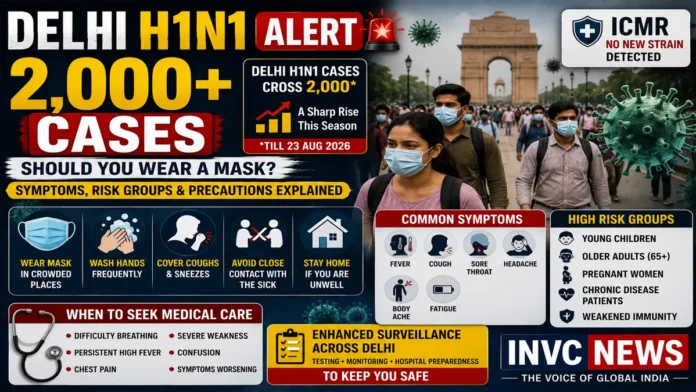
Delhi H1N1 cases have crossed the 2,000 mark this year, intensifying public attention around seasonal influenza as health authorities strengthen surveillance and urge residents to take practical precautions in crowded places.
The latest increase has prompted one question in particular: Should people in Delhi start wearing masks again?
The answer requires context.
Delhi health authorities have advised residents to consider masks in crowded settings, maintain hand and respiratory hygiene, avoid close contact with people showing respiratory symptoms and seek medical care if illness becomes persistent or severe.
However, this is not a return to pandemic-style universal masking, nor has a citywide mask mandate been announced.
Equally important, the Indian Council of Medical Research has clarified that no new H1N1 strain has been detected in India.
The currently circulating H1N1 viruses are seasonal strains that have been present since 2025, and ICMR says there is no reason for panic.
Delhi H1N1 Cases: What Do the Latest Numbers Show?
Delhi government data recorded 1,777 confirmed H1N1 infections through August 20, out of 2,392 Influenza-A cases.
That made H1N1 the dominant Influenza-A subtype detected in the capital this year.
The tally subsequently crossed the 2,000-case level by August 23, according to updated reporting based on Delhi’s surveillance data.
This represents a sharp increase from the corresponding period last year.
However, a rise in detected cases does not by itself mean that a new or more dangerous virus has emerged.
Health authorities are continuing to track:
- Influenza-like illness
- Severe acute respiratory infections
- Laboratory-confirmed influenza
- Hospital admissions
- Unusual case clusters
- Disease severity
Union Health Minister J.P. Nadda has also reviewed preparedness with particular focus on Delhi.
ICMR Says There Is No New H1N1 Strain
This is perhaps the most important fact in the current outbreak.
ICMR scientists say no new H1N1 strain has been identified in India.
The Influenza A(H1N1)pdm09 viruses currently circulating belong to a lineage that has already been circulating since 2025.
ICMR has also said that the circulating strains are well matched with influenza vaccine strains recommended for the Northern Hemisphere.
Seasonal influenza, including H1N1, is generally self-limiting for many otherwise healthy people.
Most recover with appropriate rest, fluids and supportive care.
But influenza can become serious in vulnerable individuals, which is why rising case numbers still require attention.
Should You Wear a Mask in Delhi?
For people searching “Should I wear a mask for H1N1 in Delhi?”, the practical answer is:
In crowded or poorly ventilated places, wearing a well-fitting mask can be a reasonable precaution.
Delhi authorities have specifically advised mask use in crowded environments as part of the current public-health response.
Masks are particularly worth considering when:
- You are experiencing respiratory symptoms
- You must enter a crowded indoor space
- You are around someone who is unwell
- You live with a medically vulnerable person
- You belong to a group at higher risk of flu complications
- You are visiting a healthcare facility
There is currently no blanket Delhi-wide mask mandate for the general public.
People who are ill should also avoid unnecessary close contact with others where possible.
What Are the Symptoms of H1N1?
H1N1 symptoms can look very similar to other seasonal influenza infections.
Common symptoms include:
- Fever
- Cough
- Sore throat
- Headache
- Body aches
- Fatigue
- Chills
- Runny or blocked nose
Some people can also experience gastrointestinal symptoms.
Symptoms alone cannot reliably distinguish H1N1 from H3N2, COVID-19 or several other respiratory infections.
A healthcare professional can determine whether testing or specific treatment is necessary.
When Should You Seek Medical Care?
Most seasonal influenza cases do not become severe.
However, medical advice becomes particularly important when symptoms persist, worsen or become severe.
Warning signs can include:
- Difficulty breathing
- Shortness of breath
- Chest pain
- Persistent or worsening high fever
- Unusual drowsiness or confusion
- Severe weakness
- Bluish discoloration of lips or skin
- Significant dehydration
- Worsening of an underlying medical condition
Anyone experiencing severe breathing difficulty or rapidly worsening illness should seek urgent medical care.
Who Is at Higher Risk From H1N1?
Anyone can become infected with seasonal influenza, but some people are more likely to develop complications.
Higher-risk groups include:
Young Children
Children under five, particularly very young children, can be more vulnerable to influenza complications.
Older Adults
People aged 65 and above face a greater risk of severe flu-related illness.
Pregnant Women
Pregnancy increases the risk of serious influenza complications.
People With Chronic Medical Conditions
Those with conditions involving the lungs, heart, kidneys, liver or metabolism—including asthma and diabetes—may face higher risk.
People With Weakened Immune Systems
People receiving chemotherapy or immunosuppressive treatment, or living with conditions affecting immunity, require additional caution.
Healthcare Workers
Frequent exposure to patients can increase infection risk.
People in these groups should consider contacting a healthcare professional early if flu-like symptoms develop.
How Does H1N1 Spread?
H1N1 spreads mainly through respiratory particles generated when an infected person coughs, sneezes, talks or breathes.
Transmission is easier when people remain close together, particularly in crowded and poorly ventilated indoor environments.
Schools, offices, public transport, hospitals and packed indoor venues can therefore facilitate influenza transmission.
Hands contaminated with respiratory secretions can also contribute to spread if people then touch their eyes, nose or mouth.
How to Reduce Your H1N1 Risk
The precautions are straightforward.
Wash Your Hands
Regular handwashing with soap and water remains useful.
Cover Coughs and Sneezes
Use a tissue or your elbow rather than coughing directly into your hands.
Avoid Touching Your Face
Especially avoid touching your eyes, nose and mouth with unwashed hands.
Improve Ventilation
Fresh airflow can help reduce the concentration of respiratory particles indoors.
Avoid Close Contact With Sick People
This is particularly important if you or someone in your household is medically vulnerable.
Stay Home When Sick Where Possible
Reducing unnecessary contact while symptomatic helps protect colleagues, classmates and family members.
Should Everyone Get an H1N1 Test?
No.
A person with a mild cough or fever does not automatically need an H1N1 test.
Testing decisions depend on factors such as:
- Severity of illness
- Duration of symptoms
- Underlying medical conditions
- Risk of complications
- Clinical assessment
People should follow medical advice instead of seeking unnecessary testing solely because case numbers are rising.
Do Not Self-Medicate With Antivirals
Antiviral drugs can be useful for influenza in selected patients, particularly those with severe disease or a higher risk of complications.
But they should be taken under medical guidance.
People should not purchase or start prescription antiviral medicines simply because they have fever or cough.
Antibiotics also do not treat influenza viruses unless a doctor identifies a separate bacterial infection requiring antibiotic treatment.
What About the Flu Vaccine?
Influenza vaccination remains an important preventive measure, particularly for people at greater risk of complications.
Because influenza viruses evolve over time, vaccine composition is updated periodically.
ICMR says the strains currently circulating in India are well matched with those included in the relevant recommended influenza vaccines.
People wondering whether they personally need a flu vaccine—especially pregnant women, older adults, young children or people with chronic medical conditions—should discuss timing and suitability with their doctor.
Rajasthan Also Steps Up H1N1 Surveillance
The increase in Delhi has triggered greater vigilance beyond the national capital.
Rajasthan health authorities have stepped up disease surveillance and asked medical teams, hospitals and clinics to closely watch patients with influenza-like symptoms.
The focus includes fever, cough, sore throat, body ache, nasal congestion and breathing difficulty.
This does not mean Rajasthan is experiencing the same level of H1N1 transmission as Delhi.
Rather, it reflects a precautionary effort to identify infections early and monitor whether the seasonal surge spreads more widely.
Delhi Is Managing Several Seasonal Health Risks
Delhi’s H1N1 increase is occurring during the monsoon period, when residents are also dealing with other infectious and environmental health pressures.
INVC NEWS recently tracked COVID-19 activity across India, including cases reported in Delhi and several other states, showing why respiratory-disease surveillance remains important even after the pandemic emergency ended.
COVID-19 Cases India July 2026: Latest State-Wise Update
Respiratory health in Delhi is also influenced by environmental conditions. INVC NEWS has separately reported how elevated ground-level ozone readings across multiple Delhi monitoring stations have raised concerns about respiratory exposure.
Delhi Ozone Pollution: Monitoring Stations Exceed National Limits
These illnesses and environmental risks are different and should not be confused with one another, but together they make respiratory-health awareness particularly useful for Delhi residents.
H1N1 Is Seasonal Influenza — Not a Return of the 2009 Pandemic
The phrase “swine flu” still carries memories of the 2009 global pandemic.
But H1N1 subsequently became part of normal seasonal influenza circulation.
The current increase does not mean the 2009 pandemic has returned.
Nor has ICMR detected evidence of a completely new H1N1 strain.
That distinction is essential for responsible health reporting.
The appropriate response is vigilance without panic.
H1N1 FAQ
How many H1N1 cases have been reported in Delhi?
Official Delhi data recorded 1,777 cases through August 20. Subsequent surveillance reporting indicated that the tally crossed 2,000 by August 23.
Is there a new H1N1 strain in India?
No new H1N1 strain has been identified, according to ICMR.
Should people wear masks in Delhi?
Delhi authorities have advised masks in crowded places as a precaution. There is no universal citywide mask mandate.
Is H1N1 the same as COVID-19?
No. H1N1 is an Influenza-A virus. COVID-19 is caused by SARS-CoV-2.
Can antibiotics cure H1N1?
No. Antibiotics do not treat influenza viruses.
Is H1N1 always dangerous?
Most seasonal influenza infections are self-limiting, but severe complications can occur, especially among higher-risk groups.
Who should seek medical advice early?
People with severe or worsening symptoms and those at higher risk—including young children, older adults, pregnant women and people with significant underlying medical conditions—should seek timely medical advice.
Bottom Line
Delhi’s rise in H1N1 infections deserves attention, but the latest evidence does not point to a new strain or a new pandemic.
Case numbers have crossed 2,000 after an official August 20 count of 1,777 H1N1 infections.
Health authorities are strengthening surveillance, hospitals remain on alert and residents are being advised to follow basic respiratory precautions.
For most people, that means simple measures:
wear a mask in crowded settings when appropriate, keep hands clean, improve ventilation, avoid close contact when sick and seek medical care when symptoms become severe or persistent.
The strongest message from health authorities is not to panic—and not to ignore symptoms in people at greater risk of complications.