KOTA, Rajasthan | August 24, 2026 —
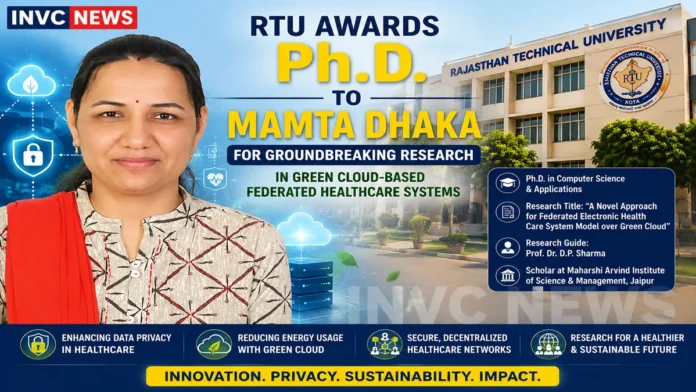
Rajasthan Technical University (RTU), Kota, has awarded a Ph.D. degree in Computer Science and Applications to Mamta Dhaka for research focused on developing a privacy-conscious and energy-efficient electronic healthcare framework using federated systems and green cloud computing.
Dhaka, a research scholar associated with Maharshi Arvind Institute of Science and Management, Ambabari, Jaipur, completed her doctoral research under RTU with a thesis titled “A Novel Approach for Federated Electronic Health Care System Model over Green Cloud.”
Her doctoral defense was conducted at the university, marking the culmination of her research into an increasingly important intersection of healthcare technology, data privacy, cloud computing and environmental sustainability.
The research examines how electronic healthcare systems can benefit from federated approaches while reducing the need to centrally pool sensitive patient information and addressing the growing energy requirements of digital infrastructure.
Research Connects Healthcare Data Privacy With Green Computing
Healthcare is becoming increasingly data-driven.
Hospitals, diagnostic centers and healthcare networks generate enormous volumes of digital information, including patient records, laboratory results, medical images and treatment histories.
Sharing and analyzing such information can help healthcare organizations improve decision-making and collaboration. At the same time, medical information is highly sensitive, making privacy and data security central concerns.
Dhaka’s research explores a federated healthcare architecture designed to address this challenge.
In federated approaches, participating institutions can collaborate computationally without necessarily transferring all underlying data to one centralized location. This can help reduce unnecessary movement of sensitive information, although the actual privacy and security achieved by any implementation depend on its technical design and safeguards.
The research combines this concept with green cloud computing, which focuses on improving the energy efficiency and environmental sustainability of cloud infrastructure.
Why Green Cloud Computing Matters
Cloud computing has transformed the way organizations store information and operate digital services.
However, the data centers supporting cloud services consume significant amounts of electricity and require additional energy for cooling and infrastructure.
As artificial intelligence, digital healthcare and cloud applications expand, improving computing efficiency is becoming increasingly important.
Green cloud computing seeks to reduce that environmental footprint through measures such as better resource allocation, workload optimization and more efficient use of computing infrastructure.
Dhaka’s doctoral work examines how these principles can be incorporated into a federated electronic healthcare model.
The approach is particularly relevant as India expands digital infrastructure across healthcare, education and government services.
Federated Systems Could Help Healthcare Institutions Collaborate
One of the challenges facing digital healthcare is enabling different medical institutions to benefit from distributed information while maintaining appropriate controls over sensitive records.
A federated model can allow computation or model development to take place across participating systems instead of requiring every institution to place all of its raw information into a common centralized database.
The concept has attracted growing attention in fields where privacy is particularly important.
Healthcare is one such field.
Hospitals and medical institutions must balance the potential benefits of data-driven technologies with requirements involving patient confidentiality, cybersecurity and responsible data governance.
Dhaka’s research addresses this intersection through a proposed architecture combining federated electronic healthcare and environmentally conscious cloud computing.
Professor D.P. Sharma Guided the Doctoral Research
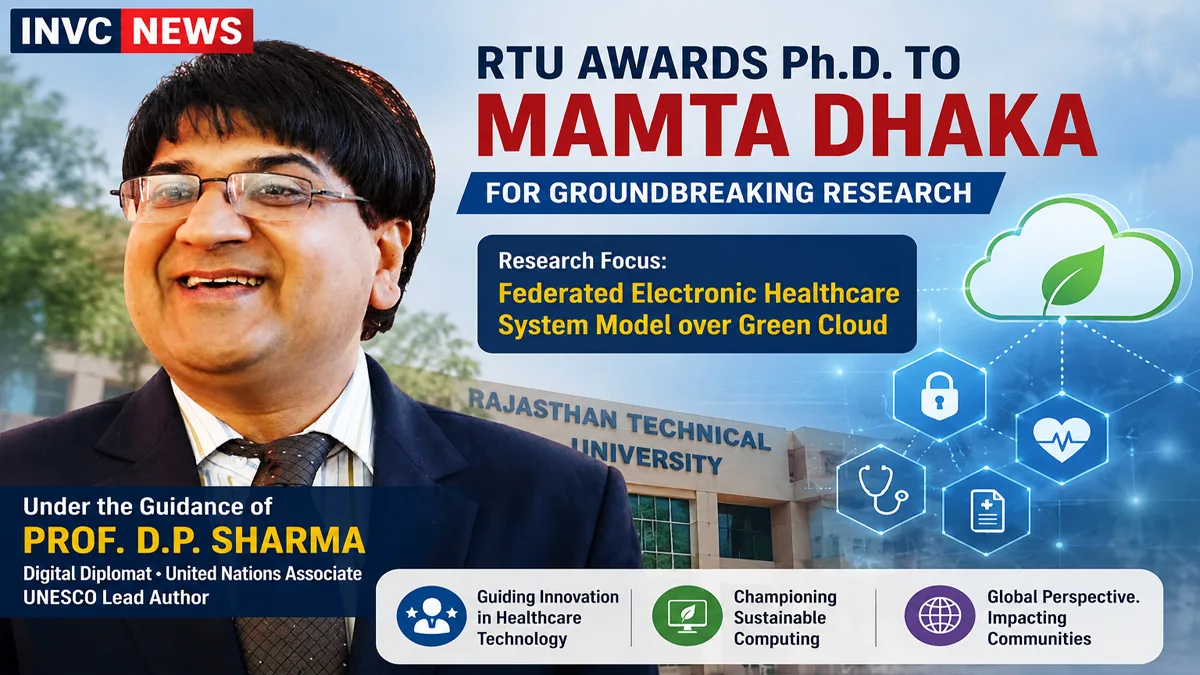
The research was carried out under the supervision of Professor Dr. D.P. Sharma, an academic and technology specialist whose work has included digital diplomacy and international academic engagements.
According to information provided about the doctoral work, Sharma’s supervision focused on guiding the conceptual development and implementation of the research model.
His mentorship supported Dhaka through the different stages of doctoral research, from defining the research problem and developing the framework to evaluating its potential applications.
The successful defense marks the completion of that academic process.
Potential Applications Extend Beyond Academic Research
The significance of the research lies in the combination of several rapidly developing technology areas.
A practical federated healthcare architecture could potentially support collaboration between hospitals and other healthcare institutions while limiting unnecessary centralization of sensitive information.
Meanwhile, incorporating green-computing principles could help developers examine ways to reduce the computational and energy costs associated with large digital healthcare networks.
Potential areas of application include distributed healthcare information systems, collaborative medical research, cloud-based healthcare platforms and privacy-conscious data analytics.
However, moving from an academic model to real-world clinical deployment would require additional validation, cybersecurity assessment, regulatory compliance and testing in operational healthcare environments.
Data Privacy Is Becoming Critical to Digital Healthcare
Healthcare digitization creates substantial opportunities, but it also increases responsibility for protecting personal information.
Medical records can contain some of an individual’s most sensitive data.
Consequently, digital healthcare systems require strong controls covering access, storage, transmission and processing.
Federated computing is being studied partly because it offers an alternative to architectures that require all raw information to be transferred into a single repository.
Even federated systems are not automatically private or secure. Their effectiveness depends on factors including encryption, authentication, access control, model security and the overall architecture.
That makes research into secure implementation particularly important.
Sustainable Computing Is Becoming a Major Technology Challenge
The second major dimension of Dhaka’s work—energy efficiency—is also becoming increasingly relevant.
Modern digital services depend on expanding data-center infrastructure.
Cloud computing, artificial intelligence and data-intensive applications require significant computing capacity, and consequently electricity.
This has created growing interest in designing systems that can achieve their computational objectives with fewer resources.
Green computing addresses this problem by seeking greater efficiency throughout the technology lifecycle.
The same principle could become increasingly relevant to India’s expanding healthcare technology ecosystem.
Rajasthan’s Academic Institutions Expand Technology Research
The awarding of the doctorate also highlights research activity taking place within Rajasthan’s higher-education ecosystem.
Rajasthan Technical University, Kota, provides technical education and research opportunities across engineering, technology and related disciplines.
Maharshi Arvind Institute of Science and Management in Jaipur, with which Dhaka has been associated as a scholar, has also been expanding its focus on technology, entrepreneurship and innovation.
INVC recently reported on the launch of a Startup Incubation and Innovation Centre at Maharshi Arvind Institute of Science and Management, aimed at exposing students to entrepreneurship, innovation and opportunities within India’s expanding startup ecosystem.
Research in areas such as healthcare IT, sustainable computing, artificial intelligence and cloud infrastructure can complement such innovation initiatives by creating pathways between academic research and practical technology development.
From Doctoral Thesis to Real-World Innovation
Completing a Ph.D. represents the end of one academic stage, but research often becomes more valuable when it leads to further experimentation.
For Dhaka’s proposed healthcare framework, future research could examine scalability, cybersecurity, energy efficiency and performance under real-world conditions.
Researchers could also study how federated healthcare architectures interact with emerging technologies such as artificial intelligence and advanced analytics.
Clinical deployment would require collaboration beyond computer science.
Healthcare professionals, cybersecurity specialists, data-protection experts, policymakers and technology companies would all have roles to play.
A Milestone for Mamta Dhaka’s Research Journey
The successful doctoral defense represents the culmination of years of academic work for Mamta Dhaka.
Her research brings together three issues that are becoming increasingly interconnected: digital healthcare, data privacy and sustainable computing.
As healthcare becomes more digital and cloud infrastructure expands, researchers worldwide are looking for ways to process information securely without allowing computing requirements to grow unchecked.
Dhaka’s doctoral work contributes to that academic discussion through a proposed federated electronic healthcare system built around green-cloud principles.
The Ph.D. awarded by Rajasthan Technical University recognizes the completion of that research and opens the way for further academic investigation into how privacy-preserving and energy-conscious computing architectures could support the healthcare systems of the future.