NEW DELHI, India | August 21, 2026
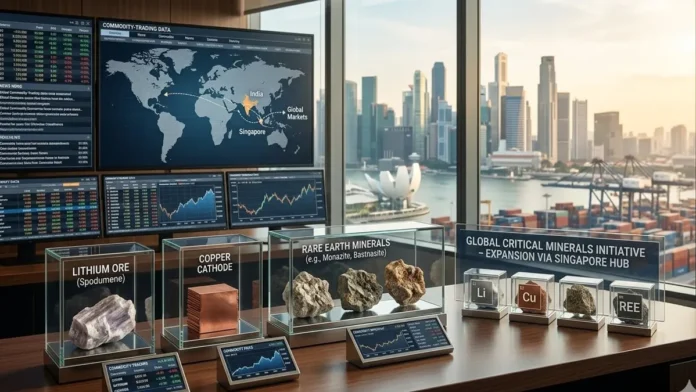
Coal India Singapore hub plans could mark one of the state-owned miner’s biggest strategic shifts beyond coal, as the company explores an international trading operation to help secure lithium, copper, rare earths and other critical mineral assets for India.
The proposed Singapore operation would give Coal India a base in one of Asia’s most important commodity-trading centers as it looks for mining assets and supply opportunities overseas.
The initiative comes as India accelerates efforts to secure minerals essential for electric vehicles, batteries, renewable energy, electronics, defense manufacturing and advanced technologies.
For Coal India, traditionally associated with supplying fuel to India’s thermal power sector, the strategy signals an attempt to build a broader resources business for an economy increasingly focused on clean energy and high-tech manufacturing.
Why Coal India Is Looking at Singapore
Singapore is a major center for global commodity trading, shipping, finance and international business.
Establishing a presence there could give Coal India closer access to international mining companies, commodity traders, financial institutions and potential acquisition targets.
The hub could support trading in commodities including critical minerals while helping the company identify overseas mining opportunities.
It could also provide a platform for partnerships and acquisitions outside India.
The plan remains under development, meaning the eventual structure, investment and timeline could change.
Coal India Wants to Diversify Beyond Coal
Coal remains central to India’s electricity system and Coal India remains one of the world’s largest coal producers.
However, the long-term global energy transition is changing the strategic value of different natural resources.
Electric vehicles require battery minerals.
Renewable-energy infrastructure requires large quantities of metals.
Electronics, defense equipment, wind turbines and advanced manufacturing depend on specialized mineral supply chains.
Coal India is therefore exploring how its mining expertise can be extended into commodities likely to become increasingly important to India’s future economy.
Lithium Is Critical for India’s EV Ambitions
Lithium is one of the most closely watched minerals because of its importance in rechargeable batteries.
Lithium-ion batteries are widely used in electric vehicles, smartphones, energy-storage systems and consumer electronics.
India wants to expand domestic electric-vehicle manufacturing while reducing reliance on imported battery components.
Securing reliable access to lithium therefore has implications well beyond the mining sector.
Overseas assets can potentially provide Indian companies with long-term access to raw materials even when sufficient domestic production is unavailable.
Why Rare Earths Matter
Rare earth elements are another strategically important group of materials.
Despite the name, they are not necessarily extremely rare in the Earth’s crust. The challenge lies in economically extracting, separating and processing them.
Rare-earth materials are used in high-performance magnets, electric motors, wind turbines, electronics and defense systems.
Supply chains are heavily concentrated, particularly in China.
That concentration has encouraged India, the United States, Europe, Japan and other economies to look for alternative sources and processing capacity.
China Dependence Is a Strategic Concern
China occupies a dominant position in several critical-mineral supply chains, especially rare-earth processing.
That creates vulnerability for countries trying to rapidly expand clean-energy manufacturing.
A disruption caused by trade restrictions, geopolitical tensions or supply shortages could affect industries far beyond mining.
India’s response has increasingly focused on diversification.
Securing resources from multiple countries can reduce the risk associated with depending heavily on a single supplier.
Coal India’s international strategy could become part of that wider effort.
Copper Is Also Becoming More Important
Copper may not attract the same public attention as lithium, but it is essential to electrification.
Electric vehicles use substantially more copper than conventional vehicles.
Power grids, charging infrastructure, renewable-energy systems, data centers and industrial equipment also require large quantities of the metal.
As electricity demand and clean-energy investment increase globally, long-term copper supplies have become a major strategic issue.
That makes overseas copper assets potentially attractive for Indian resource companies.
Which Countries Could Coal India Target?
Resource-rich countries across several regions could potentially fit Coal India’s strategy.
Australia is a major producer of lithium and other minerals.
Latin American countries including Argentina and Chile hold significant lithium resources, while Africa contains deposits of numerous minerals required for batteries and advanced manufacturing.
The eventual investment decisions would depend on geology, valuations, government policies, infrastructure, political risk and the commercial viability of individual projects.
Buying a mining asset is very different from purchasing a finished commodity.
Mining projects can take years to develop and require substantial capital.
India’s Critical Minerals Push Is Accelerating
New Delhi has increasingly treated critical minerals as an economic and national-security priority.
India’s ambitions in electric vehicles, renewable energy, semiconductor manufacturing and defense production all require dependable raw-material supplies.
The country is pursuing domestic exploration while simultaneously encouraging overseas acquisitions and international partnerships.
The two approaches are complementary.
Domestic discoveries can improve long-term self-reliance, while overseas assets can diversify supply in minerals where India lacks sufficient commercially viable resources.
Why a Trading Hub Could Help Coal India
A Singapore hub could potentially do more than simply buy and sell commodities.
A physical presence in a global trading center can provide faster access to market intelligence, potential partners and financing networks.
It can also allow a company to monitor commodity flows and pricing more closely.
For Coal India, those capabilities would be relatively new compared with its traditional domestic coal-mining operations.
Building expertise in international commodity markets could therefore become an important part of its diversification.
Coal Will Still Remain Important
The new strategy does not mean Coal India is immediately moving away from its core business.
India continues to depend heavily on coal-fired electricity, and the company remains central to meeting domestic power-sector demand.
Instead, critical minerals represent an additional long-term growth opportunity.
The company can continue producing coal while simultaneously developing expertise and assets in minerals required for the next generation of India’s industrial economy.
What Happens Next?
The most important questions now involve execution.
Investors will watch whether Coal India formally establishes the Singapore operation, which commodities it prioritizes and whether the company moves from evaluating assets to making significant overseas acquisitions.
The prices paid for mining projects will also matter.
Critical minerals may offer enormous strategic value, but commodity cycles can be volatile and expensive acquisitions can destroy shareholder value if assumptions prove overly optimistic.
If executed carefully, however, Coal India’s international diversification could transform a company synonymous with India’s coal era into a broader resources group participating in the country’s electric-vehicle, renewable-energy and advanced-manufacturing future.