New Delhi, India — August 20, 2026
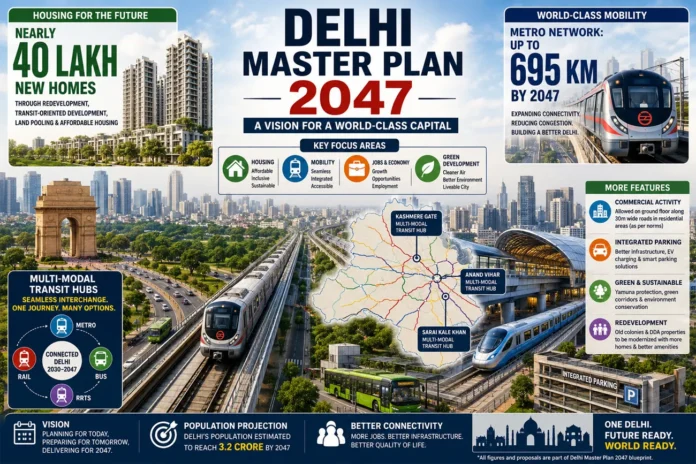
Delhi Master Plan 2047 promises one of the biggest transformations of the national capital in decades, with plans for nearly 40 lakh additional homes, expansion of the Metro network to around 695 kilometers, integrated transport hubs, higher-density development around transit corridors and new opportunities for commercial activity.
Union Housing and Urban Affairs Minister Manohar Lal unveiled the long-term blueprint on Thursday, describing it as an important step toward transforming Delhi into a more connected, affordable, sustainable and globally competitive city.
The plan is designed around Delhi’s expected population and infrastructure needs through 2047, covering housing, transport, employment, redevelopment, environmental protection and urban services.
Importantly, the reference to 40 lakh homes should not be interpreted as the government directly constructing 40 lakh apartments itself. The master plan provides the planning framework under which additional housing supply can be created through land pooling, redevelopment, transit-oriented development and other public and private projects.
Nearly 40 Lakh Additional Homes Planned
Housing is one of the biggest pillars of MPD 2047.
The blueprint estimates that Delhi could require close to 40 lakh additional dwelling units as its population expands over the next two decades.
The objective is to increase housing supply through several channels rather than relying on a single government construction program.
These include:
- transit-oriented development;
- redevelopment of existing residential areas;
- land pooling;
- higher-density development;
- affordable housing;
- redevelopment of older DDA properties; and
- planned expansion in emerging areas.
The plan is particularly important because affordable housing has become increasingly difficult to find within Delhi, pushing many families toward neighboring NCR cities.
Delhi Metro Network Could Expand to 695 Km
Transport is another major focus.
Under the Delhi Master Plan 2047, the capital’s Metro network is envisioned to expand to approximately 695 kilometers.
The expansion would dramatically increase the reach of high-capacity public transport and bring more residential and employment areas closer to mass-transit corridors.
The strategy is not limited to adding Metro lines.
The wider mobility framework also envisions stronger integration between Metro, railway, buses, RRTS and last-mile transport so passengers can switch between different modes more easily.
Three Major Multi-Modal Transport Hubs
One of MPD 2047’s most significant mobility proposals involves the development of major multi-modal transport hubs.
Three key locations identified in current planning include:
Anand Vihar-Karkardooma
Kashmere Gate
Nizamuddin-Sarai Kale Khan
These locations already serve multiple transportation systems and could become even more important interchange points.
The idea is to connect Metro, railways, buses, RRTS and para-transit facilities within integrated transport districts, reducing transfer times and congestion.
The Anand Vihar-Karkardooma area is expected to play a particularly important role in eastern Delhi.
What Will Change Around Metro and RRTS Stations?
MPD 2047 places significant emphasis on Transit-Oriented Development, or TOD.
The principle is simple: build more housing, offices, retail and public amenities near major public-transport corridors so people do not have to depend as heavily on private vehicles.
Delhi’s expanded TOD framework covers development around Metro, railway and RRTS corridors.
The recently expanded policy opens about 207 square kilometers for higher-density transit-linked development, including areas that had previously faced planning restrictions.
Under the policy, residential development remains the dominant component, while space can also be provided for commercial uses and local amenities.
Shops and Commercial Activity Could Get More Space
Chief Minister Rekha Gupta said MPD 2047 would also create more flexibility for commercial activity in appropriate residential locations.
One proposed change would allow commercial activity on the ground floor of properties along qualifying wider roads, including stretches with approximately 30-meter rights of way, subject to the detailed planning and building regulations.
Such mixed-use planning could make neighborhood services more accessible while reducing the need for residents to travel long distances for everyday needs.
However, actual permission will depend on the final notified regulations, applicable land use and building conditions.
Integrated Parking Is Part of the New Approach
Parking is another persistent problem MPD 2047 aims to address.
Instead of allowing vehicles to dominate residential streets and commercial corridors, the plan encourages more integrated parking infrastructure.
Future high-density developments around transport corridors are expected to combine parking with public transport access and pedestrian movement.
This could include:
- structured parking;
- shared parking facilities;
- EV charging;
- pedestrian connections;
- last-mile mobility; and
- better integration with Metro and bus services.
The overall objective is to reduce roadside parking and improve the use of valuable urban land.
High-Density Development Along UER-II
Another potentially transformative area is the Urban Extension Road-II, or UER-II corridor.
The approximately 75-kilometer orbital route passes through several outer Delhi growth areas.
MPD 2047 proposes higher-density residential and mixed-use development along parts of this corridor, potentially opening significant new land for housing and commercial activity.
The strategy seeks to connect new development directly with major road and public-transport infrastructure instead of allowing unplanned urban sprawl.
Affordable Housing Becomes a Major Priority
The new master plan gives affordable housing an important role.
Transit-oriented development can allow a much larger number of homes to be constructed near public transport.
Under the wider TOD framework, a significant portion of residential development is intended to consist of relatively compact units, making housing around transport corridors more accessible to middle- and lower-income households.
The DDA had approved MPD 2047 on August 12 as the long-term framework for the capital’s development. The plan adopts an integrated approach covering housing, economic growth, mobility, infrastructure and environmental sustainability.
Redevelopment Could Transform Older Delhi Housing
The plan could also change the future of aging residential developments.
Many DDA housing schemes built decades ago consist of older two-story structures that have limited redevelopment possibilities.
New policies are designed to make redevelopment easier and allow more efficient use of such land.
In some cases, this could mean:
- replacement of aging structures;
- additional housing units;
- improved lifts and accessibility;
- better parking;
- modern fire-safety infrastructure; and
- upgraded community facilities.
The DDA has already approved a uniform policy framework for redevelopment of old two-story units.
What Happens to Unauthorized Colonies?
Unauthorized colonies remain one of Delhi’s most difficult planning issues.
MPD 2047 seeks to bring more existing settlements into a structured planning framework while improving infrastructure and providing clearer development regulations.
The government has separately moved toward regularization of a large number of unauthorized colonies under existing schemes.
The goal is to improve property rights, roads, sanitation and urban services while preventing future uncontrolled development.
Yamuna Protection Is Also Part of MPD 2047
The master plan is not only about construction.
Environmental protection, particularly around the Yamuna floodplain, is also a significant component.
The DDA-approved framework restricts concrete construction in the core portion of the Yamuna O-Zone while allowing limited recreational and green uses in specified areas outside the most sensitive zone.
The wider plan also seeks to address drains, green buffers and ecological restoration.
That reflects an attempt to balance Delhi’s need for housing with the need to protect floodplains and environmentally sensitive land.
Delhi’s Population Could Reach 3.2 Crore
The scale of MPD 2047 becomes clearer when population projections are considered.
Delhi’s population is expected to reach approximately 3.2 crore by 2047, creating enormous demand for homes, transportation, water, sewage systems, electricity and employment.
Without planned development, that growth could worsen:
traffic congestion,
housing shortages,
unauthorized construction,
air pollution,
pressure on utilities, and
long commuting times.
The master plan attempts to address those problems before they become even more difficult to manage.
Manohar Lal Calls It a Vision for a World-Class Delhi
Manohar Lal linked the plan with the broader Viksit Bharat 2047 vision.
The objective is to make Delhi not merely larger, but more livable.
That means development must be accompanied by infrastructure, environmental safeguards, public transport and employment opportunities.
Delhi Lieutenant Governor Taranjit Singh Sandhu, who also chairs the DDA, has described the plan as a roadmap for sustainable and inclusive urban growth, with greater ease of living and ease of doing business. The Delhi government’s official Urban Development website currently lists Sandhu as lieutenant governor and Rekha Gupta as chief minister.
What Could MPD 2047 Mean for Property Prices?
The plan could have significant implications for Delhi’s real-estate market.
Areas around new Metro corridors, RRTS stations, UER-II and redevelopment zones could see increased development interest.
However, a master plan does not automatically guarantee higher property values.
Actual impact will depend on:
- implementation timelines;
- land availability;
- infrastructure completion;
- development approvals;
- construction costs; and
- market demand.
Homebuyers should therefore distinguish between areas proposed for development and projects that already have statutory approvals.
Will 40 Lakh Flats Be Built Immediately?
No.
The 40 lakh figure is a long-term housing requirement and planning target through 2047, not a promise that millions of flats will appear within a few years.
Housing will be added gradually as individual development policies, infrastructure projects and redevelopment schemes are implemented.
This distinction is important for both homebuyers and investors.
Similarly, the Metro network will not jump immediately to 695 km. Expansion will occur through multiple phases over the coming years.
What Delhi Residents Could Gain
If implemented effectively, MPD 2047 could change everyday life in several ways.
Residents could potentially gain:
More housing options through redevelopment and new construction.
Better public transport through a larger Metro and multimodal network.
Shorter commutes through transit-oriented development.
More neighborhood services through controlled mixed-use development.
Improved parking through integrated facilities.
Better connectivity between Metro, RRTS, railways and buses.
More employment districts closer to residential areas.
A greener city through environmental and floodplain safeguards.
Delhi Master Plan 2047: The Bottom Line
The Delhi Master Plan 2047 is far more than a proposal to construct new apartments.
It is a blueprint for how the national capital will house, move and employ millions of additional residents over the next two decades.
The headline figures are striking: nearly 40 lakh additional homes and a Metro network reaching roughly 695 kilometers.
But the wider transformation could be even more significant.
Multi-modal hubs, transit-oriented neighborhoods, redevelopment, mixed-use corridors, better parking and stronger environmental safeguards could fundamentally change how Delhi grows.
The biggest challenge now is implementation.
A master plan can establish where and how Delhi should develop, but the real test will be whether infrastructure, housing, redevelopment and environmental projects move from policy documents to the ground on schedule.
Official Links
Delhi Development Authority:
DDA Official Website
Ministry of Housing and Urban Affairs:
MoHUA Official Website
Delhi Urban Development Department:
Delhi Urban Development Department