Mumbai, India — August 20, 2026
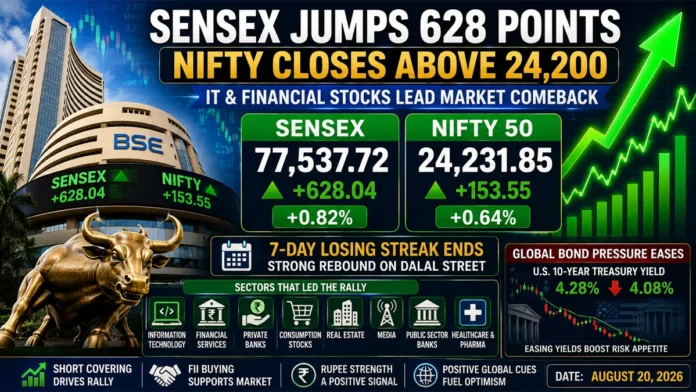
Indian Stock Market Today staged a powerful comeback on Thursday, with benchmark indices ending sharply higher after days of persistent selling. The BSE Sensex surged 628.04 points, or 0.82%, to close at 77,537.72, while the NSE Nifty 50 gained 153.55 points, or 0.64%, to settle at 24,231.85.
The rebound brought relief to investors after the Nifty endured seven consecutive sessions of losses. Technology and financial stocks led the recovery, while easing global bond-market pressure, short covering and improved overseas sentiment helped restore risk appetite.
The National Stock Exchange provides official index and end-of-day market data through its market-data and reporting platforms.
Nifty Breaks Seven-Day Losing Streak
Thursday’s recovery was particularly important for the Nifty 50, which had been under selling pressure for seven straight sessions.
On Wednesday, August 19, the Nifty had finished at 24,078.30, leaving investors concerned that the index could slip below the psychologically important 24,000 level.
Instead, buyers returned strongly on Thursday.
The Nifty reclaimed 24,200 and closed at 24,231.85, indicating renewed buying interest after the prolonged correction.
The Sensex also recovered decisively and ended the day more than 600 points higher.
Why Did the Indian Stock Market Rise Today?
Several domestic and global factors came together to support Thursday’s rally.
1. Easing US Bond Yields Improved Risk Appetite
One of the most important triggers came from the United States bond market.
Concerns over sharply rising long-term Treasury yields had recently pressured global equities, particularly emerging-market stocks.
The U.S. Treasury has expanded measures intended to support liquidity in the Treasury market, including changes to its debt-buyback program. Its current quarterly financing framework includes regular liquidity-support buyback operations across different maturity segments.
As bond-market stress eased, investors became more willing to take exposure to equities.
For Indian markets, lower global yields are generally supportive because they can reduce the relative attraction of U.S. fixed-income assets and ease pressure on foreign portfolio flows.
2. Short Covering Accelerated the Recovery
Short covering provided another major boost.
After seven consecutive declines in the Nifty, many traders had built bearish positions expecting further weakness.
When the market began moving higher on Thursday, some of those traders bought stocks or index contracts to close their short positions.
That additional buying can accelerate an upward move.
The result was a sharp relief rally across benchmark indices.
3. IT Stocks Led the Market Higher
Information technology emerged as one of the strongest sectors of the session.
Technology shares benefited from improved global sentiment and renewed buying after recent weakness.
The IT sector’s performance was significant because heavyweight technology companies carry substantial weight in the Nifty and Sensex.
A strong move in large IT counters can therefore have an outsized impact on benchmark indices.
4. Financial Services and Private Banks Add Support
Financial services and private-sector banks also contributed to the recovery.
Banking and financial companies are among the largest components of India’s benchmark indices, making their participation crucial for sustaining a broad market rally.
Buying in these stocks helped the Sensex and Nifty retain their gains through the session rather than giving back the early advance.
5. Positive Global Markets Lifted Sentiment
Improved overseas market cues also helped Indian equities.
When major international markets stabilize following a period of bond-market stress, domestic investors often become more comfortable increasing risk exposure.
Thursday’s gains therefore reflected both local short covering and a broader improvement in global risk sentiment.
Most Sectors End Higher
The recovery was not limited to a handful of heavyweight stocks.
Most major sectoral indices finished in positive territory.
Information technology was among the strongest performers, followed by gains in financial services and private banks.
Buying was also seen in:
- consumer-related stocks,
- real estate,
- media,
- public-sector banks,
- healthcare, and
- pharmaceutical shares.
Healthcare and pharma posted more modest gains.
The broad participation suggested that Thursday’s move was more than a narrowly concentrated index rally.
Oil & Gas and Metals Remain Under Pressure
Not every part of the market participated equally.
Oil and gas and some metal stocks remained comparatively weak.
The divergence reflects continuing uncertainty surrounding commodity prices, global demand and geopolitical developments.
Elevated crude oil prices remain a particularly important risk for India because the country imports most of the oil it consumes.
A prolonged period of expensive crude could increase inflation, pressure the rupee and raise costs for companies dependent on transportation and energy.
Why Global Bond Markets Matter for Indian Stocks
The connection between U.S. bond yields and Dalal Street has become increasingly important.
When U.S. Treasury yields rise sharply, global investors can earn higher returns from assets considered relatively low risk.
That can make emerging-market equities less attractive.
Foreign capital may then move away from markets such as India, putting pressure on stocks and currencies.
When Treasury yields fall or stabilize, the opposite can happen.
That is why movements in the U.S. bond market have become a major daily trigger for Indian equities.
What Does Thursday’s Rally Mean for Investors?
Thursday’s recovery is encouraging, but one positive session does not necessarily establish a new bullish trend.
The market had fallen consistently before the rebound, meaning some of Thursday’s rise was driven by technical factors such as short covering.
Investors will now watch whether fresh buying continues in the next few sessions.
Sustained participation from foreign and domestic institutional investors would provide stronger evidence that sentiment has genuinely improved.
Nifty 24,200 Becomes an Important Level
The Nifty’s close above 24,200 gives traders an important short-term reference level.
If the index remains above this zone, market sentiment could continue improving.
A sustained move higher could encourage traders who remained cautious during the seven-session correction to return.
However, another sharp increase in global bond yields or crude oil prices could quickly test the recovery.
Sensex Back Above 77,500
The Sensex’s close at 77,537.72 also represents a significant recovery from Wednesday’s level.
The index gained more than 600 points during Thursday’s session and finished near the day’s stronger levels.
That suggests buyers remained active rather than treating the morning rally solely as an opportunity to sell.
What Investors Should Watch Next
Market direction from here is likely to depend on several factors.
US Treasury yields: Further easing would be supportive for emerging-market equities.
Crude oil prices: Higher oil remains one of India’s biggest macroeconomic risks.
Foreign investor flows: Sustained overseas buying could strengthen the rebound.
Rupee movement: Currency stability can support foreign investor confidence.
RBI policy expectations: Investors are closely watching whether inflation pressures eventually force the central bank toward tighter monetary policy.
Global geopolitical developments: Middle East tensions remain capable of producing sharp moves in oil and financial markets.
Indian Stock Market Today: The Bottom Line
The Indian Stock Market Today finally delivered the recovery investors had been waiting for.
The Sensex closed 628.04 points higher at 77,537.72, while the Nifty gained 153.55 points to finish at 24,231.85, snapping its seven-day losing streak.
Technology, financial services and private banks helped lead the rebound, while easing U.S. bond-market pressure and short covering strengthened momentum.
The rally is an important short-term positive for Dalal Street.
However, investors will now want to see whether Thursday’s rebound develops into sustained buying or remains primarily a relief rally after seven difficult sessions.