Washington, United States — August 20, 2026
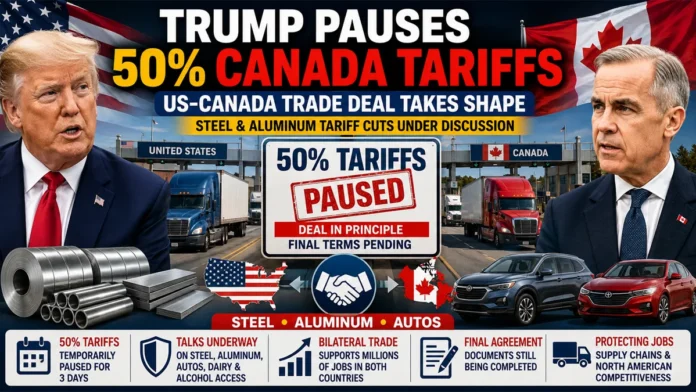
US Canada Tariff Deal negotiations have entered a decisive phase after President Donald Trump said Washington and Ottawa had reached an agreement in principle, prompting the United States to temporarily suspend new 50% tariffs on a range of Canadian goods while officials finalize the documents.
Trump said the agreement followed what he described as a productive conversation with Canadian Prime Minister Mark Carney. However, the arrangement is not yet fully finalized, and negotiations continue over several of the most contentious areas of bilateral trade, including automobiles, steel and aluminum.
The White House formally suspended the additional duties for three days, saying Canada had indicated a commitment to address U.S. concerns over treatment of American alcoholic beverages, dairy products and motor vehicles.
The development temporarily removes the immediate threat of a major new tariff escalation between two of the world’s most closely integrated economies.
Trump Says US and Canada Have a Deal
Trump has publicly described the breakthrough as a deal, although he emphasized that the documents still need to be completed.
The distinction is important.
The two governments appear to have reached an understanding on the broad framework of an agreement, but several technical and sector-specific provisions remain under negotiation.
Canada has been more cautious in its public language, stressing progress in negotiations rather than presenting every outstanding issue as settled.
For businesses on both sides of the border, the three-day pause provides critical additional time for negotiators to convert the political understanding into detailed trade commitments.
Why Were 50% Tariffs About to Take Effect?
The Trump administration announced the additional tariffs in July under Section 338 of the Tariff Act of 1930.
The White House said the measure was intended to respond to what it considers discriminatory Canadian treatment of U.S. products, particularly in areas such as:
- alcoholic beverages,
- dairy products, and
- motor vehicles.
The planned tariffs covered selected Canadian products and were set at an additional 50% even for certain goods that otherwise qualified under the U.S.-Mexico-Canada Agreement.
Energy, potash and several other categories were excluded from the measure.
Trump Pauses 50% Tariffs for Three Days
Instead of allowing the new duties to take effect as originally scheduled, Trump signed a proclamation suspending them for three days.
The White House said senior administration officials believed negotiations had advanced sufficiently to justify the temporary pause.
The proclamation states that Canada had expressed a commitment to remove or address the practices at the center of Washington’s complaints.
That gives the two countries a narrow window to complete the final agreement.
If negotiations fail, the tariff threat could return unless Washington extends the suspension or issues a new trade measure.
Steel and Aluminum Tariffs Remain a Key Issue
One of the biggest unresolved questions is what happens to U.S. tariffs on Canadian steel and aluminum.
Those duties are separate from the newly threatened Section 338 tariffs and have become a major source of friction in bilateral trade.
Canada has consistently pushed Washington to reduce or remove sectoral tariffs affecting steel, aluminum, automobiles and other industries.
Official Canadian government documents confirm that Ottawa has been seeking relief from existing U.S. sectoral tariffs while negotiating a broader modernization of the North American trade relationship.
A reduction in steel and aluminum tariffs is now being discussed as part of the wider negotiations, but the final rates and any quota structure have not yet been officially confirmed.
Canada Wants Broader Relief for Its Industries
For Ottawa, avoiding the new 50% duties addresses only part of the problem.
Canada’s larger objective is to reduce tariffs already affecting strategically important sectors.
Steel, aluminum and automobile manufacturing are particularly important because North American supply chains are deeply integrated.
Canadian producers frequently sell to U.S. customers, while American manufacturers rely on Canadian metals, components and other industrial inputs.
Higher tariffs therefore do not affect only exporters. They can also raise costs for manufacturers and consumers inside the United States.
Auto Tariffs Are Also Under Negotiation
Automobiles remain another difficult issue.
Canada and the United States share one of the world’s most integrated auto-manufacturing systems.
Parts can cross the border multiple times before a completed vehicle reaches a dealership.
Canada has said approximately 90% of its finished vehicles are exported to the United States, illustrating how heavily its auto sector depends on access to the American market.
That makes any reduction in U.S. auto tariffs particularly important for Ontario and the wider Canadian manufacturing economy.
Trump has indicated that automobile duties could be reduced as part of the agreement, although final terms are still being negotiated.
Why the US-Canada Trade Relationship Matters
The United States and Canada have one of the world’s largest bilateral trading relationships.
Their economies are interconnected across:
- automobiles,
- energy,
- agriculture,
- steel and aluminum,
- machinery,
- consumer products,
- technology, and
- cross-border investment.
Despite the tariff disputes, Canada says approximately 85% of its exports to the United States remain tariff-free under CUSMA/USMCA rules.
Canada’s government estimates the effective average U.S. tariff rate on Canadian goods at around 5.2%, lower than that faced by many other major American trading partners.
That makes the new negotiations less about dismantling the entire trade relationship and more about resolving several high-profile sectoral disputes.
Trump Wants Greater Access for US Farmers and Businesses
Agricultural trade has become another important element of the talks.
Trump has argued that U.S. farmers face unfair barriers when selling products in Canada, particularly in the country’s tightly controlled dairy market.
The administration has also criticized restrictions affecting American alcoholic beverages.
The White House says its tariff strategy is intended to obtain more favorable market access for U.S. producers.
Trump has suggested that the emerging agreement could sharply reduce Canadian barriers affecting American agricultural exports.
The final text will be important because it will determine precisely how much market access changes and which Canadian rules will be modified.
Canada Had Retaliated Against Earlier US Tariffs
The tariff dispute has produced retaliatory measures from Ottawa.
Canada imposed counter-tariffs on a range of American products after the United States introduced sectoral duties.
Most broader Canadian counter-tariffs were later removed, but measures involving steel, aluminum and automobiles remained as negotiations continued.
Canada’s official tariff guidance confirms that countermeasures on those sectors remain tied to efforts to secure relief from U.S. tariffs.
A comprehensive agreement could therefore result in tariff reductions by both countries.
What Happens to the 50% Tariffs Now?
For now, the additional 50% tariffs have been temporarily suspended rather than permanently canceled.
That is the most important point for businesses and investors.
Trump says a deal has been reached in principle.
But until the final documents are completed, the tariff dispute is not fully resolved.
The three-day suspension creates a short negotiating deadline.
If both governments agree on the remaining terms, the threatened duties could be withdrawn or replaced with new arrangements.
If talks break down, Washington retains the ability to allow the tariffs to take effect.
Could Steel and Aluminum Tariffs Be Cut?
Yes, that is one of the central possibilities being discussed.
The United States currently maintains significant tariffs on Canadian metals, while Canada has retaliatory measures of its own.
Reducing those duties could provide immediate relief to:
steel producers,
aluminum manufacturers,
automakers,
construction companies,
industrial suppliers, and
businesses dependent on cross-border metals.
A final agreement could also use tariff-rate quotas, which would allow a specified volume of Canadian products to enter the United States at a lower tariff while imposing higher duties on imports above that threshold.
Any such mechanism will need to be confirmed when the official agreement is published.
What Does the Deal Mean for Canadian Businesses?
Avoiding a 50% tariff is significant.
A duty of that size can make many imported products commercially uncompetitive almost overnight.
Canadian exporters facing the tariff threat had been forced to consider whether to:
absorb part of the cost,
raise U.S. prices,
reduce shipments,
shift production, or
seek customers in other markets.
The temporary suspension removes that immediate pressure while negotiations continue.
For companies in steel, aluminum and automobiles, however, the broader tariff dispute is not finished.
What Does It Mean for American Consumers?
The outcome also matters for U.S. households.
Canada supplies the American market with a wide range of consumer and industrial products.
Very high tariffs can increase import costs, potentially raising prices for American companies or customers.
This is particularly relevant for industries where production systems operate on both sides of the border.
A negotiated reduction in tariffs could therefore reduce costs compared with a full-scale escalation.
The Deal Could Reshape USMCA Talks
The tariff negotiations are unfolding ahead of broader discussions over the future of the United States-Mexico-Canada Agreement.
Washington has signaled that it wants substantial changes to the North American trade framework.
Canada also says it wants a modernized agreement that gives businesses greater predictability.
The current tariff deal could therefore become an early framework for the larger USMCA/CUSMA negotiations.
Why Canada Is Taking a Cautious Position
Canada has deliberately avoided declaring victory before the documents are signed.
The Carney government has emphasized that protecting Canadian workers and industries remains its priority.
Ottawa also continues efforts to reduce its economic dependence on the United States by expanding trade relationships elsewhere.
However, the United States remains Canada’s dominant export market, making stable access to the U.S. economy exceptionally important.
That reality gives both sides strong incentives to avoid a prolonged tariff war.
What Happens Next?
The next few days will be decisive.
Negotiators must finalize the legal and technical details of the agreement before the temporary tariff suspension expires.
The biggest issues to watch include:
50% tariffs: Whether they are permanently canceled.
Steel and aluminum: Whether U.S. tariffs are reduced and whether quotas are introduced.
Automobiles: The level of any new U.S. auto tariff and treatment of North American content.
Agriculture: Whether Canada changes market-access rules affecting U.S. farm products.
Alcohol: Whether Canadian provinces restore access for American alcoholic beverages.
Canadian retaliation: Whether Ottawa removes remaining counter-tariffs.
US Canada Tariff Deal: The Bottom Line
The US Canada Tariff Deal represents the strongest sign yet that Washington and Ottawa may be able to step back from another damaging round of tariffs.
Trump says the two governments have reached a deal, and the White House has formally paused the threatened 50% duties for three days.
But the story is not finished.
The documents still need to be finalized, and major questions remain over steel, aluminum and automobile tariffs.
For North American businesses and financial markets, the difference between an agreement in principle and a signed agreement is critical.
The next step is therefore not simply another political announcement — it is whether U.S. and Canadian negotiators can turn their breakthrough into a durable trade settlement before the tariff clock starts again.