Jerusalem, Israel — August 20, 2026
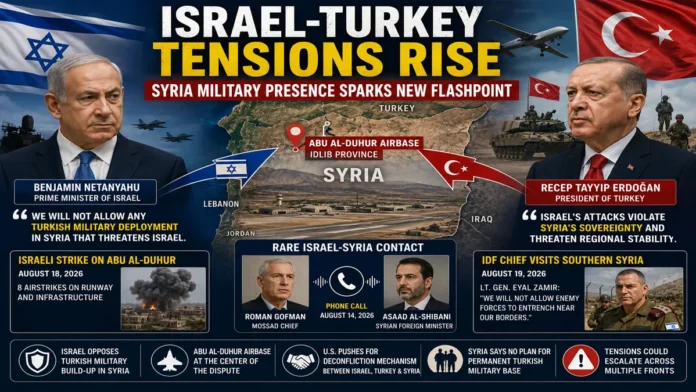
Israel Turkey Syria Tensions have intensified after Mossad chief Roman Gofman held a rare phone conversation with Syrian Foreign Minister Asaad Hassan al-Shibani, focusing largely on Turkey’s expanding military role in Syria, according to current reporting on the contact. The call took place on August 14, four days before Israeli aircraft struck the Abu al-Duhur airbase in northwestern Syria.
The conversation is significant because it was among the highest-level known contacts between Israel and Syria under President Ahmed al-Sharaa’s government and the first reported contact of its kind involving Gofman since he took over Mossad in June.
The reported outreach came as Israel increasingly warned that a deeper Turkish military presence in Syria could cross what it considers a security red line.
Mossad Chief Asked About Turkey’s Military Role in Syria
During the August 14 call, Gofman reportedly raised concerns about Turkish military involvement in Syria, including the transfer of weapons, drones and other forms of support to Syrian forces.
The contact suggests that Israel was attempting to clarify Damascus’ intentions before taking military action.
Syrian Foreign Minister al-Shibani later said Damascus had informed Israel that there were no plans to establish a permanent Turkish military base at Abu al-Duhur and that the facility was being rehabilitated for use by the Syrian Air Force. He acknowledged that Turkish military personnel had visited the site as part of training and defense cooperation.
Israel Strikes Abu al-Duhur Airbase
On August 18, Israeli aircraft struck the Abu al-Duhur military airbase in Idlib province.
Multiple reports said the strikes hit the runway and other infrastructure. Syrian state media reported eight airstrikes, and no casualties were immediately reported.
Israel said it acted because Damascus was close to allowing a Turkish military deployment at the base that Israel considered a threat to its security.
Syria rejected that justification and condemned the operation as a violation of its sovereignty.
Netanyahu: Israel Will Not Accept Turkish Military Build-Up
Prime Minister Benjamin Netanyahu defended the strike and warned that Israel would not tolerate a Turkish military deployment in Syria that it viewed as threatening.
Referring to the airstrike, Netanyahu said Israel had already communicated its concerns and acted when it believed those warnings had not been sufficiently understood.
His comments underline a major shift in Israel’s Syria policy.
For years, Israeli operations in Syria were focused primarily on Iran and Hezbollah. With Syria’s political order transformed after the fall of Bashar al-Assad, Israeli attention is increasingly turning toward Turkey’s influence over the new government in Damascus.
Turkey Rejects Israel’s Claims
Turkey strongly rejected Israel’s explanation for the strike and accused it of using unsupported allegations to justify attacks on Syrian territory.
Ankara said Israel’s actions violated Syria’s sovereignty and risked destabilizing the region.
Turkey has become one of the most important backers of Syria’s new leadership and has expanded military training, reconstruction and security cooperation with Damascus.
A Turkish delegation had visited Abu al-Duhur shortly before the Israeli attack, according to Syrian officials.
However, Turkey has denied that it was preparing the type of permanent troop deployment Israel alleged.
Why Abu al-Duhur Matters
The Abu al-Duhur airbase is strategically located in northwestern Syria, near important transport corridors linking Idlib, Aleppo and Hama.
The facility had been largely inactive for years because of Syria’s civil war, but the new Syrian government has been working to rebuild military infrastructure.
For Israel, a Turkish military presence there could be significant because it would extend Ankara’s operational reach farther south and potentially complicate Israel’s freedom of action over Syrian airspace.
For Turkey, military cooperation with Damascus is part of a broader effort to stabilize and rebuild Syria under the post-Assad government.
That creates a direct strategic collision between two regional powers.
Israeli Army Chief Visits Southern Syria
The tensions were reinforced on Wednesday when Israeli military chief Lt. Gen. Eyal Zamir visited Israeli troops operating in southern Syria.
During the visit, Zamir said Israel would not allow hostile forces to establish themselves near its borders and that the military was closely monitoring changes on the Syrian front.
The Israeli military said Zamir conducted a security assessment with senior commanders and met troops operating in the area.
His visit came a day after the Abu al-Duhur strikes.
Israel Says It Remains Ready on Multiple Fronts
Zamir also stressed that Israel continues to face security challenges across several fronts.
His remarks reflected Israel’s concern that developments in Syria could quickly escalate into a wider confrontation involving Turkey or other regional actors.
The Israeli military has maintained positions in southern Syria since the collapse of the Assad government and describes its presence as necessary to prevent hostile forces from approaching its frontier.
Syria rejects that presence and considers Israeli operations violations of its sovereignty.
Why Turkey and Israel Are Competing in Syria
The dispute goes far beyond a single airbase.
Turkey views Syria’s new government as a strategic partner and has become deeply involved in military training, reconstruction and political support.
Israel, however, remains distrustful of the new Syrian leadership and is wary of any regional power gaining a large military foothold close to its borders.
Ankara and Jerusalem also remain divided over Gaza and Turkey’s relationship with Hamas.
As a result, Syria is emerging as another arena of competition between the two countries.
US Tries to Prevent a Direct Israel-Turkey Clash
The United States is attempting to prevent the rivalry from turning into a direct military confrontation.
U.S. envoy Tom Barrack said Washington is working on a formal deconfliction mechanism involving Israel, Turkey and Syria to reduce the risk of miscalculation or accidental escalation.
Barrack also criticized the Israeli strike as an unnecessary escalation.
The mechanism would allow the three sides to share information and clarify military movements before they trigger a confrontation.
The need for such a system highlights how dangerous the situation has become.
Syria Says It Wants De-Escalation
Al-Shibani has maintained that Damascus wants to avoid escalation with Israel and remains interested in a security arrangement.
He said Syria had attempted to reassure Israel before the Abu al-Duhur strike that there would be no permanent Turkish military deployment at the facility.
That claim complicates Israel’s justification for the operation and raises questions about whether the strike reflected a breakdown in communication rather than the absence of communication.
Could Israel and Turkey Confront Each Other Directly?
A direct military conflict remains far from inevitable.
Both countries have significant incentives to avoid one.
Turkey is a NATO member, while Israel remains one of Washington’s closest regional partners. A confrontation between the two would create a serious challenge for the United States and destabilize Syria’s already fragile transition.
However, the risk of accidental escalation is increasing as both militaries operate in or around Syrian territory.
That is why communications between Israeli and Syrian officials, and Washington’s proposed deconfliction mechanism, have become increasingly important.
What Does the Mossad-Syria Contact Tell Us?
The reported conversation between Gofman and al-Shibani shows that despite Israel’s military operations, direct communication channels between Israel and Syria remain active.
That is significant.
The two countries do not have normal diplomatic relations, yet security contacts are taking place at a senior level.
The existence of such communication suggests that both sides still see value in avoiding uncontrolled escalation.
At the same time, the strike four days after the Mossad chief’s call shows how limited those channels can be when Israel believes its security concerns are not being adequately addressed.
The Bigger Strategic Picture
The Israel Turkey Syria Tensions are becoming one of the most consequential geopolitical challenges in post-Assad Syria.
Turkey wants to deepen its influence through defense cooperation and reconstruction.
Israel wants to prevent any military force it considers threatening from establishing itself close to its borders.
Syria wants to rebuild its own armed forces while restoring control over its territory.
The United States is trying to prevent those competing interests from producing a direct regional confrontation.
For now, the Abu al-Duhur strike and the Mossad chief’s rare contact with Damascus show that diplomacy and military pressure are unfolding simultaneously.
The next major question is whether Israel, Turkey and Syria can establish clear rules for military activity before another incident pushes the crisis into a more dangerous phase.