Mumbai, India, August 19, 2026
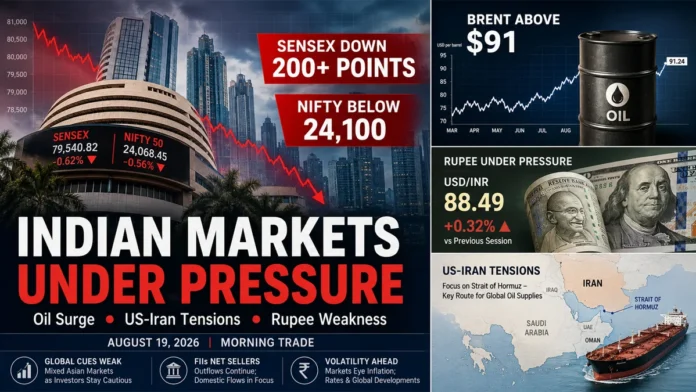
Stock Market Today August 19 2026 remained under pressure Wednesday morning as Indian equity benchmarks extended their losing streak, with the Sensex dropping more than 200 points and the Nifty slipping below the psychologically important 24,100 level amid elevated crude oil prices, geopolitical uncertainty and weak global risk sentiment.
At around 9:45 a.m., the Sensex was trading near 77,018.48, down about 217 points, while the Nifty was around 24,081.70, lower by more than 70 points. Later in the morning, the Sensex remained under pressure near 76,970, indicating that sellers continued to dominate early trade.
The decline came after the Nifty had already fallen for six consecutive sessions, losing about 1.7% over that period. Wednesday’s weakness put the benchmark on course for a potential seventh straight session of losses if the decline persists through the close.
The final closing levels will only be available after the completion of Wednesday’s trading session.
Why Is the Indian Stock Market Falling Today?
Several global and domestic factors are weighing on Indian equities.
The most significant immediate concern is the renewed rise in global crude oil prices.
Brent crude has been trading above $91 per barrel, with uncertainty surrounding oil shipments through the Strait of Hormuz keeping energy markets nervous.
Higher oil prices are particularly important for India because the country imports a large share of its crude requirements.
A prolonged rise in oil prices can increase India’s import bill, put pressure on inflation and the rupee, and potentially squeeze corporate margins in energy-sensitive sectors.
US-Iran Tensions Keep Investors on Edge
Geopolitical uncertainty between the United States and Iran remains another major source of pressure.
U.S. President Donald Trump said no talks were currently planned with Iran, while Tehran maintained its position on the Strait of Hormuz, creating further uncertainty around one of the world’s most important energy shipping routes.
The deterioration in expectations for a diplomatic breakthrough has helped keep crude oil prices elevated.
Brent crude closed around $91.02 per barrel on Tuesday, its highest level in more than three weeks, before edging higher again Wednesday.
For Indian markets, the combination of geopolitical risk and expensive crude is a difficult one.
Strait of Hormuz Becomes Key Market Risk
The Strait of Hormuz has emerged as one of the biggest variables for global markets.
The narrow waterway is a critical route for oil and gas exports from the Persian Gulf.
Uncertainty over shipping movements has pushed traders to price in a greater risk premium for crude.
Oil markets are increasingly considering the possibility that disruption around Hormuz could last longer than initially expected, which could keep energy prices elevated.
For India, sustained disruption could affect inflation, the current account, the rupee and investor sentiment simultaneously.
Rupee Remains Under Pressure Against Dollar
The Indian rupee also remained under pressure Wednesday.
It had closed Tuesday at around ₹95.68 per U.S. dollar and was expected to weaken toward the ₹95.75-₹95.80 range as high crude prices and risk aversion increased demand for dollars.
Therefore, a rupee level around ₹95.73 should be described as a marginal depreciation from Tuesday’s close, rather than an appreciation.
The Reserve Bank of India has been intervening in currency markets to contain excessive volatility.
Traders have reported that the central bank has been selling dollars to prevent sharper declines in the rupee.
RBI Intervention Helps Limit Rupee Losses
RBI intervention has become an important stabilizing factor for the currency.
The central bank has intervened across spot, futures and offshore currency markets in recent sessions as rising crude prices and higher global bond yields put pressure on the rupee.
The objective appears to be limiting disorderly moves rather than defending a specific exchange-rate level.
Market participants are watching the ₹95.80-₹96 per dollar zone closely to see whether the RBI steps up its intervention if selling pressure increases.
Rising US Treasury Yields Add Another Headwind
Oil is not the only international problem facing Indian equities.
Long-term U.S. Treasury yields have also risen sharply.
The U.S. 30-year Treasury yield climbed to its highest level since 2007, reducing investor appetite for riskier assets and emerging markets.
Higher U.S. bond yields can make dollar-denominated assets more attractive relative to emerging-market equities.
That can place additional pressure on foreign flows into markets such as India.
Foreign Investors Remain an Important Factor
Foreign portfolio flows will remain another key indicator for the Indian market.
Foreign investors have sold a substantial amount of Indian equities during 2026 amid geopolitical risks, oil-price volatility and high global yields, although they turned net buyers on Tuesday with purchases worth about ₹16.52 billion.
Whether that buying continues will be important for market stability.
Persistent foreign selling combined with expensive crude could keep pressure on benchmark indexes even if domestic institutional investors provide support.
Bajaj Stocks and M&M Among Early Laggards
Financial and automobile heavyweights were among the stocks under pressure during early trade.
The Bajaj group’s major financial stocks and Mahindra & Mahindra were among the notable laggards during the morning session, contributing to weakness in the headline indexes.
When heavyweight financial and auto stocks fall together, their relatively large index weights can have an outsized impact on both the Sensex and Nifty.
Stock-specific moves, however, can change considerably during the trading session.
Seven-Session Losing Streak in Focus
The benchmark Nifty entered Wednesday after six consecutive sessions of declines.
That makes Wednesday particularly important from a technical perspective.
If the Nifty closes lower again, it would extend the decline to seven consecutive sessions.
However, because trading was still underway when the morning figures were recorded, the seven-session losing streak should not yet be described as a confirmed closing outcome.
A late-session recovery could still change the picture.
What Are the Main Reasons Behind Today’s Market Fall?
The market’s weakness can broadly be traced to five factors.
1. Rising crude oil prices: Brent above $91 is reviving concerns about India’s import bill and inflation.
2. US-Iran tensions: The absence of a clear diplomatic breakthrough is keeping geopolitical risk elevated.
3. Strait of Hormuz uncertainty: Disruption to energy shipping remains a major global risk.
4. Higher global bond yields: Rising U.S. Treasury yields are reducing investor appetite for emerging-market assets.
5. Rupee weakness: Expensive oil and dollar demand are putting renewed pressure on the Indian currency.
Together, these factors have left traders reluctant to take aggressive positions.
Why High Crude Oil Hurts India
India is particularly sensitive to oil-price shocks because of its dependence on imported crude.
When crude becomes expensive, refiners and importers require more dollars to pay for energy imports.
That can increase demand for foreign currency and weaken the rupee.
A weaker rupee can then make imports even more expensive, creating an additional inflationary effect.
Higher fuel and transportation costs can eventually filter into corporate expenses and consumer prices.
This is why Indian equity markets often react negatively to sharp increases in international crude.
Inflation Risks Could Return to Focus
If oil remains near or above current levels for an extended period, investors may begin reassessing India’s inflation outlook.
Higher fuel costs can have both direct and indirect consequences.
Transportation, logistics, aviation, chemicals, paints and several manufacturing industries are particularly sensitive to energy costs.
Companies that cannot pass higher costs on to consumers may face pressure on profit margins.
The impact is therefore broader than the oil sector alone.
Fed Minutes Could Influence Global Markets
Investors are also monitoring the U.S. Federal Reserve.
Minutes from the Fed’s July policy meeting are among the major global cues being watched for signals about the future direction of U.S. interest rates.
Any indication that U.S. monetary policy could remain restrictive for longer may keep Treasury yields high.
That could further strengthen the appeal of U.S. assets and create pressure on emerging-market capital flows.
What Should Investors Watch Next?
Several indicators will determine whether the current market weakness deepens or stabilizes.
The most important will be Brent crude prices.
A retreat in oil could provide relief for Indian equities, the rupee and inflation expectations.
Conversely, another sharp rise could increase pressure.
Investors should also monitor developments involving the United States and Iran, shipping activity through the Strait of Hormuz, foreign institutional flows and RBI action in the currency market.
Global bond yields will remain equally important.
Nifty 24,000 Becomes an Important Psychological Zone
With the Nifty trading below 24,100 during the morning session, attention is likely to shift toward the 24,000 level.
Round-number levels often attract considerable trader attention, particularly during periods of persistent selling.
Whether the index holds above that zone or breaks decisively below it could influence near-term sentiment.
Technical levels, however, should be considered alongside broader macroeconomic and geopolitical developments.
Market Outlook Remains Cautious
The immediate outlook for Indian equities remains cautious rather than decisively bearish.
The fundamental pressure from high oil prices, geopolitical uncertainty and global yields has not disappeared.
At the same time, sharp declines can attract domestic institutional buying and selective value purchases.
Tuesday’s foreign-investor buying also shows that overseas flows are not uniformly negative.
That leaves the market vulnerable to continued volatility in both directions.
Stock Market Today: What Comes Next?
Stock Market Today August 19 2026 remains dominated by external risks.
Crude oil prices above $91, uncertainty surrounding the Strait of Hormuz, unresolved U.S.-Iran tensions and elevated global bond yields are combining to keep investors defensive.
The Sensex remained more than 200 points lower during Wednesday morning trade, while the Nifty slipped below 24,100.
The rupee also remained under pressure despite continued RBI efforts to moderate volatility.
The key question for the remainder of the session is whether domestic buying can help the benchmarks recover or whether weakness persists into the closing auction.
Final Sensex and Nifty closing levels should be updated only after Wednesday’s trading session ends.