Canberra, August 18, 2026
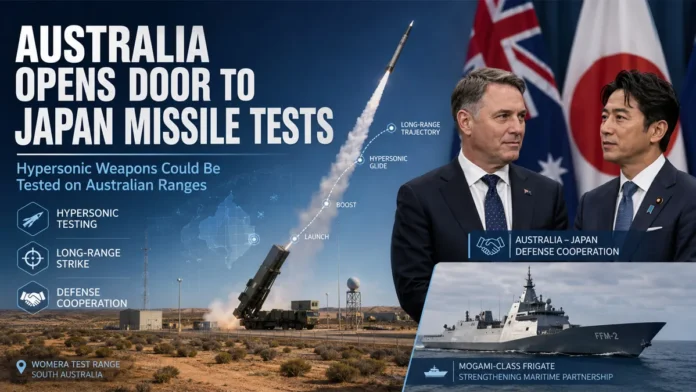
Australia-Japan Missile Testing Deal talks are moving toward a major new phase, with Canberra and Tokyo planning a framework that could allow Japan to use Australian test ranges for advanced weapons programs, including hypersonic missiles and next-generation long-range precision-strike systems.
Australian Deputy Prime Minister and Defense Minister Richard Marles and Japanese Defense Minister Shinjiro Koizumi announced the initiative after talks in Canberra on Tuesday, describing it as part of a wider push to strengthen bilateral defense cooperation. An official ministerial statement said the two sides would establish a framework for testing new equipment, advanced weapons and emerging technologies in Australia, including support for Japan’s hypersonic missile program.
The proposed arrangement would mark a notable expansion of Australia-Japan security ties beyond naval exercises and defense procurement into missile development, testing infrastructure and advanced weapons technology.
Japan Could Test Hypersonic Missiles in Australia
Marles said the framework under discussion would give Japan access to Australian testing ranges for a range of capabilities.
The official statement specifically identifies next-generation long-range precision-strike assets, autonomous capabilities and Japan’s hypersonic missile program as areas where cooperation could be supported.
That is significant because hypersonic weapons can travel at very high speeds while maneuvering in ways that make interception more difficult than conventional ballistic missiles.
For Japan, gaining access to large Australian test areas could provide additional space for evaluating such systems under realistic conditions.
Koizumi Calls Potential Test Launches a Major Step
Japanese Defense Minister Shinjiro Koizumi welcomed the initiative and said the ability of Japan’s Self-Defense Forces to conduct test launches of standoff weapons in Australia would represent a major development.
During the joint press conference, Koizumi said both countries intended to accelerate discussions on the framework following their ministerial meeting under the Framework for Strategic Defence Coordination.
The talks underline how quickly defense cooperation between Canberra and Tokyo has broadened in recent years.
Why Australia Matters for Japan’s Missile Program
Australia offers several advantages for advanced weapons testing.
Its vast landmass and relatively remote military training areas can provide the distances required to test long-range strike systems without the geographic constraints Japan faces on its own islands.
That could make Australian ranges particularly useful for evaluating:
- Hypersonic weapons
- Long-range standoff missiles
- Autonomous military systems
- Precision-strike technologies
- Other next-generation defense equipment
The new framework could also improve interoperability between the Australian Defence Force and Japan Self-Defense Forces as both countries invest in longer-range capabilities.
Japan Is Rapidly Expanding Its Defense Capabilities
The proposal comes as Japan continues to strengthen its long-range defensive and counterstrike capabilities.
Tokyo has increased defense investment and placed greater emphasis on standoff weapons, missile defense and advanced technologies amid a more challenging regional security environment.
Concerns over North Korea’s missile and nuclear programs, along with China’s expanding military capabilities in the Indo-Pacific, have played an important role in Japan’s defense planning.
The missile-testing arrangement with Australia would therefore fit into a broader effort to give Japan more options for developing and validating advanced systems.
Australia-Japan Defense Partnership Is Becoming More Advanced
Australia and Japan already describe each other as close strategic partners.
Their cooperation includes:
- Joint military exercises
- Reciprocal access arrangements
- Defense-industry cooperation
- Naval integration
- Cybersecurity
- Advanced technology projects
- Maritime security
The latest ministerial statement also highlighted more complex multi-domain exercises and Japan’s deployment of F-35 aircraft and other air assets to Australia for exercises in July 2026.
Opening Australian missile test ranges to Japan would add another high-end capability to that relationship.
Mogami Frigate Deal Is Another Major Pillar
The missile-testing initiative comes alongside one of the most important defense-industrial agreements between the two countries: Australia’s acquisition of Japan’s upgraded Mogami-class frigates.
Australia finalized contracts in April 2026 for the first three general-purpose frigates based on the upgraded Japanese Mogami design.
The first frigate is scheduled for delivery to Australia in December 2029, with the class expected to become a major component of the Royal Australian Navy’s future surface fleet.
The project also includes deeper cooperation with Japanese industry and the Japan Maritime Self-Defense Force.
First Three Frigates Will Be Built in Japan
The first three Australian Mogami-class frigates are being produced in Japan before shipbuilding progressively shifts toward Australia.
Canberra says the vessels will feature:
- A range of up to 10,000 nautical miles
- A 32-cell Vertical Launch System
- Surface-to-air missiles
- Anti-ship missiles
- Capacity to operate the MH-60R Seahawk helicopter
- A crew of about 92 sailors and officers
Those specifications underscore how the frigate program is already bringing Australia and Japan into a deeper level of industrial and operational cooperation.
Missile Cooperation Could Take Ties Beyond Maritime Security
The Mogami project has largely centered on naval capability.
By contrast, the proposed test-range arrangement would expand cooperation directly into missile, autonomous systems and advanced weapons development.
That could make Australia an increasingly important testing and development partner for Japan during the next decade.
It could also give Australian defense planners greater exposure to Japanese technologies while improving compatibility between the two countries’ armed forces.
Indo-Pacific Security Is Driving Closer Cooperation
The broader strategic context is an Indo-Pacific region experiencing rapid military modernization.
Australia and Japan have both emphasized the importance of maintaining regional stability and strengthening deterrence.
Canberra’s official defense statements increasingly describe cooperation with Japan as central to a stable Indo-Pacific, while Tokyo views Australia as one of its most important security partners outside its alliance with the United States.
The new missile-testing framework would reflect that convergence.
Is the Missile Testing Deal Final?
Not yet.
The two governments have committed to establishing a framework and accelerating negotiations, but the detailed arrangements governing access, test schedules, safety, security and technology sharing still need to be finalized.
That means Japanese hypersonic missile testing in Australia should currently be described as a planned or proposed capability, rather than an already operational program.
What Happens Next?
Australia and Japan are expected to continue negotiations over how the testing arrangement will operate.
Key issues are likely to include:
- Which Australian ranges will be used
- What categories of weapons can be tested
- How sensitive technology will be protected
- Safety and environmental requirements
- Data-sharing arrangements
- Participation by Australian personnel
- How frequently Japanese forces may use the ranges
If finalized, the framework could remain in use through much of the next decade as Japan develops and fields new long-range systems.
Why the Deal Matters
For Japan, access to Australian test ranges could solve a practical problem created by its limited geography.
For Australia, the arrangement could deepen integration with one of its closest Indo-Pacific security partners and expand cooperation in technologies that will shape future warfare.
Combined with the Mogami frigate program, joint exercises and defense-industry agreements, missile testing would signal that the Australia-Japan relationship is moving from traditional military cooperation toward shared capability development.
Bottom Line
The Australia-Japan Missile Testing Deal could become one of the most significant new elements of defense cooperation between Canberra and Tokyo.
Australia has agreed to work toward a framework that would allow Japan to use its test ranges for advanced systems, including hypersonic missiles and long-range precision-strike weapons.
The arrangement is still being negotiated, but both defense ministers have publicly backed faster progress.
Alongside Australia’s acquisition of Japan’s upgraded Mogami-class frigates, the initiative shows that the bilateral defense relationship is expanding rapidly into advanced weapons, technology and long-term military integration.