
WASHINGTON, August 18, 2026 —
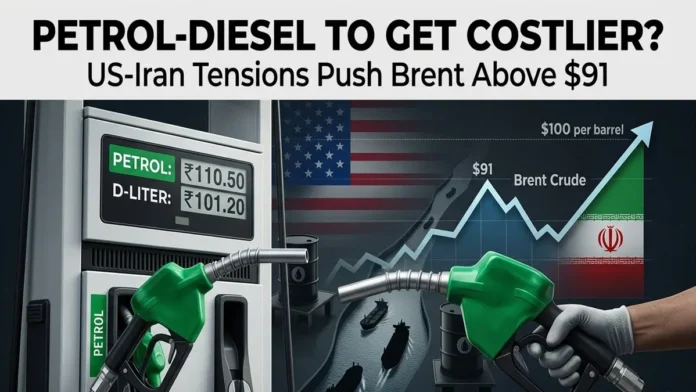
Iran-America War Petrol Diesel Prices are back in focus after global crude oil prices climbed sharply on Tuesday as hopes for a lasting agreement between Washington and Tehran weakened. Brent crude moved above $91 a barrel, raising fresh concern over what prolonged Middle East tensions could mean for petrol and diesel prices in India.
For Indian consumers, the immediate question is straightforward: Will petrol and diesel become more expensive?
There is no automatic one-to-one increase every time crude prices rise. Retail fuel prices in India depend on several factors, including international crude and product prices, the rupee-dollar exchange rate, refining and marketing economics, central and state taxes, and pricing decisions by fuel retailers.
Still, a sustained rise in crude oil above $90 — especially if accompanied by a weaker rupee — can increase pressure on India’s fuel economy and oil-import costs. The rupee was already facing additional pressure Tuesday as higher crude prices combined with rising U.S. bond yields.
Brent Crude Climbs Above $91 as U.S.-Iran Peace Hopes Fade
Brent crude rose 62 cents to $91.49 per barrel on August 18, while U.S. West Texas Intermediate crude advanced 75 cents to $85.25 a barrel. Both benchmarks reached their highest levels since late July.
The increase came as expectations of a broader U.S.-Iran settlement weakened and concerns returned over energy supplies moving through the Middle East.
The immediate market risk is not simply whether Iran and the United States exchange tougher rhetoric. Traders are closely watching whether the confrontation further disrupts oil production, tanker movements and shipping through the Strait of Hormuz, one of the world’s most strategically important energy corridors.
Is Brent Crude Really Close to $100?
Crude is moving higher, but Brent was not yet at $100 a barrel on August 18.
At around $91.5, it would still need a substantial additional rise to reach the psychologically important $100 level.
However, oil-market analysts cited amid the current uncertainty have indicated that crude could remain volatile in roughly an $80-$100 range while geopolitical and supply risks persist.
That makes $100 a potential risk scenario rather than the current market price.
For consumers, this distinction matters. A headline suggesting that Brent has already reached $100 would overstate today’s move, while the larger concern is whether prolonged disruption pushes it there in the days or weeks ahead.
Why Is Trump-Iran Tension Driving Oil Prices Higher?
The latest rise follows deteriorating expectations for diplomacy between Washington and Tehran.
A 60-day deadline tied to efforts to reach a broader agreement expired without meaningful progress, while the two sides remain divided over sanctions, maritime access, Iran’s nuclear program and wider regional security issues.
U.S. President Donald Trump has maintained a hard line as negotiations struggle, while Iran has also adopted a tougher position.
Markets tend to place a geopolitical premium on oil when conflict threatens physical supply routes. That premium can rise quickly when uncertainty surrounds the Persian Gulf and the Strait of Hormuz.
Strait of Hormuz Is the Biggest Oil-Market Flashpoint
The Strait of Hormuz is central to the current fuel-price story because disruption there can affect the movement of crude and petroleum products from major Gulf producers.
Tanker traffic through the waterway has already been heavily disrupted by the conflict, contributing to tighter supply conditions and higher shipping risks.
Iran has been discussing arrangements involving Oman for managing maritime access, but diplomatic disagreements involving Washington have complicated efforts to normalize shipping.
If traffic remains constrained, oil markets could continue pricing in a supply-risk premium.
If shipping conditions improve and negotiations resume, crude could also retreat quickly. That is why oil prices remain highly volatile.
Could Petrol and Diesel Prices Rise in India?
Yes, they could — but a price increase is not guaranteed merely because Brent has crossed $90.
India imports a large share of the crude oil it consumes, so an extended period of high global prices generally increases the cost of bringing oil into the country.
The impact can become stronger if the Indian rupee weakens against the U.S. dollar because international crude purchases are largely dollar-denominated.
On Tuesday, the rupee was already under pressure, with traders pointing to rising crude prices as one of the major downside risks.
That creates a double challenge:
Higher crude price + weaker rupee = higher landed cost of imported oil.
Whether that higher cost ultimately reaches motorists at the pump depends on how much of it is absorbed elsewhere in the pricing chain.
What Are Petrol and Diesel Prices in Delhi Now?
The Government of India’s Petroleum Planning & Analysis Cell (PPAC) listed the retail selling price at an Indian Oil outlet in Delhi on August 17, 2026 at:
- Petrol: ₹102.12 per liter
- Diesel: ₹95.20 per liter
These are the latest Delhi figures displayed by PPAC ahead of Tuesday’s market move.
Official PPAC Fuel and Petroleum Data:
https://ppac.gov.in/
Fuel prices vary from state to state because of differences in local taxation and other pricing components.
Why Higher Crude Does Not Immediately Mean a Pump-Price Hike
Consumers often assume that a 5% increase in crude should produce a similar increase in petrol or diesel prices. The pricing mechanism is more complicated.
Retail fuel prices include much more than the raw crude-oil cost.
They can reflect:
- International crude prices
- Refined petrol and diesel prices
- Rupee-dollar exchange rate
- Refining costs
- Freight and logistics
- Dealer commissions
- Central taxes
- State VAT and other local taxes
- Oil-marketing company margins
As a result, short-term crude fluctuations may not immediately appear at fuel stations.
A sustained increase, however, creates greater pressure.
India Has Already Faced Much Higher Crude Prices This Year
The current $91 Brent price remains below some of the extreme levels seen earlier in the conflict.
India’s crude basket was around $69 a barrel in February 2026 before surging to $136.68 in March amid the West Asia conflict, according to information provided by the government in Parliament. The government said public-sector oil companies absorbed a significant part of the increase rather than fully passing it on to consumers.
That experience demonstrates why crude prices alone cannot tell consumers precisely when or by how much petrol and diesel prices will change.
The duration of the increase matters as much as the headline price.
What Happens if Brent Crosses $100 Again?
If Brent moves toward or above $100 and remains there for an extended period, pressure on India’s energy system would intensify.
Potential effects could include:
- Higher crude import costs
- Additional pressure on the rupee
- Lower margins for oil-marketing companies if retail prices remain unchanged
- Greater risk of petrol and diesel price adjustments
- More expensive aviation and transportation fuel
- Higher freight costs
- Broader inflationary pressure
Fuel prices affect far more than motorists.
Diesel is heavily linked to road freight and commercial transport, meaning higher diesel costs can eventually influence the price of food, manufactured goods and logistics.
A Weaker Rupee Could Make the Situation More Difficult
The crude-oil price is only one half of India’s import-cost equation.
Because international oil is generally traded in dollars, a weaker rupee means Indian buyers have to spend more rupees to purchase the same dollar-priced barrel.
The rupee was expected to weaken further Tuesday after closing at 95.6025 against the dollar on Monday, with rising crude prices identified as a key source of pressure.
Therefore, even if global crude does not reach $100, a simultaneous weakening of the currency could still increase India’s effective oil cost.
Could Oil Prices Fall Again?
Yes.
Oil markets can reverse sharply if geopolitical conditions improve.
Prices could ease if:
- Washington and Tehran restart meaningful negotiations
- Shipping through Hormuz normalizes
- Supply disruptions decline
- Global oil inventories rise
- Demand weakens
- Other producers increase supply
There are already forces limiting the upside. Global inventories and weaker consumption expectations have prevented crude from rising as dramatically as might normally be expected during such severe geopolitical disruption.
This is why a move to $100 should be viewed as a risk rather than a certainty.
Petrol and Diesel Consumers Should Watch Three Things
For Indian motorists, three indicators will be particularly important in the coming days.
1. Brent Crude
If Brent remains above $90 and begins moving toward $100, pricing pressure will increase.
2. Rupee-Dollar Exchange Rate
A weakening rupee makes imported crude more expensive for India even if the dollar price of oil remains unchanged.
3. Strait of Hormuz
Any escalation that further restricts tanker traffic could produce another rapid jump in crude prices.
On the other hand, signs of reopening or a diplomatic breakthrough could pull prices lower.
Will Petrol-Diesel Become Costlier? The Bottom Line
For now, there is no basis to say that a nationwide petrol or diesel price increase is inevitable.
But the risk has clearly increased.
Brent crude has moved above $91 as the prospects for a quick U.S.-Iran peace agreement deteriorate. At the same time, the rupee is under pressure and the Strait of Hormuz remains disrupted.
If crude moves toward $100 and remains elevated for a sustained period, India’s oil-import costs would rise further and fuel retailers could face greater pressure.
For motorists, therefore, the real question is not simply whether crude touches $100 for a few hours. It is how high oil prices go, how long they remain there and whether the rupee weakens further.
That combination will determine whether the Iran-America War Petrol Diesel Prices story ultimately reaches Indian fuel pumps.
hy Higher Crude Does Not Immediately Mean a Pump-Price Hike
Consumers often assume that a 5% increase in crude should produce a similar increase in petrol or diesel prices. The pricing mechanism is more complicated.
Retail fuel prices include much more than the raw crude-oil cost.
They can reflect:
- International crude prices
- Refined petrol and diesel prices
- Rupee-dollar exchange rate
- Refining costs
- Freight and logistics
- Dealer commissions
- Central taxes
- State VAT and other local taxes
- Oil-marketing company margins
As a result, short-term crude fluctuations may not immediately appear at fuel stations.
A sustained increase, however, creates greater pressure.
India Has Already Faced Much Higher Crude Prices This Year
The current $91 Brent price remains below some of the extreme levels seen earlier in the conflict.
India’s crude basket was around $69 a barrel in February 2026 before surging to $136.68 in March amid the West Asia conflict, according to information provided by the government in Parliament. The government said public-sector oil companies absorbed a significant part of the increase rather than fully passing it on to consumers.
That experience demonstrates why crude prices alone cannot tell consumers precisely when or by how much petrol and diesel prices will change.
The duration of the increase matters as much as the headline price.
What Happens if Brent Crosses $100 Again?
If Brent moves toward or above $100 and remains there for an extended period, pressure on India’s energy system would intensify.
Potential effects could include:
- Higher crude import costs
- Additional pressure on the rupee
- Lower margins for oil-marketing companies if retail prices remain unchanged
- Greater risk of petrol and diesel price adjustments
- More expensive aviation and transportation fuel
- Higher freight costs
- Broader inflationary pressure
Fuel prices affect far more than motorists.
Diesel is heavily linked to road freight and commercial transport, meaning higher diesel costs can eventually influence the price of food, manufactured goods and logistics.
A Weaker Rupee Could Make the Situation More Difficult
The crude-oil price is only one half of India’s import-cost equation.
Because international oil is generally traded in dollars, a weaker rupee means Indian buyers have to spend more rupees to purchase the same dollar-priced barrel.
The rupee was expected to weaken further Tuesday after closing at 95.6025 against the dollar on Monday, with rising crude prices identified as a key source of pressure.
Therefore, even if global crude does not reach $100, a simultaneous weakening of the currency could still increase India’s effective oil cost.
Could Oil Prices Fall Again?
Yes.
Oil markets can reverse sharply if geopolitical conditions improve.
Prices could ease if:
- Washington and Tehran restart meaningful negotiations
- Shipping through Hormuz normalizes
- Supply disruptions decline
- Global oil inventories rise
- Demand weakens
- Other producers increase supply
There are already forces limiting the upside. Global inventories and weaker consumption expectations have prevented crude from rising as dramatically as might normally be expected during such severe geopolitical disruption.
This is why a move to $100 should be viewed as a risk rather than a certainty.
Petrol and Diesel Consumers Should Watch Three Things
For Indian motorists, three indicators will be particularly important in the coming days.
1. Brent Crude
If Brent remains above $90 and begins moving toward $100, pricing pressure will increase.
2. Rupee-Dollar Exchange Rate
A weakening rupee makes imported crude more expensive for India even if the dollar price of oil remains unchanged.
3. Strait of Hormuz
Any escalation that further restricts tanker traffic could produce another rapid jump in crude prices.
On the other hand, signs of reopening or a diplomatic breakthrough could pull prices lower.
Will Petrol-Diesel Become Costlier? The Bottom Line
For now, there is no basis to say that a nationwide petrol or diesel price increase is inevitable.
But the risk has clearly increased.
Brent crude has moved above $91 as the prospects for a quick U.S.-Iran peace agreement deteriorate. At the same time, the rupee is under pressure and the Strait of Hormuz remains disrupted.
If crude moves toward $100 and remains elevated for a sustained period, India’s oil-import costs would rise further and fuel retailers could face greater pressure.
For motorists, therefore, the real question is not simply whether crude touches $100 for a few hours. It is how high oil prices go, how long they remain there and whether the rupee weakens further.
That combination will determine whether the Iran-America War Petrol Diesel Prices story ultimately reaches Indian fuel pumps.










Comments are closed.